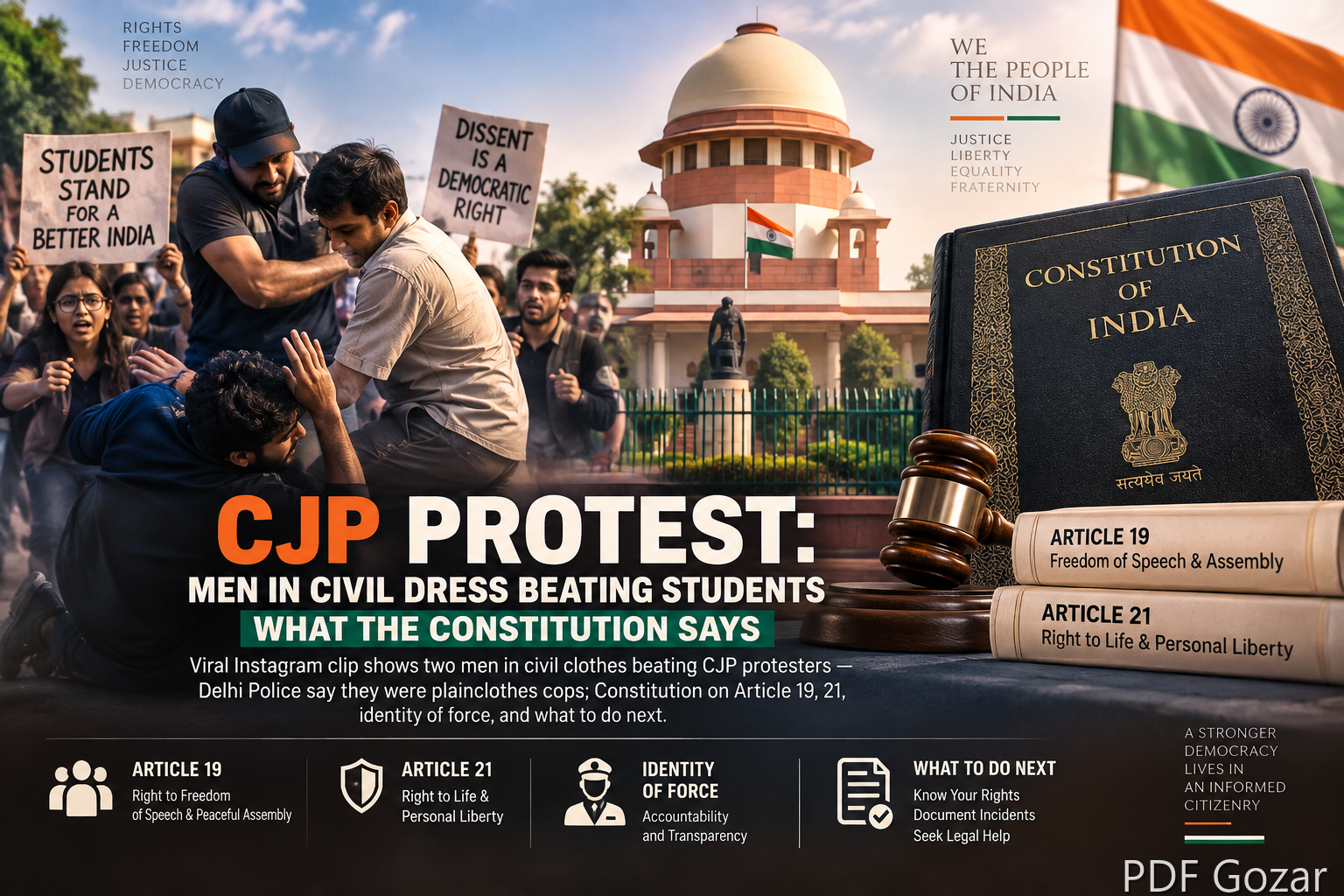
CJP Protest: Men in Civil Dress Beating Students — What the Constitution Says
After the Cockroach Janta Party (CJP) Sansad Chalo crackdown on 20 July 2026, a new wave of Instagram clips focused on two men in civil dress — no uniform, no clear name badge — allegedly beating students with sticks while uniformed police stood nearby. Many viewers asked: were these hired goons, or plainclothes police? This page explains what is alleged, what Delhi Police told the press, what the Constitution requires when the state uses force, and what to do next — without turning a blog into a doxxing page.
Spotlight: Cockroach Janta Party · Related: Slap Video Explainer · Many Police vs One Boy · Protest Rights
Disclaimer: This is news literacy and constitutional education, not legal advice. Naming someone from a viral screenshot is a lead for investigation, not a conviction. Do not publish private phone numbers, home addresses, Aadhaar / ID numbers, or family details online. That can be illegal, can harm innocent people if the ID is wrong, and weakens real cases in court.
The viral claim in plain words#
| Point | What is circulating |
|---|---|
| Event | CJP / student protest, central Delhi, 20 July 2026 |
| Clip | Two men in civil clothes allegedly beating / lathi-charging students |
| Public suspicion | “Hired” outsiders or party muscle mixed with police |
| Police line (The Print) | They were policemen from special staff / non-active units, deployed as reinforcements in plain clothes — claimed as lawful and not unprecedented |
| Outrage angle | No uniform / name plate → hard for citizens to know who hit them or to complain |
Background: Sansad Chalo Explained · How CJP Is Being Treated.
Instagram post to verify#
One widely shared post showing men in civil dress during the crackdown:
Post link: instagram.com/p/DbC3gSNpk3k/
View post on Instagram
If the embed fails, open the link in the Instagram app. Prefer original, unedited clips. In one widely reported confrontation, a protester asked a man in civil clothes who he was and why he had no uniform or name badge — and the assault continued on camera (The Print).
Hired goons or plainclothes police?#
Two stories competed online.
Story A — “hired men”#
Viewers who saw civil dress + sticks assumed outsiders were hired to beat students so police could deny responsibility. That fear is old in Indian protest politics. It is a serious allegation: private violence under colour of state power.
Story B — police confirmation#
Senior Delhi Police officers told The Print the men were policemen — from special staff and teams not usually on active policing — used as law-and-order reinforcements. They said the deployment was neither illegal nor unprecedented.
So the constitutional test is not only “were they hired?” It is also: even if they were police, did they use lawful, proportionate force, and were they identifiable enough for accountability?
Political voices (including MPs on X) demanded names, posting details, and records of specific individuals seen in civil clothes. Treat those names as leads, not final identity documents.
What the Constitution tells us#
1. Article 19 — peaceful protest is a right#
Article 19(1)(a) protects speech. Article 19(1)(b) protects assembly peaceably and without arms.
The state may impose reasonable restrictions for public order (Article 19(2)–(3)). Barricades near Parliament under Section 163 BNSS sit in that zone. But the right does not vanish because a march is politically inconvenient. Force to disperse must still be lawful and proportionate — not a free licence to thrash students.
Plain map: Protest Rights: Articles 19 & 32.
2. Article 21 — life, liberty, dignity#
Article 21 says no person shall be deprived of life or personal liberty except according to procedure established by law. Courts read this to include dignity and protection from arbitrary state violence.
Beating a student with a stick — whether the attacker wears khaki or jeans — engages Article 21 if the force is unjustified or excessive. Civil dress does not create a constitutional free pass. If anything, anonymous force makes the dignity violation worse: the victim cannot even name who hit them.
3. Article 14 — no arbitrary state action#
Article 14 requires equality before law and bars arbitrary state action. Using unidentified men in civil clothes to deliver blows, while uniformed officers stand by, raises a fairness question: is force being used as order, or as punishment without procedure?
4. Identity of the force is part of the rule of law#
A democratic police force is not a secret militia. Citizens must be able to:
- Know they are dealing with state agents, not private thugs
- Note a name / number / unit for complaint
- Challenge excess in FIR, NHRC, or court
Even when plainclothes deployment is administratively common for special units, using stick force on a crowd without clear identification collides with transparency and remedy. Courts and human-rights bodies have repeatedly stressed accountability and minimum force. Nameplates and identification during dispersal are not a fashion choice — they are how Article 21 remedies stay real.
5. If they were not police — private assault is still a crime#
Suppose investigation later finds a beater was a civilian hired to attack protesters. Then:
- It is ordinary criminal assault / rioting (BNS provisions on hurt, wrongful restraint, etc.)
- If done in concert with police or with their knowledge, questions of conspiracy / abetment and state responsibility arise
- Article 21 still protects the student; the state cannot outsource brutality and walk away
So “hired” vs “plainclothes cop” changes the charge sheet, not the victim’s right to dignity and remedy.
6. Articles 32 and 226 — how rights are enforced#
Article 226 (Delhi High Court) can seek directions for inquiry, CCTV, deployment orders, and identity of plainclothes personnel on that stretch. Article 32 (Supreme Court) remains available for fundamental-rights enforcement. Explainer: Article 32 and CJP.
What police law allows — and what it does not#
Police may disperse an unlawful assembly and use civil force when needed. The classic limit: as little force as possible, and only as much injury as needed to restore order.
That means:
- Reinforcement from special staff in civil clothes may be an operational choice
- It does not legalise sadistic or retaliatory beating
- It does not erase the duty to investigate a clear video of excess
- Women and minors in the crowd attract extra procedural care
Delhi Police reported many of their own injured. Injury on both sides is possible. It does not cancel the duty to test this clip on its own facts.
What should be done now (rules)#
For victims and witnesses#
- Preserve the Instagram original — instagram.com/p/DbC3gSNpk3k/ plus any other angles
- Note time, place, clothing, face, stick, and nearby uniformed officers
- Get MLC if injured
- File an FIR describing the assault; say whether the man claimed to be police or stayed silent
- Ask investigation to produce deployment orders for plainclothes reinforcements that day
- Approach NHRC / Delhi rights bodies with the video and medical papers
- Through counsel, consider Article 226 for CCTV and identity disclosure
For the public — hard rules#
| Do | Don’t |
|---|---|
| Share the video and ask for official ID of personnel | Publish Aadhaar, phone, home address, father’s name dumps |
| Demand a departmental inquiry and court-ready ID | Doxx the wrong lookalike and destroy a family’s safety |
| Separate this clip from slap / vehicle / death rumours | Merge every viral story into one mob narrative |
| Follow PIB / police fact-checks on false death claims | Threaten named people on WhatsApp |
Why we will not paste private “address / phone / DocNumber” lists here:
- Wrong ID = permanent harm to an innocent person
- Aadhaar and personal data misuse can itself attract legal liability
- Courts want clean evidence, not a lynch list
- Doxxing weakens the victim’s case and can become a separate crime
Hand sensitive identity tips only to police / lawyer / NHRC, not to Instagram comments.
How this fits the bigger CJP story#
- CJP’s three demands — Pradhan, ₹1 crore NEET relief, Wangchuk release
- Monday crackdown — tear gas, batons, hospitalised students
- Parallel viral force clips — slap video, vehicle / girl injury claim, many police vs one boy
- Tuesday politics — Rahul Gandhi detention
Plainclothes beatings sit in the accountability lane: who used force, under whose order, and with what identification?
Quick facts vs open questions#
Known / reported
- Viral clips show men in civil dress using sticks on protesters during CJP crackdown
- Delhi Police told The Print they were police reinforcements, not illegal outsiders
- Protesters confronted at least one man over missing uniform / name badge
Still open
- Full official list of plainclothes personnel on that stretch
- Whether any specific beater faces departmental or criminal action
- Independent forensic review of each clip
Until then: say alleged excess, not convicted thug.
FAQs#
1. Does the Constitution allow men in jeans to beat protesters?#
No article says private clothes create a right to assault. If they are police, force must still be lawful and proportionate under Articles 14, 19, and 21. If they are civilians, it is criminal assault — and possibly worse if done with state cover.
2. Is plainclothes deployment automatically unconstitutional?#
Not automatically. Special units often work in civil dress. The constitutional stress point is force + anonymity + no remedy: citizens must still be able to identify state agents and challenge excess.
3. Should we publish the men’s home addresses online?#
No. Give leads to investigators and lawyers. Public doxxing risks wrong identity, illegal data misuse, and weakens the real case.
4. What is the first legal step?#
Preserve video → FIR / MLC → demand deployment records and CCTV → NHRC / High Court through counsel if needed.
5. Where to follow primary updates?#
CJP: @cockroachjantaparty · Delhi Police / PIB for official lines · Court / NHRC orders if filed.
Conclusion#
The Instagram clip of two men in civil dress beating students during the CJP crackdown forces a clear constitutional question: the state may keep order, but it may not hide the face of force. Articles 19, 21, and 14 protect peaceful protest and dignity; Articles 32 and 226 open the path to inquiry. Whether the beaters were plainclothes police (as Delhi Police claim) or hired outsiders, the student still has a right to a named investigation — not a WhatsApp address dump. Preserve the video, file a proper complaint, refuse doxxing, and let evidence — not only rage — decide. Full context: CJP Spotlight.