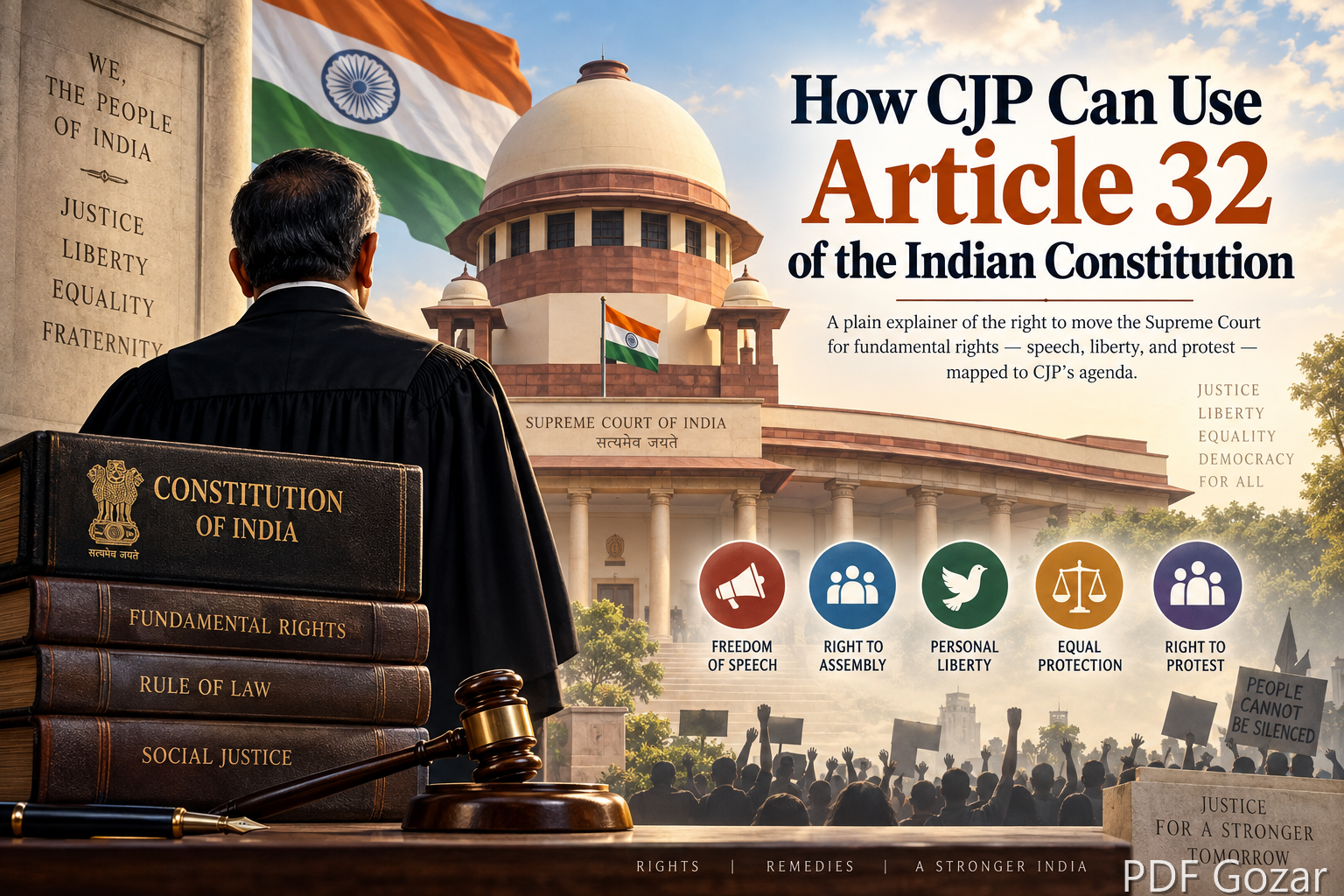
How CJP Can Use Article 32 of the Indian Constitution
Article 32 of the Indian Constitution is often called the heart and soul of fundamental rights. It gives every person the right to move the Supreme Court when those rights are violated. For readers following the Cockroach Janta Party (CJP), this page is a plain-language map — not legal advice, and not a claim that CJP has already filed an Article 32 petition.
Spotlight: Cockroach Janta Party · Instagram: @cockroachjantaparty
Important: This article explains constitutional ideas for general readers. Filing a writ petition requires lawyers and facts of a specific case. Do not treat this as instructions to sue.
What Article 32 says, in simple words#
Article 32 does two big things:
- It guarantees the right to approach the Supreme Court for enforcement of fundamental rights.
- It allows the Court to issue writs — special orders such as habeas corpus, mandamus, prohibition, quo warranto, and certiorari — to protect those rights.
Dr. B.R. Ambedkar famously called Article 32 the most important article because rights without a remedy are empty promises. For movements like CJP that talk about speech, dignity, and liberty, Article 32 is the constitutional fire exit: when other doors feel closed, the Supreme Court remains open for rights claims.
Why CJP readers ask about Article 32#
CJP’s public story includes:
- A youth movement built on satire and protest after May 2026
- An X account withheld in India under IT Act rules, later fought in the Delhi High Court
- Peaceful protest at Jantar Mantar and a Sansad Chalo call
- Three demands, including release of Sonam Wangchuk after his hunger strike
- Warnings about Instagram access and rumour
Those events touch fundamental-rights themes — especially freedom of speech and expression (Article 19) and personal liberty (Article 21). Article 32 is the tool that can take a rights violation straight to the Supreme Court. Companion guide: Protest rights under Articles 19 and 32.
Possible rights angles (educational map only)#
Below is how readers might connect CJP’s public agenda to Article 32 themes. This is not a list of filed cases.
1. Speech and expression after platform blocks#
When the state orders intermediaries to block content under Section 69(A) of the IT Act, citizens often argue that Article 19(1)(a) — freedom of speech — is affected. Article 32 would be relevant if someone chooses the Supreme Court as the forum to challenge such action as unconstitutional.
CJP’s known legal path on the X withhold was reported through the Delhi High Court, not as a confirmed Article 32 filing. High Courts also protect rights under Article 226. See CJP X Ban Explained.
2. Personal liberty and the Wangchuk demand#
CJP’s third demand asks for immediate release of Sonam Wangchuk with no prohibition on his movements, and freedom to address people. In constitutional language, disputes about detention or restrictions often involve Article 21 (life and personal liberty). Habeas corpus under Article 32 is the classic writ when someone claims unlawful detention.
Again: whether any specific habeas petition exists is a question of public record and legal reporting — not something this explainer invents.
3. Equality, dignity, and student justice themes#
CJP’s second demand — ₹1 crore for families of NEET aspirants who died by suicide after the paper leak — is framed as state responsibility and justice. Broader equality and dignity themes can connect to Articles 14 and 21, but compensation politics usually moves through policy, inquiry, and ordinary courts first. Article 32 is for fundamental rights enforcement, not every policy disagreement.
4. Peaceful assembly and protest#
Peaceful protest links to Article 19(1)(b) (assemble peaceably and without arms). Reasonable restrictions exist. Article 32 becomes relevant when a person claims the state has crushed peaceful assembly in a way that violates fundamental rights.
Article 32 vs Article 226: which court?#
| Forum | Constitutional base | Typical use |
|---|---|---|
| Supreme Court | Article 32 | Direct enforcement of fundamental rights |
| High Court | Article 226 | Broader writ power, including rights and legality |
Key point for CJP readers: Dipke’s reported challenge to the X block went to the Delhi High Court. That is a normal path. Article 32 is not the only remedy — and courts sometimes expect parties to use the High Court first depending on facts.
Choosing a forum is a lawyer’s decision. This table only helps you understand news headlines.
What Article 32 cannot do alone#
Article 32 is powerful, but it is not magic:
- It does not automatically force a minister to resign.
- It does not replace elections or convert a satirical movement into an ECI-registered party.
- It does not guarantee ₹1 crore compensation without a legal and factual case.
- It does not replace peaceful political pressure, memos, or protest.
CJP’s three demands remain political asks. Courts decide rights and legality; governments decide many policy replies. Mixing those lanes confuses readers.
How this fits CJP’s next move#
CJP has said it will continue peaceful protest until there is a response to the three demands. Possible forks include more street pressure, digital mobilisation, government talks, or court routes. Article 32 sits in the court-routes fork — one option among several.
For strategy context: CJP’s Next Move After the Three Demands. For how platforms and the state have responded so far: How CJP Is Being Treated.
Practical takeaways for supporters#
- Know the right exists. Article 32 is your constitutional guarantee to approach the Supreme Court for fundamental rights.
- Know the linked rights. Speech (19), assembly (19), liberty (21), equality (14) are the usual neighbours.
- Know High Courts matter too. Article 226 is often used first, as with the reported X case.
- Do not spread fake “SC petition filed” claims. Wait for CJP’s official Instagram or reliable court reporting.
- Peaceful protest and law are different tools. Both can coexist; rumour helps neither.
Related reading#
- How CJP Is Being Treated
- Protest Rights: Articles 19 and 32
- CJP X Ban Explained
- Sonam Wangchuk Release Demand
- CJP’s 3 Demands Explained
- CJP Spotlight
FAQs#
1. What is Article 32 in one line?#
It is the right to move the Supreme Court to enforce fundamental rights through writs.
2. Has CJP already used Article 32?#
This page does not claim that. Public reporting on CJP’s X fight has focused on the Delhi High Court. Treat new “Article 32 petition” claims as unverified until confirmed by official or court sources.
3. Can Article 32 force the Education Minister to resign?#
Resignation is primarily a political outcome. Courts can address legality and rights; they do not run party politics.
4. How does Article 32 relate to Sonam Wangchuk?#
If someone alleges unlawful restriction of liberty, habeas corpus under Article 32 is the classic constitutional remedy. Whether that path is used depends on lawyers and facts.
5. Where should I get official CJP updates?#
@cockroachjantaparty on Instagram.
Conclusion#
Article 32 exists so fundamental rights are not decorative. For CJP watchers, it is the clearest constitutional answer to the question “what if speech or liberty is crushed?” Use it as a map of rights — and keep political demands, protest strategy, and courtroom filings carefully separated. Follow confirmed updates via the CJP Spotlight.