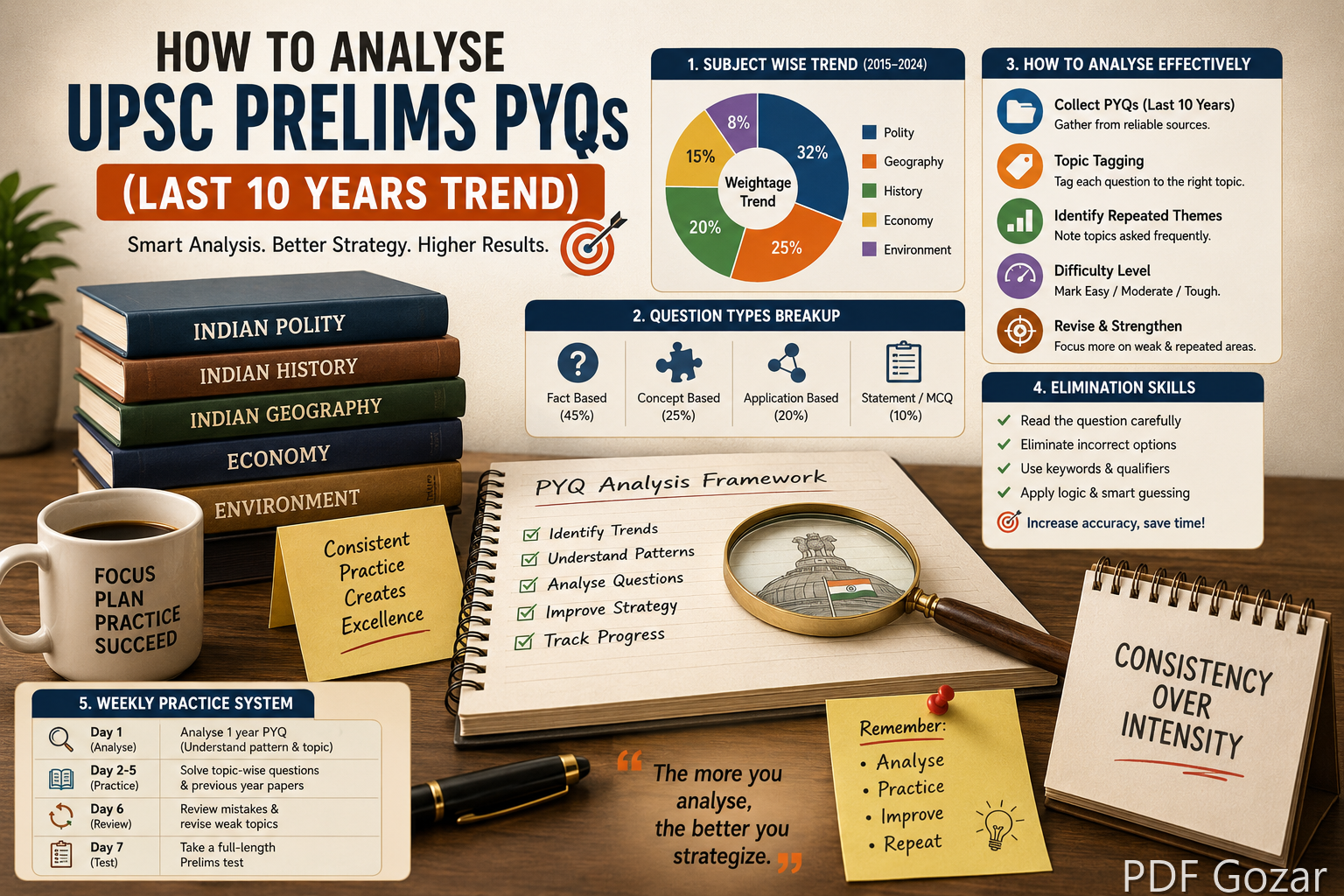
How to Analyse UPSC Prelims PYQs (Last 10 Years Trend)#
Solving previous year questions is not enough. Most aspirants “attempt” PYQs, check answers, and move on. That gives familiarity, not mastery. Analysis means finding what UPSC repeats, how options are framed, and which concepts convert into marks every year.
This guide shows a practical method to analyse the last 10 years of Prelims GS Paper I. Use it with your CSE roadmap, subject weightage trends, and booklist.
Why PYQ Analysis Beats Random Mock Flooding#
Mocks are useful for timing and temperament. PYQs are useful for truth. They show:
- which topics are evergreen
- how factual vs conceptual the paper is becoming
- which statements are designed to trap haste
- what depth is “enough” for Prelims
If your mock score is high but PYQ accuracy is weak, your preparation is misaligned.
Step-by-Step PYQ Analysis Method#
Step 1: Solve year-wise under timed conditions#
Start with one full paper (2 hours). Do not peek. Mark questions as:
- Sure correct
- Educated guess
- Blind guess
- Left
This tells you about temperament, not only knowledge.
Step 2: Check answers with reasons, not keys only#
For every wrong or guessed question, write one line:
- Concept missing
- Fact missing
- Misread question
- Trap option
Your improvement comes from this tagging.
Step 3: Map every question to a syllabus micro-topic#
Example mapping:
- “Speaker of Lok Sabha…” → Polity → Parliament
- “Coral bleaching…” → Environment → Marine ecology + climate
- “GST Council…” → Polity/Economy → Federal institutions
Over 10 years, you will see clusters. Those clusters become your revision priority list.
Step 4: Build a “repeats and twins” notebook#
UPSC rarely repeats the exact question. It repeats themes.
Examples of twin themes:
- Constitutional bodies vs statutory bodies
- National parks / species / conventions
- Inflation tools and RBI functions
- Freedom struggle organisations and Acts
- Map locations in news
When you spot a theme thrice in 10 years, it is revision gold.
What the Last 10 Years Broadly Show#
Trends shift year to year, but these patterns are durable:
Polity#
Still core. Focus on Constitution, Parliament, judiciary, federalism, rights, bodies, and governance mechanisms. Analytical statement questions are common. Revise Fundamental Rights vs DPSPs and Indian federalism as theme packs.
Environment & Ecology#
Consistently high. Mix of static ecology and current biodiversity/climate. Conventions, protected areas, pollution basics, and species-in-news dominate. Keep Environment crash notes on weekly revision.
Economy#
Concept-heavy. Budget jargon, monetary policy, banking, external sector, and scheme architecture matter more than memorising every Yojana name.
History#
Modern India remains safer than over-detailed ancient/medieval trivia. Art and culture appears in bursts. Prioritise movements, Acts, organisations, and Governor-General themes.
Geography#
Map + physical geography + India-specific resources/climate. Current location-based questions (seas, countries, minerals, rivers) keep rising.
Science & Tech#
Mostly application and current developments: space, biotech, health, IT, defence tech. See Science & Tech for UPSC.
Current affairs#
Not a separate subject. It modifies static topics. Read CA as an extension of Polity, Economy, Environment, and IR.
For a compiled subject-weight view, cross-check UPSC weightage trends. Use this post for method; use that post for distribution context.
Question-Type Decoder#
Train for these formats:
- Two/three-statement correctness
- Pairs matching
- Chronology
- Location-based / map
- Assertion-style logic inside options
- “Which of the following is/are correct?” with close distractors
Elimination skill matters as much as recall. If two statements are clearly right, do not overthink the third unless you know it is wrong.
Weekly PYQ System (8-Week Cycle)#
Weeks 1–4: Subject-wise PYQs#
- Polity: 2 days
- Environment: 2 days
- Economy: 1–2 days
- History + Geography: remaining days
Solve topic blocks of 25–40 questions. Analyse the same day.
Weeks 5–6: Year-wise full papers#
One paper every 3–4 days. Full analysis before the next paper.
Weeks 7–8: Weak-area only#
Rebuild only your lowest-accuracy themes. Retake those PYQ sets.
This beats solving random PDFs every night with no memory of mistakes.
How to Convert PYQs into Notes#
Do not copy full solutions. Make micro-notes:
- One concept card per mistake
- One “trap pattern” card (extreme words, absolute claims, reversed definitions)
- One current-static link card (e.g., COP decision → UNFCCC framework)
Revise these cards more than the original thick books in the final 60 days.
Common PYQ Mistakes#
- Solving without timer and thinking exam temperament will magically appear
- Checking answer keys without writing why you were wrong
- Ignoring questions you guessed correctly
- Collecting 20 PYQ PDFs and finishing none
- Studying only latest 2 years and missing evergreen themes
Also revise repeated Prelims patterns after your first full analysis cycle.
Building a Theme Matrix (Example)#
Create a spreadsheet or notebook with columns: Theme | Years appeared | Static source | CA link | My accuracy.
Sample rows:
- Constitutional bodies | multiple years | Laxmikanth | appointments in news | 70%
- Protected areas / species | almost every year | Environment book | species CA | 55%
- Inflation / MPC | frequent | Economy notes | RBI statements | 80%
- Modern history organisations | frequent | Spectrum | museum/anniversary CA | 65%
Anything below 65% accuracy becomes next week’s priority. This matrix stops random revision.
Final 60-Day PYQ Rule#
In the last two months:
- 40% time: revise mistake log and theme matrix
- 30% time: full mocks + analysis
- 20% time: weak subject static
- 10% time: fresh CA consolidation
Do not start a brand-new book because one mock felt bad. PYQ themes should drive revision choices now.
Metrics That Actually Matter#
Track weekly:
- Accuracy in sure attempts
- Accuracy in guessed attempts
- Subject-wise accuracy
- Repeat-theme coverage completed
If sure-attempt accuracy is below 80%, slow down and rebuild concepts. If guess accuracy is chaos, practise elimination with statement splitting.
FAQ#
Should I start PYQs from Day 1?#
Start light topic-wise PYQs after 4–6 weeks of basic reading. Full-year papers make more sense after one static pass.
Are last 10 years enough?#
Yes for pattern building. Add older papers only for Polity/History/Environment themes if time allows.
PYQs or mocks first?#
Do both. PYQs for truth and themes; mocks for speed and pressure. In the final phase, keep both weekly.
How many times should I revise the same PYQ paper?#
At least twice: once as a test, once as a revision of your mistake log.
Next Step#
Take one recent Prelims paper today, solve it in 2 hours, and build your first mistake log tonight. Then schedule an 8-week PYQ cycle inside your roadmap. Analysis turns past papers into a future scoring plan.