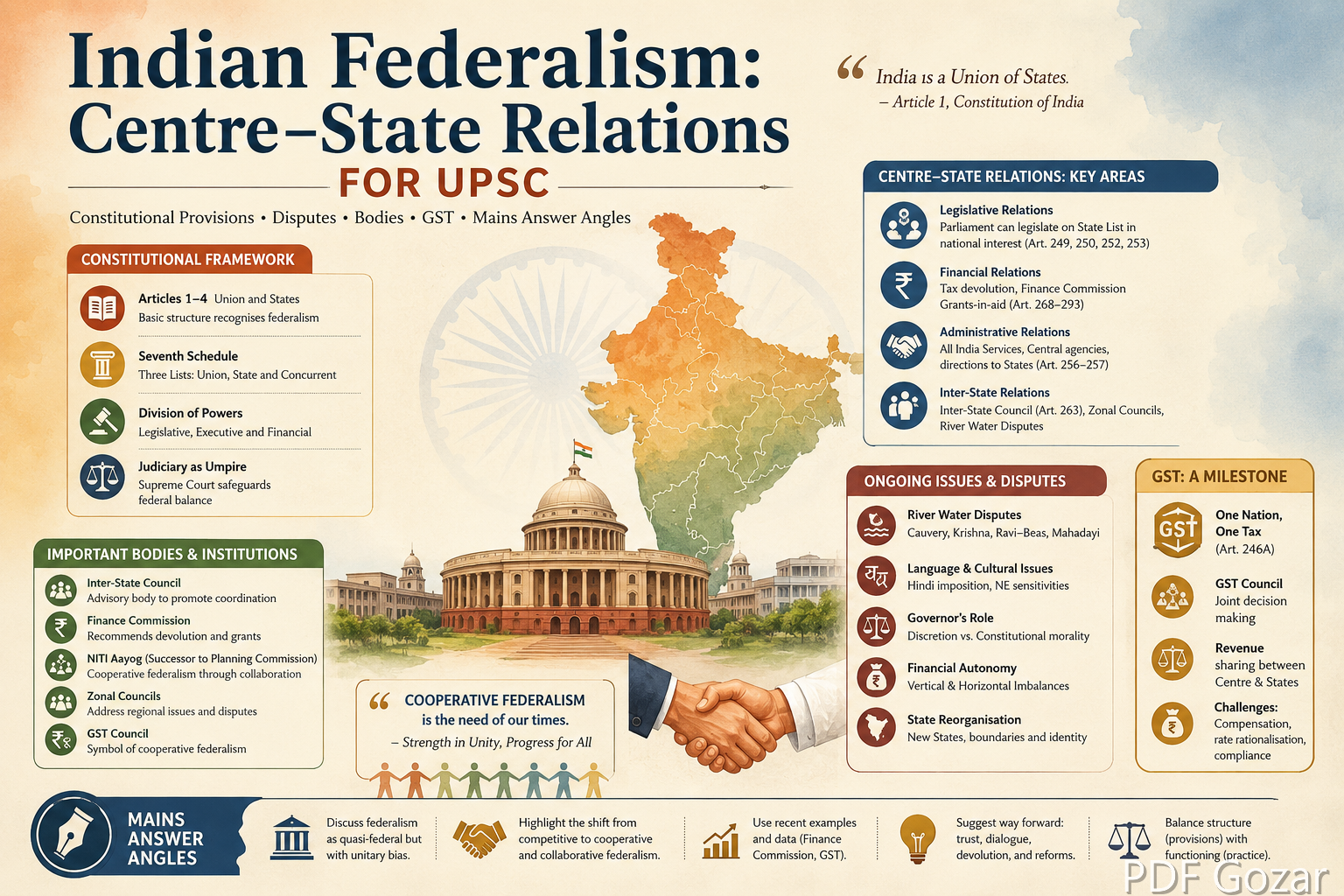
Indian Federalism: Centre–State Relations for UPSC#
India is often called a “Union of States” with a federal design and a strong Centre. For UPSC, federalism is not one chapter. It appears in Polity Prelims, GS2 Mains, Economy (GST/Finance Commission), and even Essay. If you can explain how power is shared, contested, and coordinated, you score across papers.
This post covers the constitutional scheme, legislative–administrative–financial relations, friction points, and answer-writing angles. Link it with GS2 strategy, FR vs DPSP, and GST–federalism notes.
What Kind of Federation Is India?#
India is a quasi-federal system: federal in form, unitary in spirit during stress.
Federal features#
- Written Constitution
- Division of powers (Union, State, Concurrent Lists)
- Bicameralism and independent judiciary
- Supremacy of the Constitution
Unitary tilt#
- Strong Centre in emergencies
- Single citizenship
- Integrated judiciary
- Union can alter state boundaries (with procedure)
- All-India Services
- Governors appointed by the Centre
UPSC often asks you to balance both sides, not pick a slogan.
Constitutional Map of Centre–State Relations#
1. Legislative relations#
- Union List / State List / Concurrent List (Seventh Schedule)
- Parliament’s residuary powers
- Situations where Parliament can legislate on State subjects (e.g., Rajya Sabha resolution, Emergency, request by states, international treaties)
Prelims loves list placement and exceptional legislative powers. Mains loves “cooperative vs competitive federalism” with examples.
2. Administrative relations#
- Obligation of states to comply with Union laws
- Centre’s directions to states
- All-India Services (IAS, IPS, IFoS) as a steel frame across levels
- Inter-state disputes and coordination mechanisms
3. Financial relations#
- Taxing powers and distribution
- Grants-in-aid
- Finance Commission (Article 280)
- GST Council as a federal bargaining forum
Fiscal federalism is where most current debates sit: devolution share, cesses/surcharges, GST compensation politics, and state borrowing stress.
Key Institutions in Federal Practice#
Finance Commission#
Recommends vertical and horizontal devolution. Its reports shape state finances for five years. In answers, mention predictability of transfers and autonomy concerns.
NITI Aayog#
Not a constitutional finance body, but a platform for cooperative and competitive federalism through indices, ranking, and policy coordination.
Inter-State Council (Article 263)#
Meant for coordination and dispute discussion. Often under-used in practice—good critical point for Mains.
GST Council#
A major federal innovation. It institutionalises shared taxation decisions. Also see debates on voting weight, consensus culture, and dispute resolution. Deeper GST angles are in GST impact on federalism.
Governor’s office#
Constitutionally a link between Centre and state. Politically sensitive in hung assemblies, bill assent delays, and floor-test controversies. Write balanced answers: constitutional role vs political misuse concerns.
Zones of Conflict You Should Prepare#
- Governor–state government friction
- Bill assent and reserved bills
- Central agencies and state consent debates
- Deployment of forces / internal security coordination
- Fiscal transfers, cesses, and GST issues
- Language, water disputes, and border issues
- Concurrent List crowding and Union regulatory expansion
For each conflict zone, keep:
- constitutional provision
- one recent example
- institutional fix / reform suggestion
Cooperative, Competitive, and Coercive Federalism#
Use these terms carefully in Mains:
- Cooperative federalism: joint policy design (GST Council, disaster response, national missions)
- Competitive federalism: states compete on investment, ease of doing business, social indicators
- Coercive/uneasy moments: heavy central conditions, political distrust, unilateralism perceptions
Good answers show that India needs cooperation for national goals and healthy competition for service delivery.
Emergency Provisions and Federal Stress Tests#
National, State (President’s Rule), and Financial Emergencies increase central power. Historically, Article 356 misuse was a major federal complaint; judicial checks (S.R. Bommai principles) strengthened constitutional morality.
In Prelims: know grounds and effects. In Mains: discuss safeguards, politics, and federal trust.
How to Write a High-Scoring GS2 Answer#
Intro: “India’s federalism uniquely balances unity and diversity through a strong Centre and autonomous states.”
Body structure:
- Constitutional scheme (lists + financial relations)
- Working institutions (FC, GST Council, ISC)
- Friction points with examples
- Reforms: strengthen Inter-State Council, timely Finance Commission implementation, clearer Governor conventions, collaborative policy design
Conclusion: unity is preserved not by centralisation alone, but by credible rules and trust-based bargaining.
Use the Mains answer framework for Intro–Body–Conclusion and diagrams (Venn of Union/State/Concurrent; fiscal flow chart).
Prelims Drill Points#
- Seventh Schedule basics
- Articles linked to Inter-State Council, Finance Commission, GST Council context
- Who can legislate on Concurrent List conflicts (Union prevails with nuances)
- Governor discretionary grey areas (high-level awareness)
- Emergency effects on Centre–state balance
Practice statement-based questions; federalism is rarely one-fact recall now.
Reform Ideas You Can Quote#
- Make Inter-State Council meetings regular and consequential
- Improve transparency in Centrally Sponsored Schemes design
- Respect collaborative spirit in GST dispute handling
- Codify more conventions around Governor’s discretion
- Strengthen state capacity, not only state fiscal complaints
Punchy reforms + constitutional grounding = examiner-friendly answers.
Current Affairs Tracker for Federalism#
Keep a running CA list with four tags:
- Governor / constitutional functionary issues
- Fiscal transfers, GST, Finance Commission
- Law and order / central agencies coordination
- Inter-state disputes (water, border, language, migration)
For each news item, write: fact → constitutional hook → one-line implication. This converts newspaper reading into GS2 ammunition.
Example conversion#
News on delayed bill assent → Article/role of Governor → federal trust and legislative accountability debate.
Do this three times a week and your Mains examples will never look stale.
Comparison Capsule: USA vs India (Optional Value Add)#
Use only if the question asks comparative federalism:
- USA: stronger state sovereignty traditions; India: stronger central tilt by design
- India: integrated judiciary and All-India Services; different from classical dual federal models
- India’s diversity and Partition history shaped unity-first constitutional choices
Keep this capsule short. Over-comparison without India focus loses marks.
FAQ#
Is India truly federal?#
Yes in structure, with a clear unitary bias in design and crises. Best description: quasi-federal / federal with unitary features.
What is the most important current federal issue?#
Fiscal federalism and political trust (GST, grants, cesses, Governor issues) dominate recent debates. Keep 2–3 fresh examples ready.
Should I memorise all three lists?#
Not line-by-line. Know the logic and high-frequency entries; use PYQs to learn what UPSC actually asks.
How is this different from local governance?#
Centre–state is classical federalism. The 73rd and 74th Amendments add a local tier (democratic decentralisation). You can mention the third tier as deepening of federal democracy.
Next Step#
Make a one-page chart: Legislative / Administrative / Financial relations + 5 conflict examples + 5 reform points. Revise it weekly with CA. Then write one 15-mark answer on “cooperative federalism in India.” Keep momentum with your roadmap.