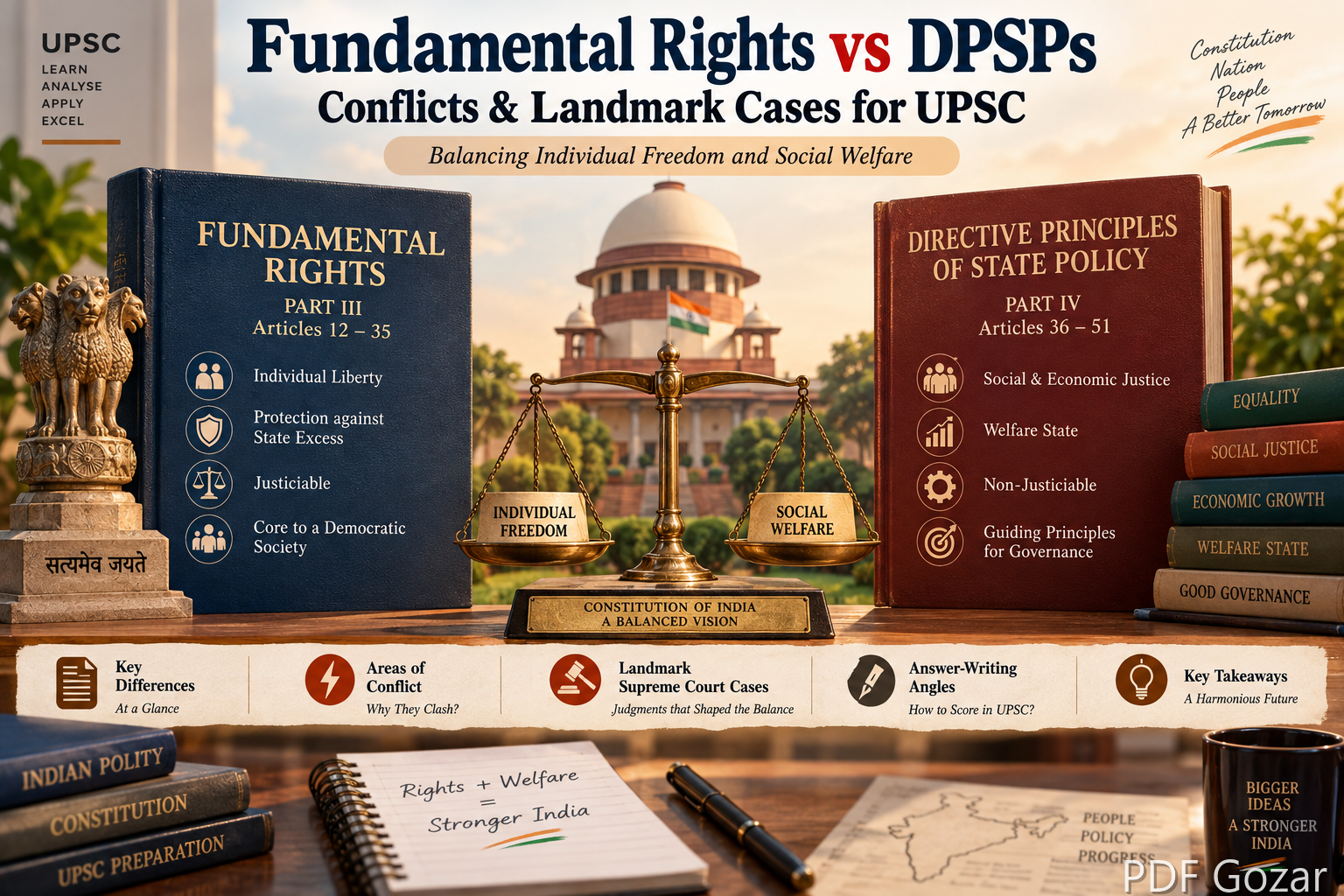
Fundamental Rights vs DPSPs: Conflicts & Landmark Cases for UPSC#
Fundamental Rights (Part III) and Directive Principles of State Policy (Part IV) are twin pillars of the Indian Constitution. Rights protect individual liberty. Directive Principles guide the State toward social and economic justice. UPSC loves this topic because it tests polity basics, constitutional history, and judicial balancing—all in one.
This post gives you a clear comparison, the conflict story through landmark cases, and how to use the topic in Prelims and Mains. Read it with Laxmikanth and link it to your GS2 strategy.
What Are Fundamental Rights?#
Fundamental Rights are justiciable guarantees. If the State violates them, a citizen can approach the courts under Articles 32 and 226.
Core clusters to remember#
- Equality: Articles 14–18
- Freedom: Articles 19–22
- Against exploitation: Articles 23–24
- Religion: Articles 25–28
- Culture & education: Articles 29–30
- Constitutional remedies: Article 32
Rights are not absolute. Reasonable restrictions apply, especially under Article 19. During a National Emergency, some rights can be suspended (with important post-44th Amendment safeguards for Articles 20 and 21).
What Are DPSPs?#
Directive Principles (Articles 36–51) are non-justiciable guidelines for the State. Courts cannot force the government to implement a DPSP the way they enforce a Fundamental Right. Still, DPSPs shape laws, schemes, and constitutional amendments.
Useful groups for revision#
- Socialist principles: livelihood, equal pay, health, living wage, reduce inequality (e.g., 39, 41, 42, 47)
- Gandhian principles: village panchayats, cottage industry, prohibit intoxicating drinks (e.g., 40, 43, 46, 47, 48)
- Liberal–intellectual principles: uniform civil code, environment, international peace, separation of judiciary from executive (e.g., 44, 48A, 50, 51)
Many flagship policies—panchayati raj, education expansion, environment protection, labour welfare—draw legitimacy from DPSPs.
Key Differences (Prelims Table)#
| Point | Fundamental Rights | DPSPs |
|---|---|---|
| Part | III | IV |
| Nature | Justiciable | Non-justiciable |
| Aim | Political democracy / individual liberty | Social & economic democracy |
| Enforceability | Courts can enforce | Moral/political force; guide State policy |
| Borrowed inspiration | Mainly USA | Mainly Ireland (also other sources) |
| Suspension | Some can be suspended in Emergency | Not “suspended” like rights |
A quick memory line: Rights limit the State; Principles direct the State.
Why Conflict Arises#
Conflict appears when a law made to fulfil a DPSP seems to restrict a Fundamental Right. Classic tension zones:
- Agrarian reform and property rights (historical)
- Social welfare regulation vs freedom of trade/speech
- Personal laws / Uniform Civil Code debates vs religious freedom
- Environment and public health rules vs individual freedoms
The Constitution originally suggested in Article 37 that DPSPs are fundamental in governance, but rights had stronger judicial teeth. Over time, the Supreme Court moved from “rights first always” to a doctrine of harmony.
Landmark Cases You Must Know#
1. Champakam Dorairajan (1951)#
The Court held that Fundamental Rights prevail over DPSPs if there is a clear conflict. This triggered the First Constitutional Amendment and early social justice adjustments.
2. Golaknath (1967)#
The Court restricted Parliament’s power to amend Fundamental Rights. This intensified the rights–amendment struggle (context for later basic structure doctrine).
3. Kesavananda Bharati (1973)#
Basic structure doctrine: Parliament can amend the Constitution but cannot destroy its basic structure. This case is bigger than FR–DPSP alone, yet it frames all later balancing.
4. Minerva Mills (1980)#
A key harmony judgment. The Court held that Fundamental Rights and DPSPs are complementary. Giving absolute primacy to one over the other can damage the Constitution’s balance. Articles 14, 19, and 21 were strongly protected within basic structure reasoning.
5. Later harmony approach#
In several cases, courts read DPSPs as aids to interpret Fundamental Rights—especially expanding Article 21 (life with dignity) to include education, health, livelihood, and environment-related concerns. The 42nd Amendment also elevated certain DPSPs (including Articles 39(b) and 39(c) contexts in the property/social justice journey), while later judicial review kept constitutional balance intact.
For revision, remember the arc:
Primacy of Rights → Parliamentary pushback → Basic structure → Harmonious construction.
How DPSPs Influenced Real Policy#
- Article 40: 73rd Amendment and Panchayati Raj
- Article 45 / education goals: path toward Article 21A and RTE
- Article 48A / 51A(g): environment laws and green jurisprudence
- Article 39: equal pay, living wage, and welfare framing
- Article 44: ongoing UCC policy debate
This is gold for Mains: link article → policy → outcome → challenge.
Prelims Angle: What UPSC Often Tests#
- Which part / which articles
- Justiciable vs non-justiciable
- Which principle is socialist / Gandhian / liberal
- Amendment politics around rights and directives
- Case name matched to principle (Champakam, Minerva Mills)
Practice matching lists and assertion–reason style questions. Do not memorise case paragraphs; memorise holdings in one line.
Mains Angle: How to Write the Answer#
Use a comparison table early, then discuss conflict and harmony through cases, then conclude with “complementary, not contradictory.”
Sample structure:
- Intro: rights + directives as two wheels of democracy
- Differences table
- Conflict with 1–2 cases
- Harmonious construction and present relevance
- Conclusion: liberty with social justice
For structure technique, follow the Mains Answer Writing Framework.
Value addition lines you can use#
- Political democracy needs Fundamental Rights; socio-economic democracy needs DPSPs
- Article 21 expansion shows directives shaping rights jurisprudence
- Good governance is the bridge between Part III and Part IV
Common Mistakes Aspirants Make#
- Writing “DPSPs are useless because non-justiciable”
- Ignoring the post-Minerva Mills harmony doctrine
- Mixing Fundamental Duties (Part IVA) with DPSPs
- Quoting case names without the legal takeaway
- Over-focusing on property history and missing current examples (education, environment, health)
Link with Fundamental Duties (Quick Add-on)#
After the 42nd Amendment, Part IVA added Fundamental Duties (Article 51A). In answers, you can show a triangle:
- Rights empower citizens
- Duties remind citizens of responsibilities
- DPSPs commit the State to justice goals
This triangle is useful in Essay and GS2 conclusions on citizenship, environment, and constitutional morality. Do not merge Duties into Part IV by mistake in Prelims.
Current Affairs Hooks for This Topic#
Keep a running list of news that maps to FR–DPSP:
- Free speech and reasonable restrictions debates (Art. 19)
- Privacy and digital governance (Art. 21)
- Education access and quality (21A + DPSP education goals)
- Environment litigation and climate policy (48A, 51A(g))
- Social justice reservation and equality cases (14, 15, 16)
- Health, nutrition, and labour welfare schemes (39, 41, 42, 47)
In Mains, one fresh example can lift an average answer. In Prelims, current cases often test which right or principle is involved.
Revision Sheet (One-Page Memory)#
- Part III = justiciable rights; Part IV = non-justiciable principles
- Conflict arc: Champakam → amendments → Kesavananda → Minerva Mills harmony
- DPSPs inspire policy; Rights protect individuals
- Write “complementary” not “opposites” in Mains conclusions
FAQ#
Are DPSPs enforceable today in any way?#
Not directly like Fundamental Rights. But courts use them to interpret laws and rights, and governments use them to justify policy.
Do Fundamental Rights always override DPSPs?#
Not in the old absolute sense. The settled approach is harmony and balance, within basic structure limits.
Should I memorise all DPSP articles?#
Memorise high-yield ones and their groupings. Exact article recall helps Prelims; policy linkage helps Mains.
Is Uniform Civil Code a DPSP conflict topic?#
Yes. Article 44 often intersects with Articles 25–26 debates. Write balanced answers: equality and reform vs diversity and consent-based change.
Next Step#
Revise this comparison twice this week, add one-line case notes in your polity register, and write one 10-mark answer on “FR and DPSP are complementary.” Then continue polity with your 2026 booklist and Laxmikanth chapters on Rights, Duties, and Principles.