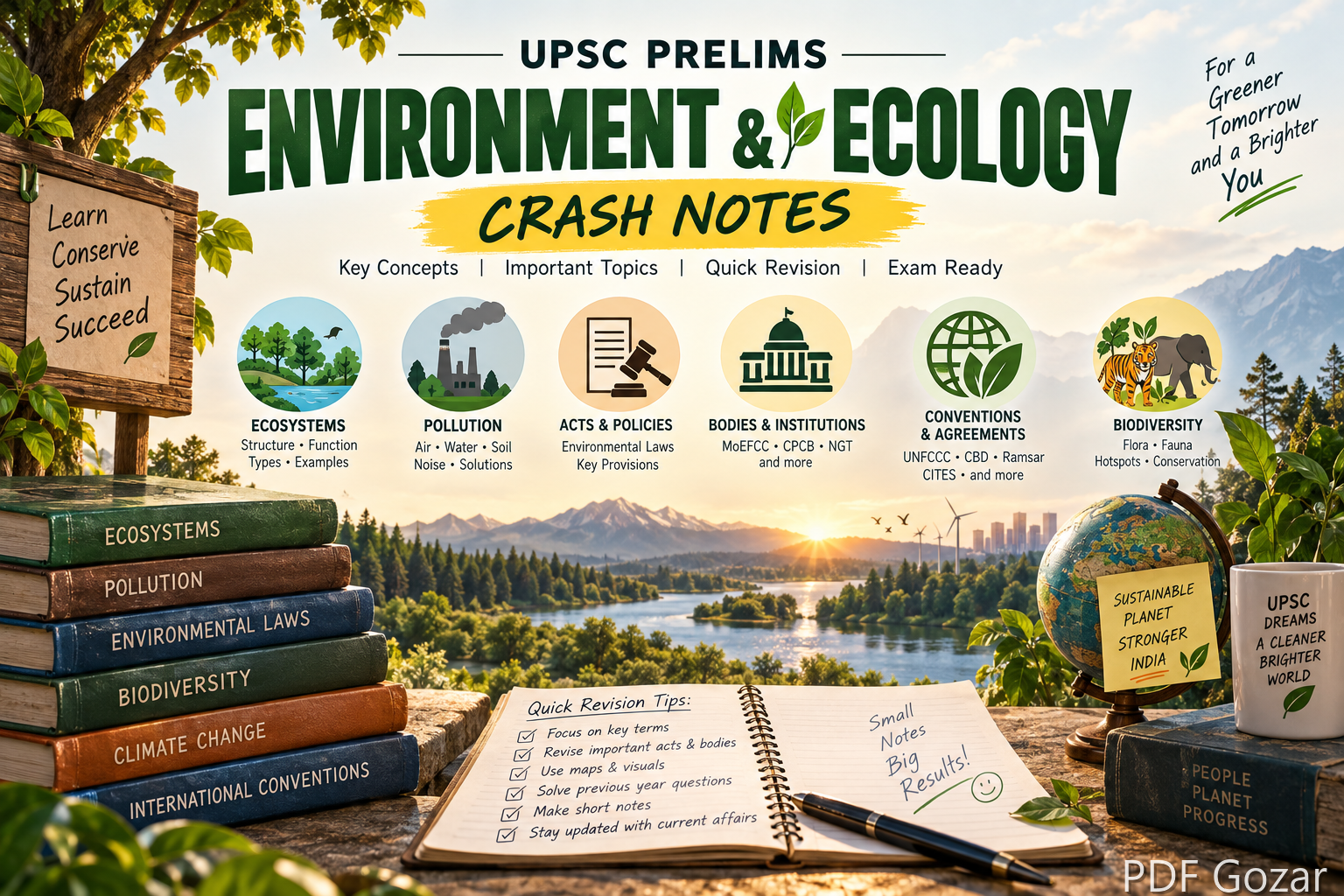
Environment & Ecology Crash Notes for UPSC Prelims#
Environment is one of the highest-return subjects in UPSC Prelims. Questions come from ecology basics, pollution, Indian laws, international conventions, biodiversity, and climate current affairs. You do not need a research-level background. You need crisp concepts and repeated revision.
These crash notes give you a revision map. Use them with Shankar IAS / NCERT Biology units and your monthly CA. For the full study path, see the UPSC CSE roadmap and best books 2026.
1. Ecology Basics (Must-Score Zone)#
Key terms#
- Ecology: study of interactions among organisms and with environment
- Ecosystem: community + physical environment (biotic + abiotic)
- Biome: large climatic ecological unit (tundra, desert, rainforest)
- Niche: organism’s functional role
- Habitat: place where an organism lives
- Food chain / food web: energy flow links
- Ecological pyramid: number, biomass, or energy
Energy flow rule#
Energy flow is unidirectional. Roughly 10% transfers to the next trophic level (10% law). This is why food chains are short.
Succession#
- Primary succession: on bare rock / new surface
- Secondary succession: after disturbance where soil remains
- Climax community is relatively stable for a given climate
Prelims often asks definitions, examples, and “which statement is correct” on these basics.
2. Biodiversity: Genes, Species, Ecosystems#
Levels of biodiversity#
- Genetic
- Species
- Ecosystem / community
Hotspots and conservation ideas#
Biodiversity hotspots need high endemism and serious habitat loss. India has rich biodiversity across Western Ghats, Himalayas, Indo-Burma, and Sundaland-related regions (as classified in standard sources).
IUCN Red List categories (revise names)#
Extinct, Extinct in Wild, Critically Endangered, Endangered, Vulnerable, Near Threatened, Least Concern, Data Deficient, Not Evaluated.
Also revise:
- Keystone species
- Endemic species
- Invasive alien species
- Flagship and umbrella species
Link species news from current affairs to static categories.
3. Pollution and Environmental Issues#
Air pollution#
- Major pollutants: PM2.5, PM10, NOx, SOx, CO, ozone, lead
- NCAP and city action plans appear in CA
- Indoor pollution matters in rural health questions
Water pollution#
- BOD vs COD (oxygen demand indicators)
- Eutrophication and algal blooms
- Groundwater contamination (arsenic, fluoride themes)
Other high-yield themes#
- Solid waste and plastic pollution
- E-waste rules basics
- Biomedical waste
- Noise pollution
- Land degradation and desertification
For Mains you analyse causes and policy; for Prelims you need definitions, pollutants, and instruments.
4. Indian Laws and Institutions (High Weight)#
Core acts (remember purpose)#
- Wildlife (Protection) Act, 1972: protected areas and species schedules
- Forest (Conservation) Act, 1980: restriction on diversion of forest land
- Environment (Protection) Act, 1986: umbrella law after Bhopal
- Air Act, 1981 and Water Act, 1974: pollution control framework
- Biological Diversity Act, 2002: access and benefit sharing, BMCs
- CAMPA / forest finance themes in current policy debates
Also revise EIA basics: screening, scoping, public consultation, appraisal.
Institutions#
- MoEFCC
- CPCB / SPCBs
- National Green Tribunal (NGT)
- National Biodiversity Authority
- Wildlife Crime Control Bureau
- Animal Welfare Board / related bodies as per syllabus updates
Know function + one distinguishing point for each body.
5. Protected Areas in India#
Revise differences clearly:
| Type | Core idea |
|---|---|
| National Park | Higher protection; no exploitation |
| Wildlife Sanctuary | Protection with some regulated activities |
| Biosphere Reserve | Core–buffer–transition; conservation + livelihood |
| Conservation / Community Reserve | Newer categories involving local participation |
| Tiger Reserve | Critical tiger habitat + buffer under Project Tiger / NTCA framework |
Map practice matters. Keep a list of recently in-news parks, Ramsar sites, and tiger reserves.
6. International Conventions & Climate Framework#
Biodiversity and wildlife#
- CBD (Convention on Biological Diversity)
- CITES (trade in endangered species)
- Ramsar (wetlands)
- CMS (migratory species)
- World Heritage natural sites
Climate and atmosphere#
- UNFCCC
- Kyoto Protocol
- Paris Agreement (NDCs, net-zero debates)
- Montreal Protocol (ozone) and Kigali Amendment (HFCs)
Others often asked#
- Basel (hazardous waste)
- Stockholm (POPs)
- Rotterdam (prior informed consent)
- UNCCD (desertification)
- Minamata (mercury)
For each, remember: full form + main aim + India angle.
7. Climate Change Quick Notes#
- Greenhouse gases: CO2, CH4, N2O, F-gases
- Mitigation vs adaptation
- Carbon sink, carbon credit, carbon tax (basic meaning)
- India’s initiatives: renewable push, national missions, green hydrogen themes, LiFE, updates from recent CA
Do not memorise every COP logo. Track the latest COP outcomes and India’s commitments through your monthly compilation.
8. Smart Prelims Revision Plan (21 Days)#
Days 1–7#
Ecology basics + biodiversity + pollution concepts
Days 8–14#
Indian acts, institutions, protected areas, maps
Days 15–21#
Conventions + climate + daily 30–40 environment MCQs + mistake log
Every night, revise only wrong questions. Environment improves fastest through error correction.
Source Strategy (Keep It Lean)#
- NCERT Biology Class 12 ecology units
- One standard environment book (Shankar IAS)
- Newspaper environment page / CA monthly
- PYQs of last 10 years
Avoid reading five environment PDFs in parallel. Depth in one source beats shallow coverage in many. Related older material on this site includes Shankar IAS references and environment fact-file style PDFs—use them as add-ons, not as your first book.
Common Traps in Environment MCQs#
- Mixing Ramsar with CBD
- Confusing National Park vs Sanctuary permissions
- Mixing Kyoto (older binding targets model) with Paris (NDC model)
- Ignoring “except” and “incorrect” words in questions
- Memorising species lists without habitat / threat context
Species & Habitats: How to Memorise Without Panic#
Do not learn 200 species in one night. Use buckets:
- Critically endangered mammals / birds often in news
- Endemic species of Western Ghats and Himalayas
- Marine and wetland species linked to Ramsar sites
- Invasive species affecting Indian ecosystems
For each species, store four fields only: name – IUCN status – habitat – one threat. That is enough for most Prelims frames.
Map drill (15 minutes, 3 days a week)#
- Mark national parks from the last 2 years of news
- Mark major biosphere reserves
- Mark important Ramsar sites by state
- Mark river-pollution and industrial-cluster news locations
Map memory converts random CA into marks.
One-Day Environment Rapid Revision Order#
If you have only one day before a mock:
- Ecology definitions and pyramids (45 min)
- Acts + institutions table (60 min)
- Conventions list (45 min)
- Protected area differences + 20 map points (45 min)
- 40 mixed MCQs + error log (90 min)
This order protects conceptual elimination skills before fact cramming.
FAQ#
How much time should Environment get before Prelims?#
In the last 3 months, give it regular slots every week. Many aspirants under-revise it despite high weight.
Is current affairs more important than static ecology?#
Both. Static concepts help eliminate options; CA supplies the facts UPSC frames into questions.
Do I need to memorise all national parks?#
Memorise important and recently in-news ones with maps. Complete rote lists without maps give low return.
Can diagrams help in Mains Environment answers?#
Yes—cycles, food webs, institutional flowcharts, and mitigation–adaptation tables. For writing method, see the Mains answer framework.
Next Step#
Print this page as a checklist, mark weak sections, and finish one full revision in 21 days with PYQs. Then keep a weekly environment slot until Prelims. Pair it with your roadmap so Environment stays a scoring subject, not a last-week panic topic.