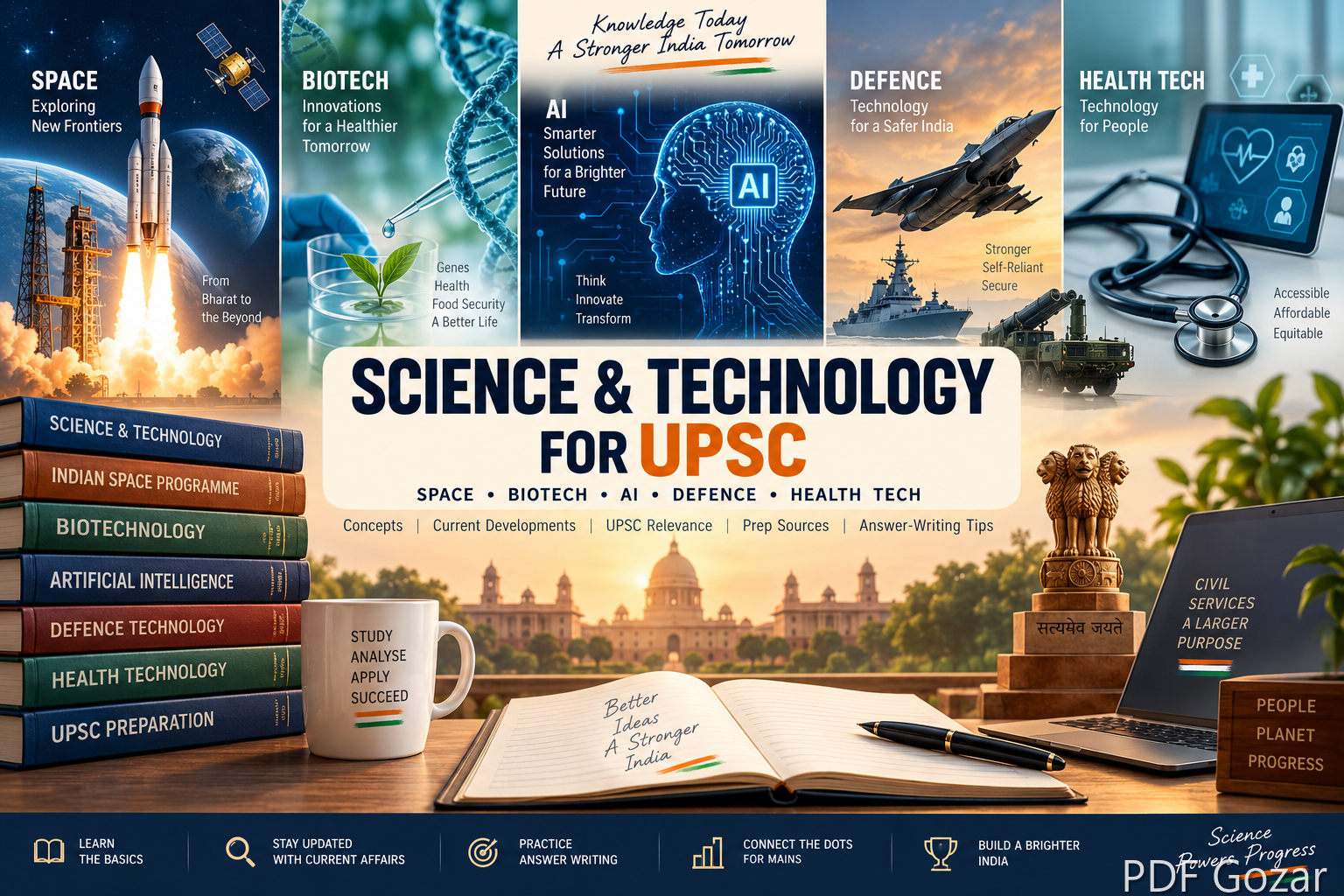
Science & Technology for UPSC: Space, Biotech, AI & Defence#
UPSC does not ask you to become an engineer. It asks whether you understand technologies that shape governance, security, health, and the economy. Most S&T questions are current-affairs driven with a static concept underneath.
This guide gives you a syllabus map, high-yield themes, source strategy, and Mains framing for Space, Biotech, AI, and Defence tech. Fit it into your roadmap and revise with PYQ analysis.
How UPSC Frames S&T#
Prelims pattern#
- Basic working idea of a technology
- India’s missions, agencies, and applications
- Distinguishing related terms (e.g., different vaccine platforms)
- Location/agency linked current events
Mains pattern#
- Benefits + risks + regulation
- Ethical and social impact
- Strategic autonomy and supply chains
- Inclusive access (health, agriculture, digital public goods)
If you only memorise launch names, Mains will hurt. If you only write opinions with no tech clarity, Prelims will hurt.
Pillar 1: Space Technology#
What to know#
- ISRO structure and major launch vehicles (conceptual)
- Navigation (NavIC), remote sensing, communication satellites
- Human spaceflight and deep-space missions (as per latest CA)
- Space applications: disaster warning, farming, connectivity, security
Answer angle#
Space is infrastructure for development and dual-use strategy. Mention civilian benefits first, then security relevance, then private-sector participation and policy reforms.
Prelims tips#
Revise mission purpose in one line. UPSC loves “which statement about mission X is correct?”
Pillar 2: Biotechnology & Health Tech#
High-yield themes#
- Vaccines and platforms (inactivated, viral vector, mRNA—basic differences)
- Gene editing concepts (CRISPR at idea level)
- GM crops debates: yield, biosafety, farmer concerns
- Diagnostics, genomics, and disease surveillance
- Antimicrobial resistance (AMR) as a governance issue
- Bioeconomy and ethical regulation
Mains framing#
Use stakeholder lens: patients, farmers, regulators, industry, environment. End with responsible innovation—promote research with biosafety and public trust.
Link outbreaks and One Health ideas when relevant (without turning the answer into a medical essay).
Pillar 3: AI, Digital Tech & Data#
Concepts to keep simple#
- AI / ML: systems that learn patterns from data
- Large models and generative AI: capabilities + hallucination risks
- Digital Public Infrastructure: identity, payments, data exchange models
- Cybersecurity basics: threats to citizens, firms, and critical infrastructure
- Data protection and privacy principles
Governance questions UPSC likes#
- AI for public service delivery vs bias and exclusion
- Deepfakes and election integrity
- Platform regulation and intermediary responsibility
- Strategic compute, chips, and supply-chain security
Write balanced answers: adopt AI for scale, regulate for safety, invest in skills and sovereign capabilities.
Pillar 4: Defence Technology#
Track at awareness level#
- Missiles and delivery systems (purpose classifications, not engineering specs)
- Drones / UAVs and counter-drone needs
- Network-centric warfare and secure communications
- Indigenisation: why import dependence is a strategic risk
- Border surveillance and space-enabled ISR (idea level)
Mains caution#
Stay analytical, not jingoistic. Focus on deterrence, preparedness, self-reliance, and civil-military technology spin-offs.
Other S&T Themes Worth a Weekly Scan#
- Semiconductors and electronics manufacturing
- Nuclear energy (civilian applications and fuel cycle basics)
- Renewable tech: green hydrogen, storage, grids
- Nanotechnology applications (health/materials) at intro level
- IPR issues in innovation policy
These often appear as CA + concept hybrids.
Source Strategy (Do Not Overbuild)#
A lean stack works:
- Newspaper S&T page / explainers
- Monthly CA compilation S&T section
- ISRO / PIB / DigiIndia style official explainers when a mission drops
- NCERT science basics only where concepts are weak
- Short notes notebook (not a fifth bulky book)
Avoid randomly watching 30-minute videos for every tech buzzword. Write a 10-line note: what it is, why it matters for India, risks, way forward.
Notes Template for Any Technology#
Use this card every time:
- What: one-line definition
- How it works: 2 lines max
- India angle: agency/mission/policy
- Applications: 3 bullets
- Risks/ethics: 3 bullets
- Way forward: 2 bullets
In 3 months you will own a personal S&T bank for both papers.
Mains Value Addition Tools#
- Committees / policies (as per latest: AI guidelines, space policy reforms, data protection law themes)
- Global comparison (one line)
- Constitutional values: privacy, equality of access, dignity
- SDG link where natural (health, climate, industry)
For structure discipline, use the Mains answer framework.
15-Day S&T Sprint Before Prelims#
| Days | Focus |
|---|---|
| 1–3 | Space missions + applications |
| 4–6 | Biotech + health + AMR |
| 7–9 | AI + cyber + data protection |
| 10–11 | Defence tech + semiconductors |
| 12–13 | Energy tech + nuclear basics |
| 14–15 | Mixed MCQs + revise mistake cards |
After Prelims, convert the same cards into Mains paragraphs with ethics and governance layers.
Common Mistakes#
- Engineering over-detail
- Ignoring social impact and regulation
- No India-specific examples
- Mixing similar mission names
- Leaving S&T for the last 10 days
S&T is a continuous CA subject. Weekly notes beat last-week cramming.
Sample Mains Intro Lines You Can Reuse#
- “Technology is now a core instrument of state capacity—from welfare delivery to border management.”
- “Scientific temper must walk with ethical safeguards if innovation is to serve constitutional values.”
- “India’s S&T challenge is not invention alone; it is adoption, regulation, and inclusion at population scale.”
Store 8–10 such intros. They save time in the exam hall.
Mini answer body for AI in governance#
- Benefits: targeting, fraud reduction, language access, predictive maintenance
- Risks: bias, opacity, privacy harm, over-surveillance
- Way forward: human-in-loop decisions, audits, grievance redress, capacity building in states
This three-block pattern works for most tech topics.
FAQ#
Is a separate S&T book necessary?#
Not for most aspirants. CA + short notes + selective basics are enough if done consistently.
How many S&T questions come in Prelims?#
It varies by year. Treat it as a swing area: low effort weekly can still save the cut-off.
Can S&T help in Interview?#
Yes. If your DAF has tech hobbies/graduation, expect basics and ethics of tech use in governance.
How do I remember missions?#
Remember by purpose clusters (navigation, earth observation, communication, science exploration), not by isolated acronyms.
Next Step#
Create 20 technology cards this week from the newspaper using the template above. Revise them every Sunday. Then solve S&T PYQs with the PYQ method. Small weekly deposits build a high-interest scoring area.