Feelings Wheel PDF: Print, Fill, and Use It at Home or School
A feelings wheel PDF is a one-page chart of emotion words arranged in rings. People use it when “fine,” “mad,” or “stressed” is too vague. Teachers pull it for social-emotional learning (SEL). Therapists use it in session. Parents keep a printout on the fridge.
This guide covers what the wheel is, who designed the best-known version, how to print or fill a PDF, and how to keep a clean digital copy. It is a vocabulary tool, not a diagnosis.
What a feelings wheel is for#
Most of us jump to a few default words. The wheel slows that down. You start at a broad feeling in the center, then pick a more specific word in the next ring. That extra word is often what you needed for a journal entry, a check-in, or a conversation.
Typical U.S. uses:
- Classroom morning meetings and counseling offices
- Individual or group therapy homework
- Couples or family check-ins
- Personal journaling when a mood feels mixed
- Coaching or workplace wellness sessions (with care — it is not an HR evaluation)
It works best when the person can see the whole page. That is why PDF printables beat a tiny phone screenshot.
Willcox’s Feeling Wheel vs Plutchik’s wheel#
Two different charts get mixed up in search.
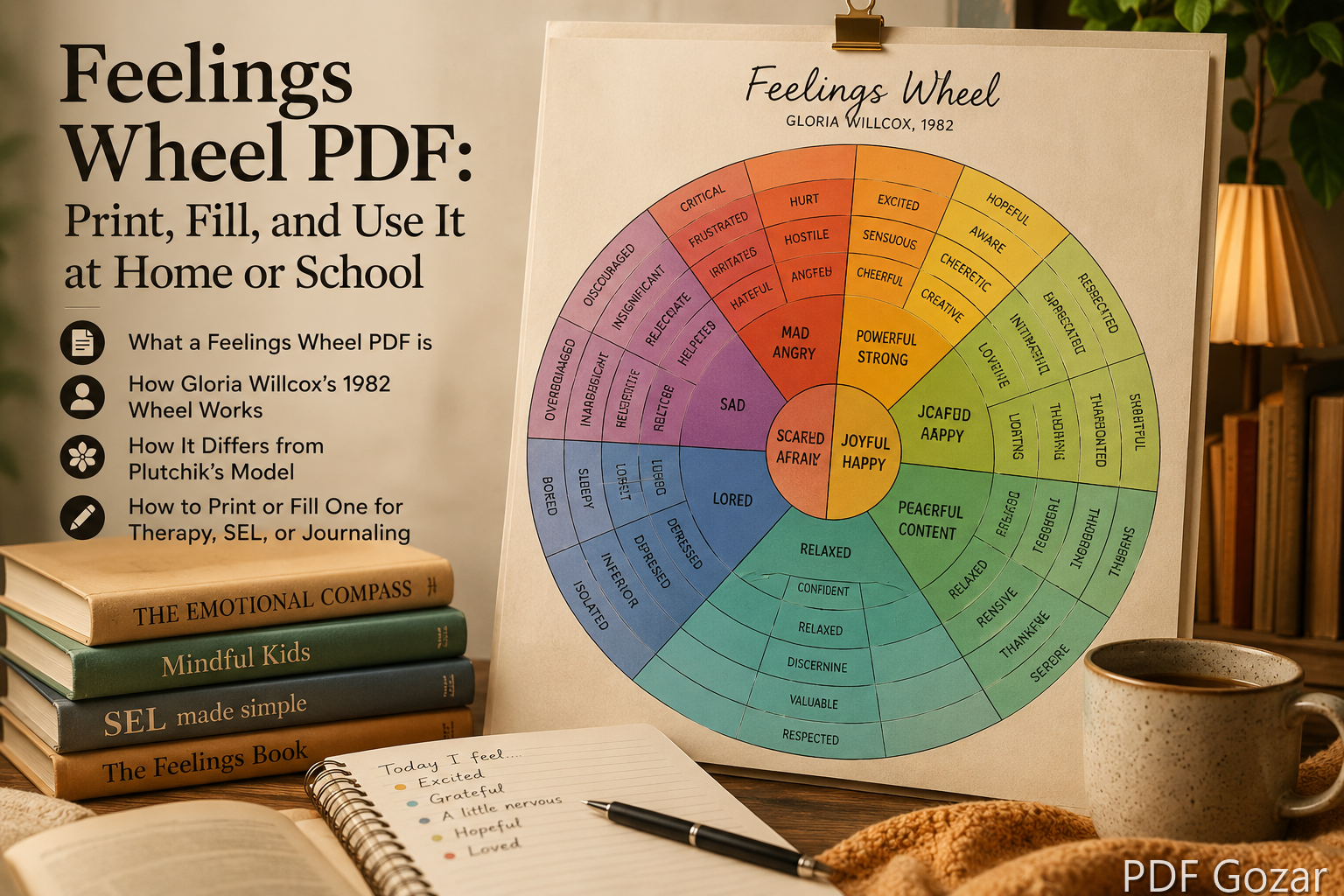
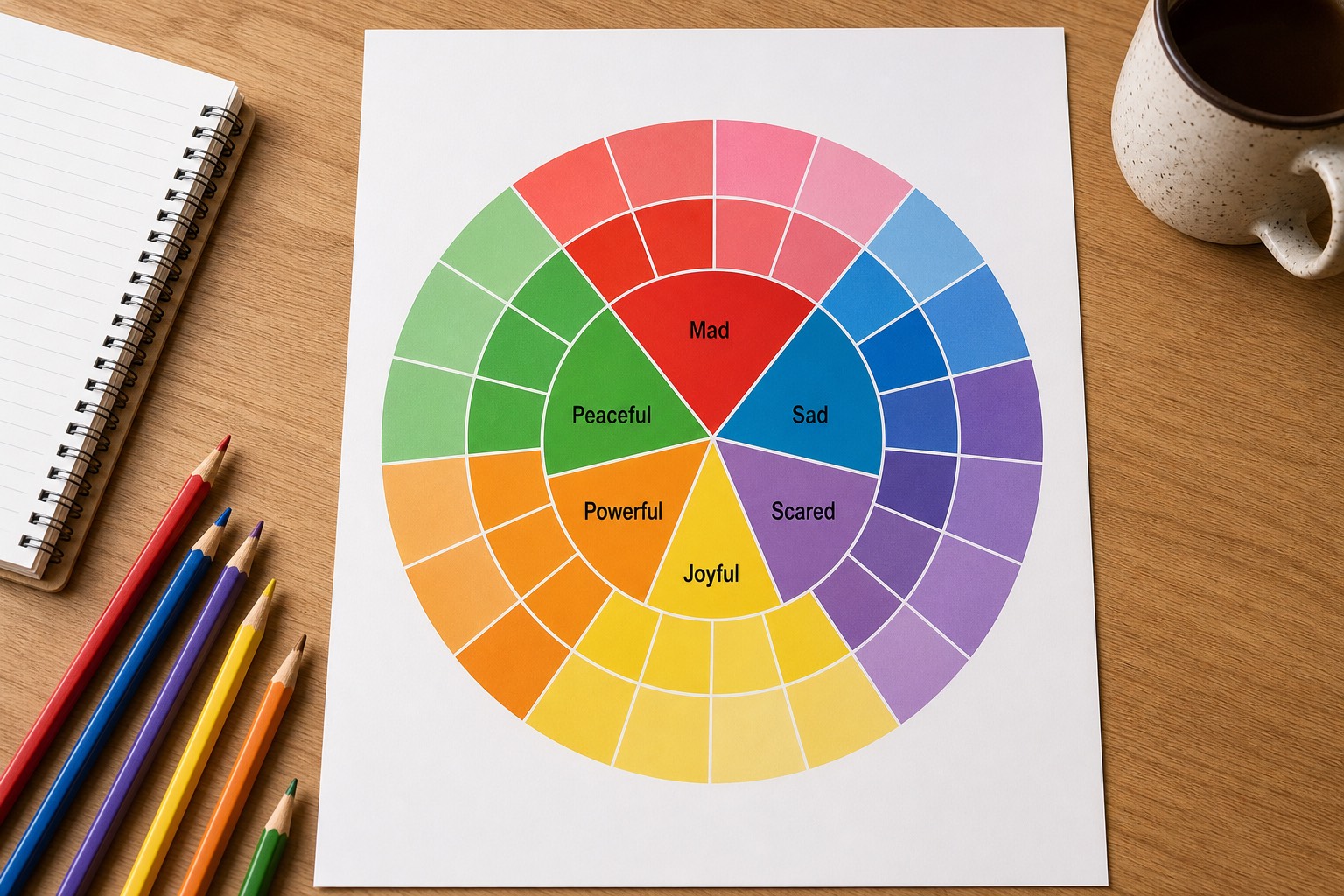
Gloria Willcox published The Feeling Wheel in the Transactional Analysis Journal in 1982. Her inner ring uses six cores: mad, sad, scared, joyful, powerful, and peaceful. She started from four basics (scared, sad, mad, glad), then split “glad” into joyful, powerful, and peaceful so comfortable and uncomfortable feelings would balance. Outer rings list related words in lighter shades. Willcox suggested adding your own words in blank spaces, coloring the wheel, and using it in small groups.
Robert Plutchik’s wheel of emotions is a different model (psychoevolutionary theory, often shown as a flower of eight primaries with opposites). If a PDF looks like a flower with “trust / disgust” pairs, that is Plutchik, not Willcox.
When you download a “feelings wheel PDF,” check the six inner labels. Mad / sad / scared / joyful / powerful / peaceful means you have the Willcox-style classroom and clinic chart most U.S. searches want.
How the rings work (without needing every word memorized)#
Think of it as zoom:
- Center: a big category (for example, sad).
- Middle ring: a clearer word in that family (lonely, guilty, bored).
- Outer ring: even more specific language.
You do not have to land on one slice. Mixed days are normal: scared plus powerful, or mad with a thread of sad. Circle more than one. Date the page if you keep a stack.
Willcox’s original idea included play: color the slices, use the chart in a group, notice “bridges” between a feeling you want to leave and one you want more of. The PDF is a prompt, not a test with a right answer.
How to get a printable PDF (and what not to copy)#
The 1982 Feeling Wheel is a published clinical tool. Many clinics, state health pages, and counseling sites share credited printables. Use a source that names Willcox and is meant for education or care — for example a public-health handout — rather than a random Pinterest crop with no citation.
Practical file tips:
- Prefer U.S. Letter (8.5 × 11 in) for home and school printers. A4 is fine if that is what you have; the wheel just prints slightly smaller.
- Color is easier to scan with the eye. A black-and-white version is better if kids will color it or if you only have a mono printer.
- One page is enough. Multi-page “emotion encyclopedia” PDFs are a different product.
If you only have a photo of a wheel from a workbook, crop it, then use JPG to PDF or PNG to PDF so you can print a clean page instead of a tilted phone picture.
Print, laminate, or fill on screen#
Print at home or school#
- Open the PDF in Chrome, Edge, Preview, or Acrobat.
- Print → Letter → Fit / Fit to printable area (do not “Actual size” if margins clip the outer ring).
- Color if you can. If not, print grayscale and keep colored pencils nearby.
- For a counseling office or fridge: print, then laminate. Dry-erase markers or clothespins let kids point without destroying the page.
Poster size (11 × 17 or A3) helps a group. Letter is better for a binder or take-home packet.
Fill a PDF without printing#
If the file is a flat image (most wheels are), you cannot “type into” the slices unless someone added form fields. You can still work digitally:
- Open the PDF in Edit PDF.
- Add a highlight, circle, or short text note for the word you picked and the date.
- Download the marked file and keep it with journal PDFs.
For a packet (wheel + journal prompts + a feelings log), Merge PDF makes one homework file. If the merged file is too big for Google Classroom or email, Compress PDF with the Balanced or Email preset.
How to use it in five minutes#
Pick a setting and keep the steps short so the tool does not become a lecture.
Kid or classroom: “Point to a center color. Now pick one word in the next ring. Say it out loud or write it.” Pair with a simple next step (drink water, ask for space, tell a teacher).
Therapy or counseling homework: Date the page. Circle today’s words. Add one sentence: what happened just before the feeling, and what you did after. Bring the PDF or a photo of the marked printout to the next session.
Journaling: Screenshot or print. Write three words from different rings if the day was mixed. You are collecting vocabulary, not scoring yourself.
Couples or roommates: Each person picks silently, then shares. The point is a more precise word than “you’re in a mood.”
Do not force a word. If nothing fits, use Willcox’s blank-space idea: write your own on the outer edge.
Common problems with feelings-wheel PDFs#
- Blurry classroom copies. A third-generation photocopy loses the outer words. Print from the original PDF.
- Phone screenshots in a group chat. Corners cut off, glare on lamination. Re-export a real PDF page.
- Wrong wheel. Plutchik vs Willcox vs a kids-only emoji chart. Match the inner six if you wanted the classic therapy/SEL layout.
- Treating it as a diagnosis. Naming “ashamed” is useful. It is not a disorder label.
- Huge scanned packets. A 40 MB color scan of one page is unnecessary. Compress before you upload.
A simple classroom or clinic packet#
If you are assembling a week of SEL or a new-client folder:
- Feelings wheel (Letter, color).
- A one-page log (date, word, intensity 1–10, what helped).
- Optional: a calm-down or “size of the problem” sheet your school already uses.
Export extra pages from another PDF with Split PDF if you only need page 1 of a long workbook. Merge the three sheets. Compress once. Name the file clearly: feelings-wheel-letter-color.pdf beats Scan2026.pdf.
FAQ#
Is there a free feelings wheel PDF?#
Yes — many schools, clinics, and public-health sites share credited printables. Look for Gloria Willcox (1982) in the caption. We do not host a copy of the copyrighted 1982 chart; use a legitimate educational or clinical source, then print or mark it with the tools above.
What are the six core feelings on Willcox’s wheel?#
Mad, sad, scared, joyful, powerful, and peaceful.
Is the feelings wheel the same as Plutchik’s wheel of emotions?#
No. Plutchik’s model is a different eight-primary diagram. The PDF most U.S. teachers and therapists mean is the Willcox-style concentric chart.
Can I fill a feelings wheel PDF on my phone?#
Yes. Print and photo it, or open the PDF in a browser editor and add a circle or note. For a photo of a paper wheel, convert it with JPG to PDF.
What size should I print?#
U.S. Letter for binders and backpacks. Tabloid or A3 for a wall. Always use “fit to page” so the outer ring is not cropped.
Conclusion#
A feelings wheel PDF is a one-page language tool: start in the center, get more specific, date it if you want a record. Willcox’s 1982 six-core layout is the version most searches mean. Print Letter size, laminate if it will be reused, or mark a digital copy in Edit PDF. If you are combining the wheel with logs and prompts, Merge PDF then Compress PDF before you send it to a teacher, parent, or clinician.