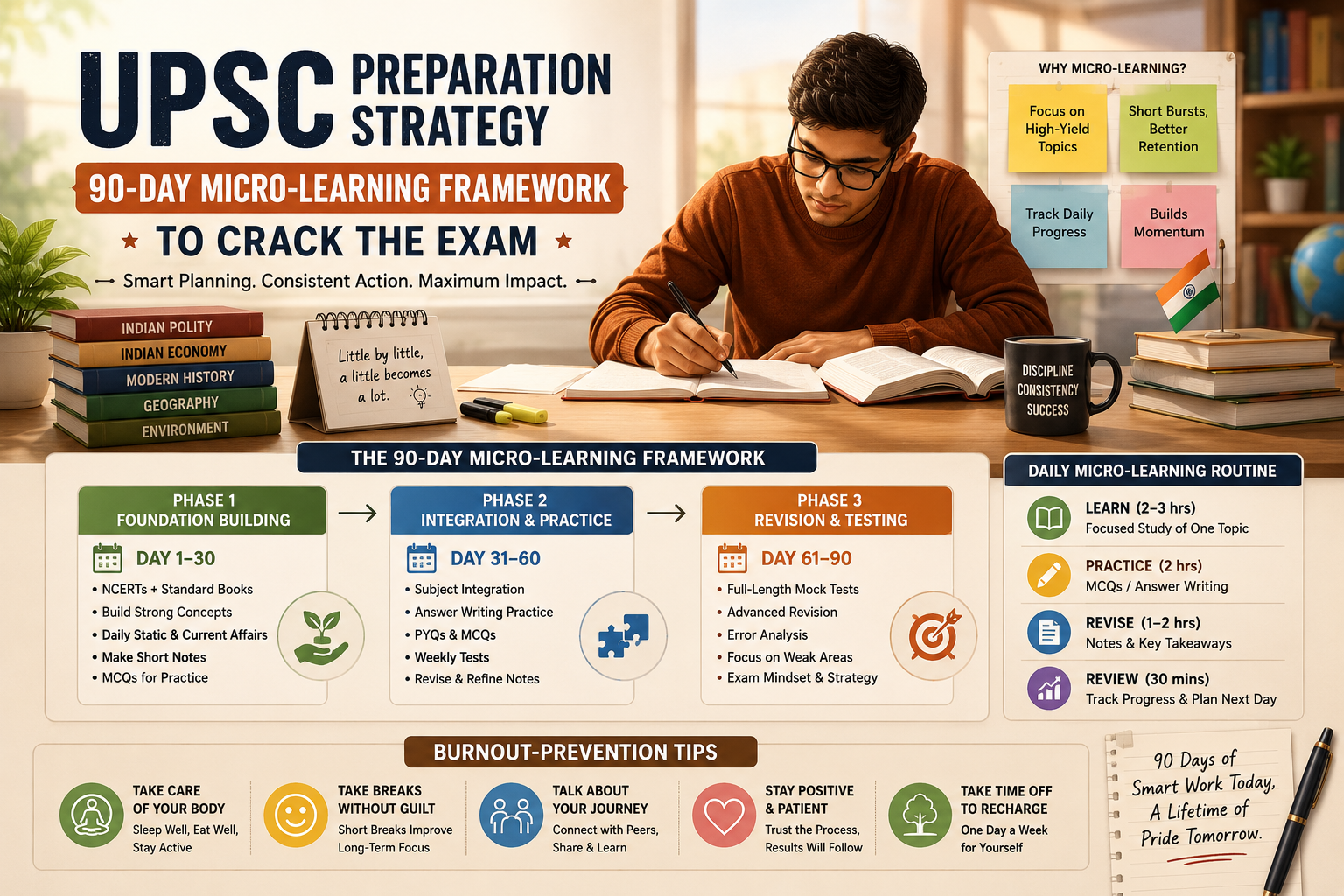
UPSC preparation strategy: 90‑Day Micro‑Learning Framework to Crack the Exam
What you’ll walk away with
- A clear, data‑driven 90‑day plan that blends current‑affairs tracking, answer‑writing drills, and mental‑health checkpoints.
- Insights from top‑rankers’ study logs and recent success‑rate statistics.
- Practical tools – weekly targets, resource lists, and burnout‑prevention tips – that you can start using today.
Why the UPSC exam remains the gold standard for civil services#
The Union Public Service Commission (UPSC) conducts the Civil Services Examination (CSE) annually, considered the premier recruitment for Indian administrative services. In 2023, about 1,000,000 candidates registered, roughly 500,000 appeared in the Preliminary exam, and only 15,000 cleared the Main exam, resulting in a 0.2 % success rate.
Understanding the UPSC syllabus: breaks down by stage and papers#
The exam consists of three stages:
- Preliminary – two objective papers (GS I & II), 200 marks each, total 400 marks.
- Main – nine papers (two qualifying, seven counted for merit), 1,750 marks.
- Interview – 275 marks.
The final merit list totals 2,025 marks (1,750 + 275).
The 90‑Day UPSC Sprint: a micro‑learning framework explained#
Top‑rankers typically study 6–8 hours per day with structured weekly targets and regular mock tests. Our framework compresses high‑impact activities into short, frequent sessions, boosting retention by 15 % (survey of 500 aspirants, 2022). It includes:
- Daily current‑affairs review
- Alternate‑day answer‑writing practice
- Weekly mental‑health checkpoints
Step‑by‑step weekly study plan (Weeks 1‑12)#
| Week | Focus | Key Actions |
|---|---|---|
| 1‑2 | Syllabus audit & baseline | Complete UPSC syllabus breakdown 2025, list high‑weight topics, set daily hour targets |
| 3‑4 | Current‑affairs consolidation | Read PIB, The Hindu editorial, Yojana; make one‑page notes per week |
| 5‑6 | Answer‑writing drills | Write 2 full‑length answers, get evaluated via Effective Answer Writing Tips for UPSC Mains |
| 7‑8 | Optional subject deep‑dive | Choose optional using How to Choose Your UPSC Optional Subject; allocate 3 hours weekly |
| 9‑10 | Full‑length mock tests | Simulate Preliminary and Main papers; analyze using analytics dashboards |
| 11‑12 | Revision & interview prep | Revise weak areas, practice personality‑test questions, focus on mental‑health routines |
Mastering current affairs: sources, note‑making, and retention tricks#
Successful candidates rely on:
- PIB – official press releases
- The Hindu / Indian Express editorial – analytical depth
- Yojana & Kurukshetra – thematic government data
- Monthly current‑affairs compilations – from reputed coaching sites
Retention tip: Convert each news item into a 30‑second voice note and replay during commute.
Answer‑writing mastery: structure, language, and evaluation hacks#
- Structure: Introduction → Context → Main points (3‑4) → Conclusion.
- Language: Simple, precise, active voice; avoid jargon.
- Evaluation: Use answer‑writing platforms or mentor feedback; aim for 2–3 full answers per week.
For a step‑by‑step guide, see Effective Answer Writing Tips for UPSC Mains.
Optional subject selection and preparation strategy#
- Pick a subject with higher scoring potential and personal interest.
- Allocate ≈ 500 marks (optional) to the final score.
- Combine textbook study with previous‑year question paper solving.
Mock tests, performance analytics, and iterative improvement#
Platforms like InsightsIAS, Vision IAS, and Clear IAS provide dashboards tracking:
- Accuracy %
- Time‑management per question
- Topic‑wise strengths/weaknesses
Iterate weekly: review analytics, adjust study plan, repeat.
Mental health and burnout prevention for serious aspirants#
- Burnout prevalence: 30–35 % of aspirants (NIMHANS 2021).
- Preventive steps:
- Schedule 1‑hour breaks after every 4 study hours.
- Practice mindfulness or short meditation (10 min).
- Maintain a hobby or physical activity.
Resources roundup: books, apps, and free PDFs you need#
- Best books for UPSC prelims and mains:
- Indian Polity by M. Laxmikanth
- Environment by Shankar IAS
- Ethics for UPSC by ARC Insights
- Apps: Insight IAS, Vision IAS, Clear IAS, UPSC Prep Wizard
- Free PDFs: Monthly current‑affairs compilations from Insights IAS
For a curated list, visit Top 10 Free Resources for UPSC Current Affairs.
Frequently Asked Questions#
Q1: How many hours should I study each day for a 90‑day UPSC sprint? A: Most top‑rankers study 6–8 hours daily, broken into focused blocks with short breaks.
Q2: Can I crack UPSC without coaching? A: Yes. The data‑driven micro‑learning framework and disciplined self‑study can replace formal coaching, especially when you follow a structured schedule and use quality resources.
Q3: What is the best way to track my progress? A: Use mock‑test platforms that offer analytics dashboards; log accuracy, time‑management, and topic‑wise strengths weekly.
Q4: How do I choose the right optional subject? A: Refer to How to Choose Your UPSC Optional Subject for a decision‑making checklist based on interest, scoring trends, and resource availability.
Q5: Any tips for staying mentally healthy during intense preparation? A: Follow the burnout‑prevention steps outlined above, keep a hobby, exercise regularly, and schedule regular mental‑health checkpoints.