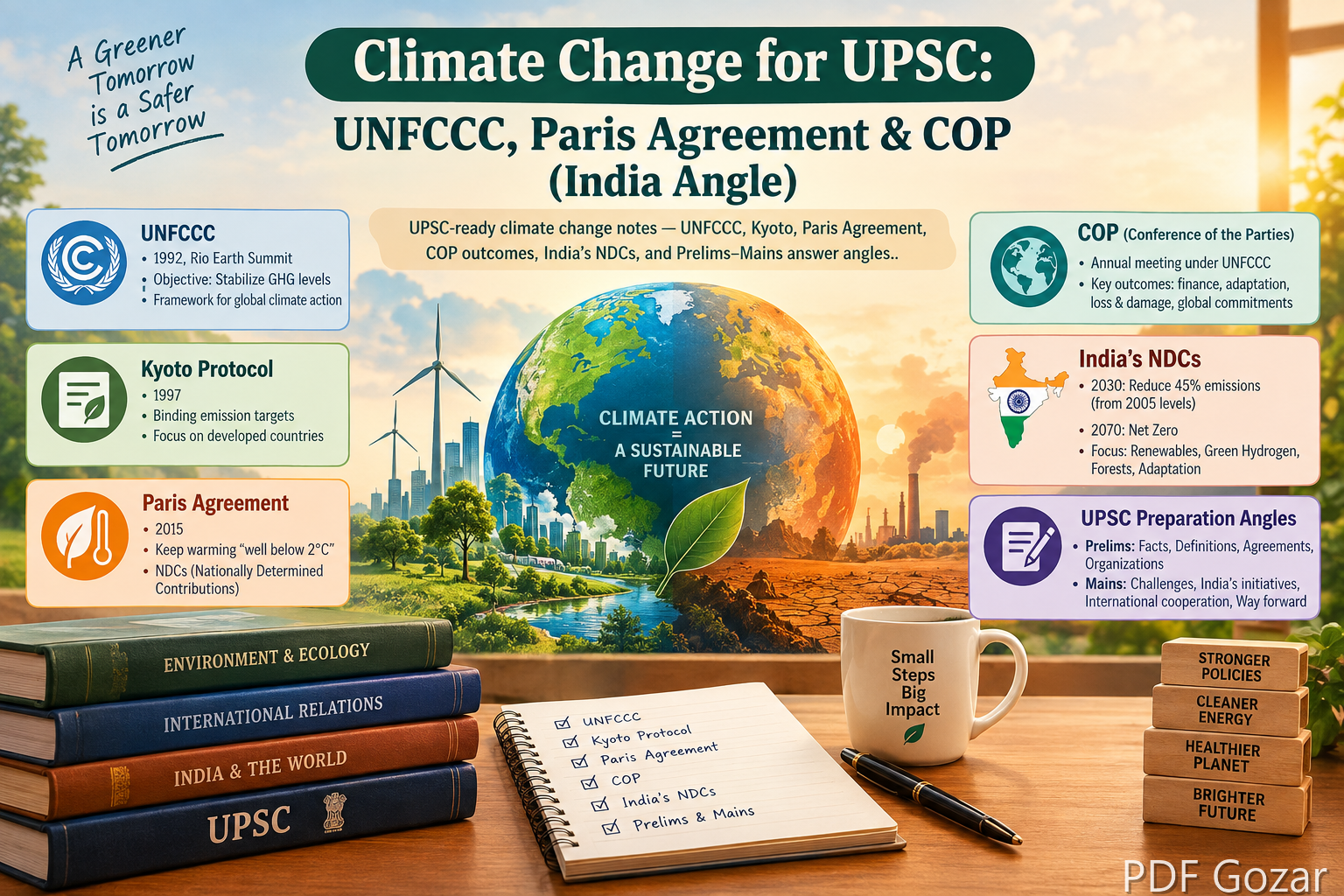
Climate Change for UPSC: UNFCCC, Paris Agreement & COP (India Angle)#
Climate change is no longer a small Environment subtopic. In Prelims it appears through conventions, funds, and reports. In Mains it enters GS3 (environment, disaster, agriculture, energy), GS2 (global governance), and Essay. The smart way is to learn the architecture once, then update COP outcomes every year.
This post gives you the UNFCCC system, Kyoto vs Paris, COP logic, and India’s stance with answer hooks. Pair it with Environment crash notes and climate–agriculture linkages.
Why Climate Questions Keep Rising#
- Extreme weather is visible and political
- Energy transition intersects economy and federal policy
- Global negotiations create yearly current affairs
- Ethics of climate justice fits GS4 and Essay
If you revise only species lists and skip climate governance, you leave easy marks.
The Global Climate Architecture (Static Core)#
UNFCCC (1992)#
The parent treaty from the Rio Earth Summit process. It sets the framework for stabilising greenhouse gas concentrations and organises annual COP meetings.
Remember:
- Near-universal membership
- Common but Differentiated Responsibilities and Respective Capabilities (CBDR–RC)
- Annex classification history (important for older Kyoto logic)
Kyoto Protocol (1997)#
Legally binding emission targets for developed country parties in commitment periods. Mechanisms included emissions trading, Clean Development Mechanism (CDM), and Joint Implementation.
Prelims angle: Kyoto = binding targets for Annex I (historical model). Paris = nationally determined contributions for all.
Paris Agreement (2015)#
Landmark shift:
- Goal: limit warming well below 2°C, pursue 1.5°C
- NDCs submitted by countries and updated periodically
- Global Stocktake to assess collective progress
- Climate finance, adaptation, and loss & damage debates intensified after Paris
Paris is bottom-up (countries self-define targets) with transparency expectations.
What Is a COP?#
Conference of the Parties is the UNFCCC decision-making body. Each COP produces negotiated outcomes: mitigation ambition, finance pledges, adaptation frameworks, carbon market rules, and loss & damage mechanisms.
How to study any COP quickly#
For each COP, store only:
- Host city / year
- 2–3 headline decisions
- Finance or adaptation outcome
- India’s stated position
- One criticism / unfinished agenda
Do not memorise every side event.
High-Yield Themes Across Recent COPs#
These themes recur even when venues change:
- Mitigation ambition gap vs 1.5°C pathway
- Climate finance ($100bn legacy debates and new quantified goals)
- Loss and damage funding for vulnerable countries
- Global Goal on Adaptation
- Carbon markets / Article 6 implementation
- Just transition and fossil fuel language fights
- Methane, forests, and sector alliances
When news breaks, map it to one of these buckets.
India’s Angle: What UPSC Expects#
India’s negotiation principles#
- Climate justice and equity
- CBDR–RC
- Development space for the Global South
- Demand for predictable finance and technology transfer
- Focus on lifestyle and sustainable consumption narratives (e.g., LiFE)
India’s domestic action pillars (revise with latest official numbers)#
- Renewable energy expansion
- Energy efficiency
- Non-fossil capacity targets
- Emissions intensity reduction
- Carbon sink enhancement through forests
- National missions / green hydrogen / mobility transitions (as per latest CA)
In answers, separate ambition, implementation challenges, and finance needs. Avoid cheerleading or cynicism.
Prelims: Exact Facts That Matter#
- UNFCCC vs Paris vs Kyoto differences
- NDC meaning
- Net-zero concept (country-level long-term goal)
- Major funds: GCF, GEF, Adaptation Fund, Loss & Damage Fund (basic roles)
- IPCC as science body providing assessment reports
- India’s missions and institutional actors (MoEFCC and related bodies)
Statement questions often mix correct finance names with wrong mandates. Learn mandates in one line each.
Mains: Ready-Made Answer Skeleton#
Question type: “Discuss India’s climate commitments and challenges.”
- Intro: climate risk to Indian lives, farms, coasts, and cities
- Commitments: NDC pillars + long-term low carbon vision
- Actions: renewables, efficiency, forestry, industry transition
- Challenges: coal dependence, just transition jobs, state capacity, finance, technology
- Global ask: equity-based finance and fair carbon space
- Conclusion: growth with resilience; development and decarbonisation together
Add a small flowchart: Mitigation / Adaptation / Finance / Technology.
Use the answer writing framework to keep it tight.
Link Climate to Other GS Topics#
- Agriculture: monsoon variability, heat stress, crop insurance (details)
- Disaster management: floods, cyclones, urban heat
- Economy: green jobs, carbon border measures, energy imports
- Federalism: Centre–state coordination on power and transport transitions
- IR: climate clubs, technology partnerships, Global South coalitions
This interlinking creates Mains value addition fast.
7-Day Climate Revision Plan#
| Day | Focus |
|---|---|
| 1 | UNFCCC + CBDR + IPCC |
| 2 | Kyoto vs Paris + NDC/Stocktake |
| 3 | Finance funds + loss & damage |
| 4 | India’s policies and missions |
| 5 | Energy transition + just transition |
| 6 | Latest COP notes + newspaper clippings |
| 7 | 40 MCQs + one 15-mark answer |
Update Day 6 after every major COP.
Common Mistakes#
- Treating Paris as a Kyoto-style binding Annex target system
- Dumping every scheme name without outcomes
- Ignoring adaptation while over-focusing on electric vehicles
- Writing climate answers with no India-specific vulnerability
- Memorising COP slogans without the decision substance
Data and Reports Worth One-Line Memory#
Keep a tiny evidence bank:
- IPCC findings on warming risks and extreme events
- India’s renewable capacity milestones (update yearly)
- Major finance pledges vs delivery debates at COP
- Domestic documents: relevant mission outcomes, Economic Survey climate chapters, adaptation plans
In Mains, one precise line of evidence beats five adjectives (“serious,” “alarming,” “urgent”).
Essay and Ethics Crossover#
Climate is excellent for Essay themes on development, justice, technology, and responsibility. For GS4, use climate as an intergenerational equity case: present benefits vs future harm, polluter responsibility, and lifestyle ethics. A short bridge to Ethics case practice helps when questions ask value-based environmental decisions.
FAQ#
Do I need to remember every COP number?#
No. Remember recent 2–3 COPs in detail and older landmarks (Kyoto, Paris, and major finance/loss-damage moments).
Is net-zero in the Paris Agreement text as a uniform date?#
Paris sets temperature goals; countries announce their own long-term net-zero timelines. Keep India’s official target aligned with latest government position in your notes.
How much climate is enough for Prelims?#
Enough to eliminate options on institutions, agreements, and India’s core pledges—plus CA of the last 12–18 months.
Should I quote IPCC reports?#
Yes, lightly: AR findings on warming risks and regional impacts help Mains intros and seriousness.
Next Step#
Make a one-page “Climate Architecture” sheet (UNFCCC–Kyoto–Paris–COP–India). Revise it monthly with CA. Then solve Environment PYQs focused on conventions using PYQ analysis method. Climate rewards structured memory, not panic reading before the exam.