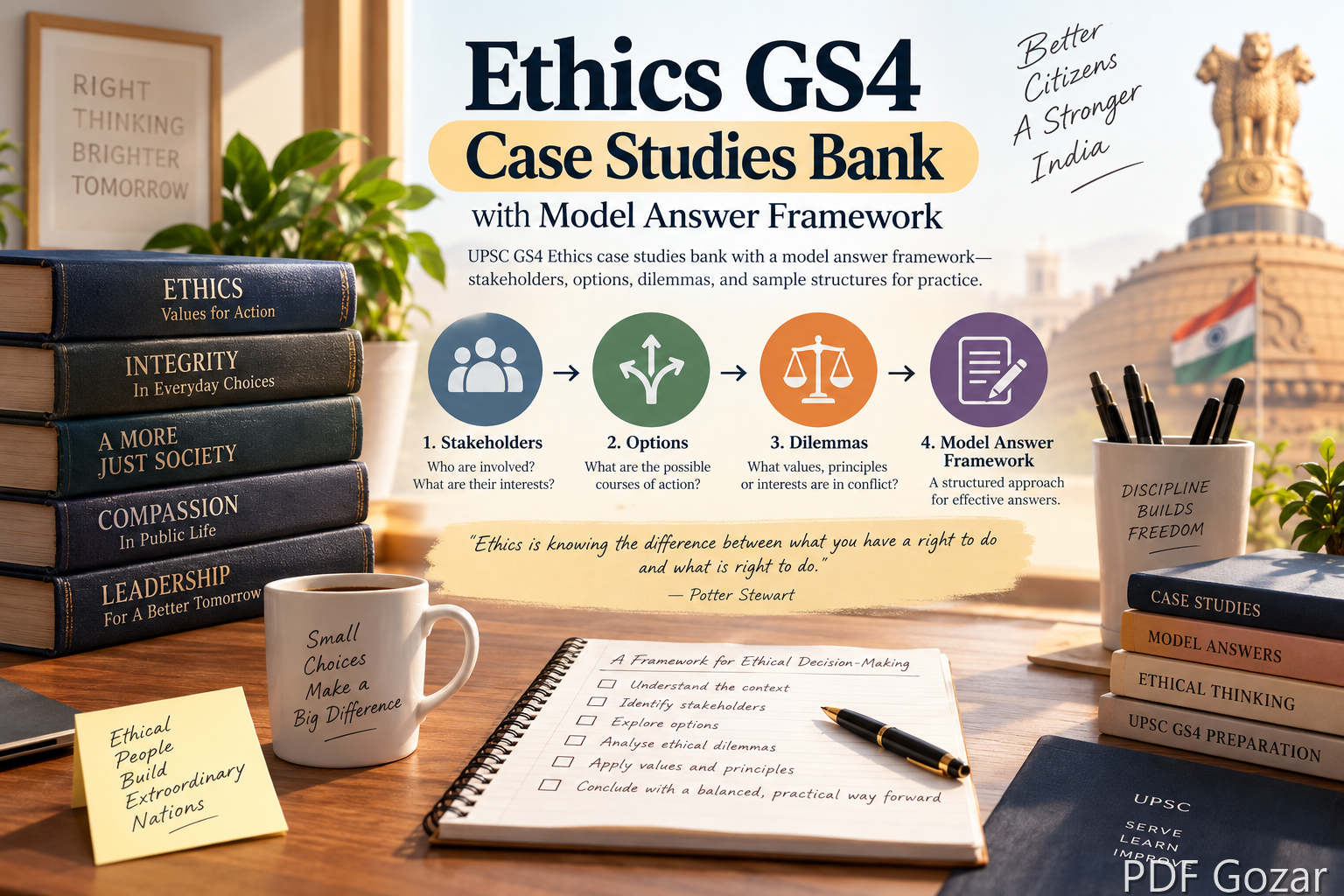
Ethics GS4 Case Studies Bank with Model Answer Framework#
GS4 case studies test decision-making, not moral speeches. The examiner wants to see whether you can identify stakeholders, spot the ethical dilemma, compare options, and choose a lawful, fair, and practical course of action.
This post gives you a reusable model framework plus a bank of case themes with answer skeletons. Use it with expected ethics cases and the general Mains answer framework.
Universal Case Study Framework (Use Every Time)#
1. Capture the facts (2–3 lines)#
What happened? What is your role? What constraints exist (law, time, resources, politics)?
2. Identify stakeholders#
List 5–7 max: citizen groups, organisation, juniors, political executive, media, yourself, future generations (if relevant).
3. Name the ethical dilemma#
Examples:
- Honesty vs loyalty
- Rule of law vs compassion
- Transparency vs confidentiality
- Efficiency vs equity
- Personal career risk vs public interest
4. List options (usually 3–4)#
For each option: merits, demerits, consequences.
5. Choose the best option with reasons#
Anchor in:
- Constitution and law
- Code of conduct / civil service values
- Impartiality, integrity, objectivity, empathy
- Proportionality and prudence
6. Implementation steps#
Short-term action + institutional fix + communication plan.
7. Conclusion#
One line on values upheld and public trust.
This structure keeps emotions in check and marks predictable.
Values and Theories: Light Touch Only#
Use theories as seasoning, not the meal.
- Utilitarianism: greatest good for greatest number (careful with minority rights)
- Deontology: duty and rules matter regardless of convenience
- Virtue ethics: character—courage, temperance, justice
- Gandhian lens: means and ends; weakest person’s face test
- Constitutional morality: liberty, equality, fraternity, dignity
Name one principle that fits. Do not dump all philosophers in every case.
Case Bank (Themes + Model Skeletons)#
Case 1: Bribery pressure by local influential person#
Setup: You are an SDM/tehsildar. A powerful person offers a bribe for clearing an illegal layout.
Dilemma: Personal safety/career pressure vs integrity and rule of law.
Best line of action: Refuse bribe, record process, apply rules uniformly, inform superior if threats arise, protect evidence, ensure citizen communication is transparent.
Keywords: integrity, courage of conviction, rule of law, zero tolerance for corruption.
Case 2: Political interference in transfers / policing#
Setup: Informal direction to spare a politically connected offender.
Dilemma: Obedience to political executive vs lawful duty and impartiality.
Best line: Follow written lawful orders; refuse illegal oral directions politely but firmly; document decisions; use institutional channels.
Keywords: anonymity/neutrality, objectivity, legality.
Case 3: Compassion vs strict rule enforcement (street vendors / eviction)#
Setup: Court/order requires clearing an encroachment; poorest families will suffer overnight.
Dilemma: Legal compliance vs humane administration.
Best line: Enforce law with phased, humane process—survey, notice, rehabilitation coordination, temporary relief, special care for elderly/children, prevent selective targeting.
Keywords: empathy, equity, procedural fairness, emotional intelligence.
Case 4: Whistleblowing inside department#
Setup: You discover fund diversion by seniors.
Dilemma: Loyalty to hierarchy vs public interest disclosure.
Best line: Use internal vigilance channels first; preserve evidence; avoid media trial; escalate legally; protect honest juniors.
Keywords: probity, accountability, tempered courage, due process.
Case 5: Conflict of interest in tendering#
Setup: Relative owns a bidding firm.
Dilemma: Private interest vs public duty.
Best line: Recuse formally, disclose conflict, let independent committee decide, strengthen transparent e-procurement norms.
Keywords: selflessness, transparency, integrity.
Case 6: Social media outrage and rushed justice#
Setup: Viral video demands immediate harsh action before investigation.
Dilemma: Public pressure vs fair inquiry.
Best line: Communicate that inquiry is underway; protect due process; take interim lawful measures if safety requires; avoid prejudging.
Keywords: objectivity, restraint, justice, crisis communication.
Case 7: Data privacy vs public health surveillance#
Setup: App-based tracking can reduce disease spread but risks privacy abuse.
Dilemma: Collective health vs individual privacy/dignity.
Best line: Necessity–proportionality–purpose limitation; legal basis; data minimisation; time-bound storage; oversight.
Keywords: rights-based governance, responsible tech, S&T ethics.
Case 8: Environmental clearance vs local employment#
Setup: Project brings jobs but threatens fragile ecology.
Dilemma: Development vs intergenerational equity.
Best line: Evidence-based appraisal, meaningful public hearing, mitigation hierarchy, reject if irreversible damage outweighs benefits.
Keywords: sustainable development, environmental ethics, stewardship.
Case 9: Gender harassment complaint in office#
Setup: Junior woman staff alleges harassment by influential officer.
Dilemma: Institutional reputation vs victim justice.
Best line: Immediate safe workplace measures, confidential ICC process as per law, no victimisation, counselling support, timely inquiry.
Keywords: dignity, zero tolerance, sensitivity, legal compliance.
Case 10: Disaster relief diversion risk#
Setup: Scarce relief materials; local leaders demand preferential distribution.
Dilemma: Political appeasement vs need-based equity.
Best line: Publish beneficiary criteria, use transparent lists, involve neutral witnesses, audit trail, prioritise vulnerability.
Keywords: fairness, utilitarianism with rights floor, accountability.
How to Practise the Bank#
- Write 3 cases per week in 60–70 minutes total
- Rotate themes: corruption, compassion, tech, gender, environment
- Maintain a phrase bank: “rule of law,” “conflict of interest,” “proportionate action,” “public trust”
- Review whether your option is legal first, then ethical, then feasible
Quality rises when implementation steps are concrete (who you call, what you record, what process you start).
Presentation Tips That Win Marks#
- Use small headings: Stakeholders / Dilemma / Options / Course of Action
- Keep options in a tiny table if time permits
- Avoid harsh one-sided moral abuse of persons
- Show emotional intelligence without abandoning law
- End with institutional reform so the problem does not recur
Common GS4 Case Mistakes#
- Jumping to solution without stakeholders
- Giving only one option
- Choosing an illegal “shortcut” as pragmatism
- Writing theory paragraphs with no decision
- Being naive (ignore safety) or cynical (assume everyone is corrupt)
30-Day Case Practice Calendar#
| Week | Focus themes | Output |
|---|---|---|
| 1 | Corruption, conflict of interest | 6 cases |
| 2 | Compassion vs law, disaster relief | 6 cases |
| 3 | Gender, workplace ethics, media pressure | 6 cases |
| 4 | Environment, tech privacy, political interference | 6–8 cases |
After 30 days you will have a personal model-answer file. In the final month before Mains, rewrite only your weakest 10 cases under stricter time.
Phrase bank (memorise and reuse)#
- “Lawful, fair, and feasible”
- “Recuse and disclose”
- “Document, escalate, protect”
- “Due process with humane enforcement”
- “Public trust is the civil servant’s real capital”
These phrases keep tone professional under pressure.
FAQ#
How many case studies should I practise before Mains?#
At least 30–40 across themes. Revisit weak themes twice.
Can the same framework work for all cases?#
Yes for structure. Content and values emphasis change by context.
Should I quote thinkers in every case?#
No. Quote only when it sharpens justification.
Are workplace and tech cases important now?#
Yes. Gender sensitivity, privacy, AI, and social media pressure are modern administrative realities—also flagged in expected cases.
Next Step#
Pick Case 1, Case 3, and Case 7 today. Write them with the universal framework in timed conditions. Tomorrow, compare your options quality and implementation detail. Ethics becomes scoring when your decisions look like a responsible officer’s decisions—not a motivational speech.