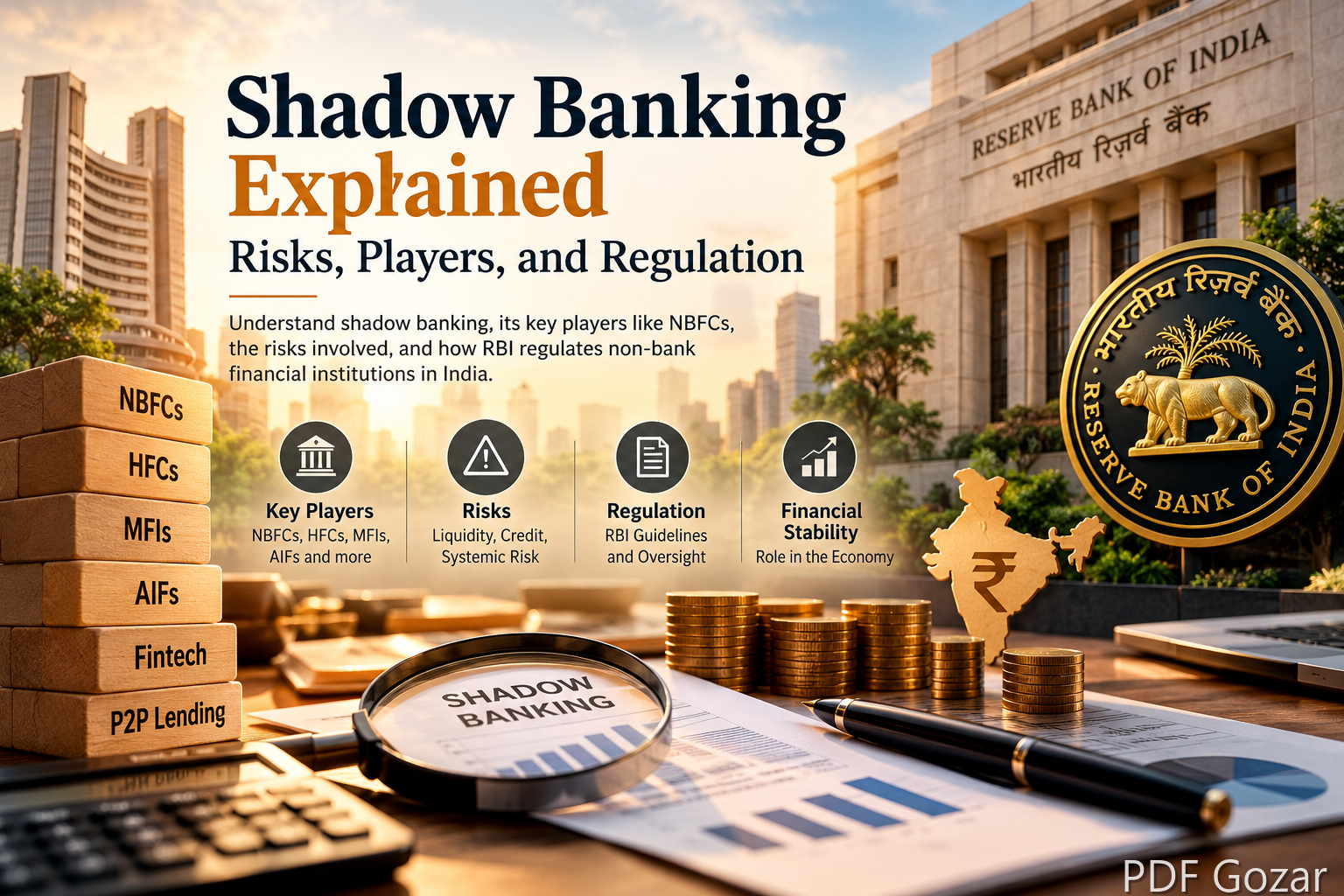
Nearly half of the world’s financial assets — $250 trillion — are managed outside traditional banks. This is shadow banking. Despite its name, it is legal and essential for the economy.
Shadow banking includes NBFCs, hedge funds, and fintech lenders. They provide credit where traditional banks cannot. Here is how they work and why they matter.
What Is Shadow Banking?#
Shadow banking refers to financial intermediaries that provide banking-like services but operate outside traditional banking regulations. They do not take deposits and do not have access to central bank funding.
Key difference from traditional banks:
- No deposit insurance protection
- Less regulatory oversight
- Cannot access central bank liquidity
- Higher risk, higher returns
Key Players in India#
- NBFCs (Non-Banking Financial Companies) — the largest segment
- Housing Finance Companies — provide home loans
- Microfinance Institutions — small loans to underserved
- Money Market Funds — short-term debt instruments
- P2P Lending Platforms — connect borrowers directly with lenders
How Shadow Banking Works#
These institutions raise money through bonds and commercial paper, then lend it to businesses and individuals.
The process:
- Issue bonds or commercial paper to raise funds
- Lend money to businesses and consumers
- Earn profit from interest rate difference
- Use securitization to manage risk
Why Shadow Banking Matters#
- Credit access — provides loans to businesses rejected by banks
- Innovation — faster loan processing, flexible terms
- Economic growth — fuels MSME and housing sectors
- Competition — forces traditional banks to improve
Risks of Shadow Banking#
- No safety net — no deposit insurance or central bank backing
- Liquidity risk — borrow short-term, lend long-term
- Systemic risk — failure can impact entire financial system
- Regulatory arbitrage — less oversight means more risk-taking
IL&FS Crisis: India’s Wake-Up Call#
The 2018 IL&FS crisis showed how shadow banking can destabilize markets. IL&FS defaulted on Rs 91,000 crore debt, triggering a liquidity crisis across NBFCs.
This led to stricter RBI regulations for NBFCs.
Key Takeaways#
- Shadow banking manages $250 trillion globally
- NBFCs are India’s largest shadow banking segment
- Provides credit access where banks cannot
- No deposit insurance makes them riskier
- RBI has tightened regulations after IL&FS crisis
Investing in NBFC bonds? Check the company’s credit rating and RBI registration. Higher returns come with higher risk.