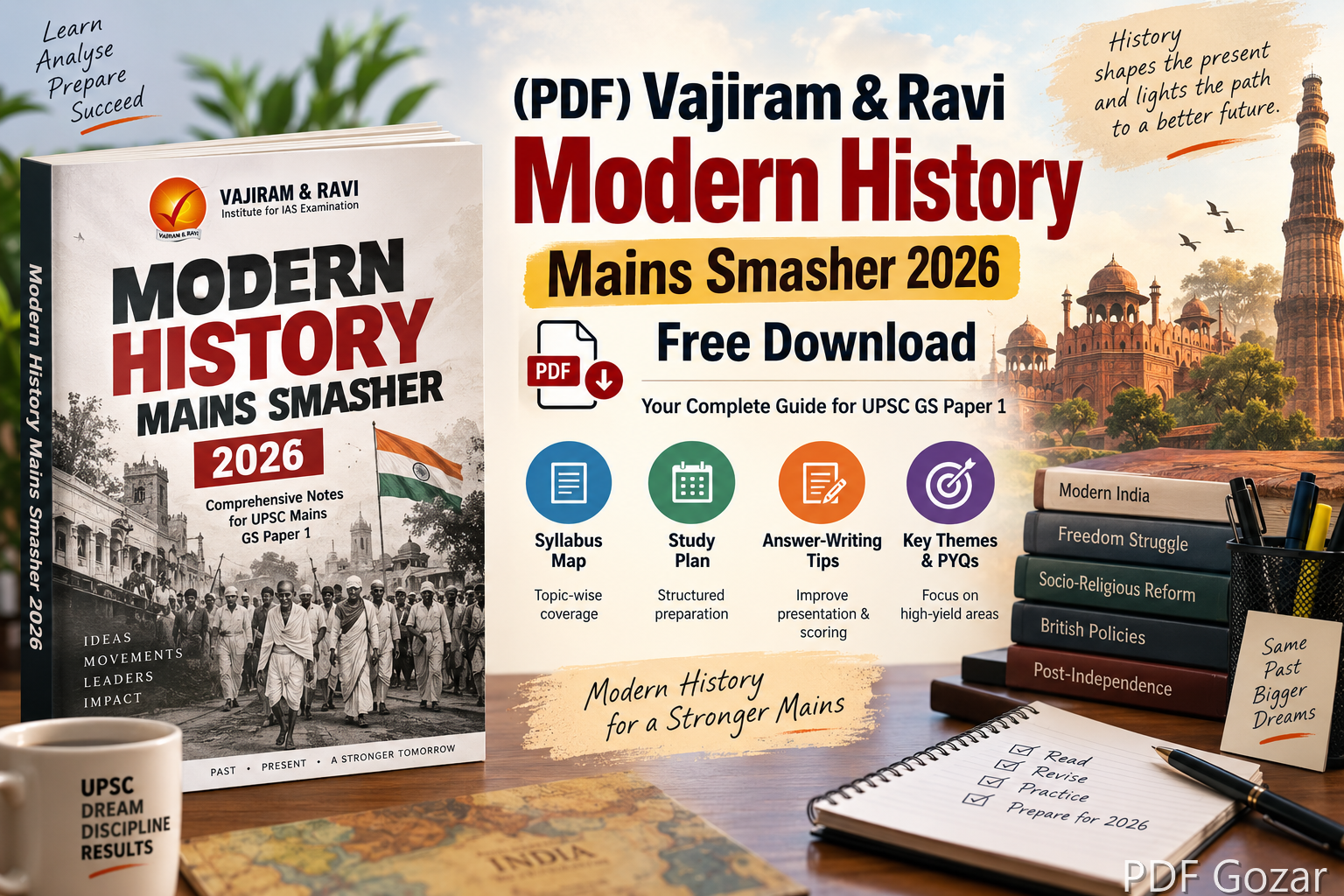
If you are revising Modern Indian History for UPSC Mains 2026, the Vajiram & Ravi Modern History Mains Smasher 2026 PDF is built for quick, high-yield recall. It is not a first-read textbook. It is a condensed revision file for aspirants who already know Spectrum or NCERTs and now need crisp points for GS Paper 1 answers.
PDF Gozar shares free study material for UPSC, State PCS, SSC, and related exams. Use this post to understand what the Mains Smasher covers, how to map it to the syllabus, and how to revise it in the last 30–45 days before Mains.
PDF details#
| Field | Details |
|---|---|
| PDF Name | Vajiram & Ravi Modern History Mains Smasher 2026 |
| Publisher | Vajiram & Ravi |
| Subject | Modern Indian History (GS Paper 1) |
| Language | English |
| Format | |
| Best for | Mains revision, answer enrichment, last-mile notes |
What this Mains Smasher is for#
Mains Smasher notes sit between full class notes and one-page flashcards. They usually focus on:
- Themes that repeat in UPSC Mains (revolt, nationalism, reforms, women, peasants, press, constitutional steps)
- Ready-to-use facts, committees, acts, and slogans
- Short analytical lines you can drop into introductions and conclusions
- Linkages between events (1857 → Congress → Swadeshi → Gandhian mass movements)
If you are still reading Modern History for the first time, start with NCERTs and a standard book. Come back to this PDF when you need speed and structure.
Syllabus map for GS Paper 1#
Use the PDF against these UPSC themes:
- Mid-18th century India and decline of Mughals — political vacuum, regional states, early company footholds
- British expansion and consolidation — wars, diplomacy, subsidiary alliance, doctrine of lapse
- Economic impact of colonial rule — deindustrialisation, land revenue, drain of wealth, famines
- Socio-religious reform movements — Brahmo, Arya, Aligarh, women’s reform, caste reform
- Revolt of 1857 and aftermath — causes, nature, regional variation, Crown rule
- Rise of nationalism — early associations, Congress, moderates and extremists
- Gandhian era — Champaran to Quit India, methods, mass base, limitations
- Revolutionary trends, Left, and other streams — HSRA, CSP, trade unions, peasant movements
- Towards independence and partition — wartime politics, negotiations, communal polarisation
Keep a one-page index in your notebook: chapter in Smasher → syllabus heading → 2 PYQ keywords.
How to use it in a 15-day revision plan#
Days 1–3: Company rule to 1857. Write 2 answers on economic impact and 1857.
Days 4–6: Reform movements and early nationalism. Make a comparison table: moderate vs extremist.
Days 7–10: 1919–1942 movements. Practice questions on methods, participation, and outcomes.
Days 11–13: Revolutionaries, peasants, workers, women, and press. Add examples to GS1 and Essay.
Days 14–15: Full syllabus rapid revision + 4 timed answers from previous years.
Rule of thumb: read one theme, close the PDF, write 5 bullet points from memory, then check gaps.
Answer-writing tips with this PDF#
- Start with a time-context line (for example, “Post-1858 Crown rule shifted…”) instead of a vague definition.
- Use one act + one organisation + one personality in the body for most 10–15 markers.
- End with a continuity line: how the issue shaped independent India’s institutions or politics.
- For “critically examine” questions, keep two columns: achievements vs limits.
- Do not copy long paragraphs from notes into the answer. Convert them into short, numbered points.
Who should download it#
- Aspirants in Mains 2026 cycle who finished basic books
- Repeaters who need a fresh, compact revision file
- Students who prefer coaching-style theme notes over bulky class PDFs
- Anyone pairing Modern History with Vision IAS Modern History Notes for dual revision
Related Mains Smasher PDFs on PDF Gozar#
- Ancient & Medieval History Mains Smasher 2026
- World History Mains Smasher 2026
- Polity Mains Smasher 2026
- Geography Mains Smasher 2026
- Indian Society Mains Smasher 2026
- Vajiram Ethics Notes PDF
Common mistakes to avoid#
- Treating Smasher as a substitute for NCERT and Spectrum
- Highlighting everything and revising nothing from memory
- Ignoring post-independence links asked in recent papers
- Memorising dates without causes, consequences, and historiography cues
- Skipping answer practice after reading
FAQ#
1. Is Vajiram Modern History Mains Smasher 2026 enough for GS1 History?
No. Use it for revision after a standard source. It helps you recall and structure, not build first concepts.
2. Can beginners use this PDF?
Only as a secondary file. Beginners should finish NCERTs and one standard book first.
3. Is it useful for Prelims too?
Some facts help Prelims, but the tone is Mains-oriented. For Prelims, prefer dedicated PT notes and PYQs.
4. How is it different from Vision IAS Modern History notes?
Vision notes are often fuller class-style notes. Mains Smasher is leaner and built for last-stage revision. Many aspirants use both.
5. Should I make my own short notes from it?
Yes. Convert each theme into half-page notes with 8–10 points. That is what you carry into the exam hall mentally.
PYQ-style themes to revise from this PDF#
Recent Mains trends favour analytical Modern History over pure chronology. While revising the Smasher, prepare short notes for these recurring angles:
- Nature of the Revolt of 1857: first war of independence vs sepoy mutiny debate
- Economic critique of colonialism: deindustrialisation, drain theory, commercialisation of agriculture
- Role of press, literature, and education in nationalism
- Women in the national movement: participation and limits
- Peasant and tribal movements as parallel streams to Congress politics
- Constitutional developments from Regulating Acts to Cabinet Mission as political strategy
For each theme, write a 120-word skeleton answer once. Revisit only the skeleton in the last week.
How to combine Spectrum and Mains Smasher#
A practical workflow many aspirants follow:
- Read one Spectrum chapter for depth.
- Immediately open the matching Smasher theme and highlight only exam-useful lines.
- Make a half-page personal note with 8 bullets.
- Solve one PYQ the same day.
- Next morning, rewrite the 8 bullets from memory.
This loop beats passive highlighting. The Smasher becomes a filter, not another book to finish.
Last 48 hours before GS1#
- Skim only your half-page notes, not the full PDF.
- Revise comparison tables: moderate vs extremist, soft vs hard Gandhi methods, revolutionary vs mass politics.
- Memorise 10 high-utility acts/events with one-line significance.
- Sleep well. History answers suffer first when recall is tired.
Quick revision checklist#
Before you close the PDF for the day, confirm you can explain each point in two sentences:
- Why British conquest succeeded in phases, not overnight
- How land revenue systems reshaped agrarian society
- Why 1857 failed organisationally yet changed colonial policy
- What made Gandhi’s methods different in mass mobilisation
- How social reformers and nationalists overlapped and diverged
- Why partition cannot be explained by a single cause
If any point feels fuzzy, re-read only that theme and write five bullets from memory. Modern History scores rise from clarity under time pressure, not from collecting more PDFs.
Download Vajiram & Ravi Modern History Mains Smasher 2026 PDF#
Download your file#
If the file link needs a refresh, leave a comment with the post name. Related free notes:
Comment for any query and feedback.
Thank you
Disclaimer#
All PDFs provided here are for education purposes only. Please use them to build your knowledge and do not use them commercially. We request you to respect the hard work of authors and publishers. pdfgozar.com does not charge for this service.
pdfgozar.com does not own this material, neither created nor scanned it. Links shared are already available on the internet for educational reference. If any content violates the law or rights, kindly contact us at [email protected]. Thank you.