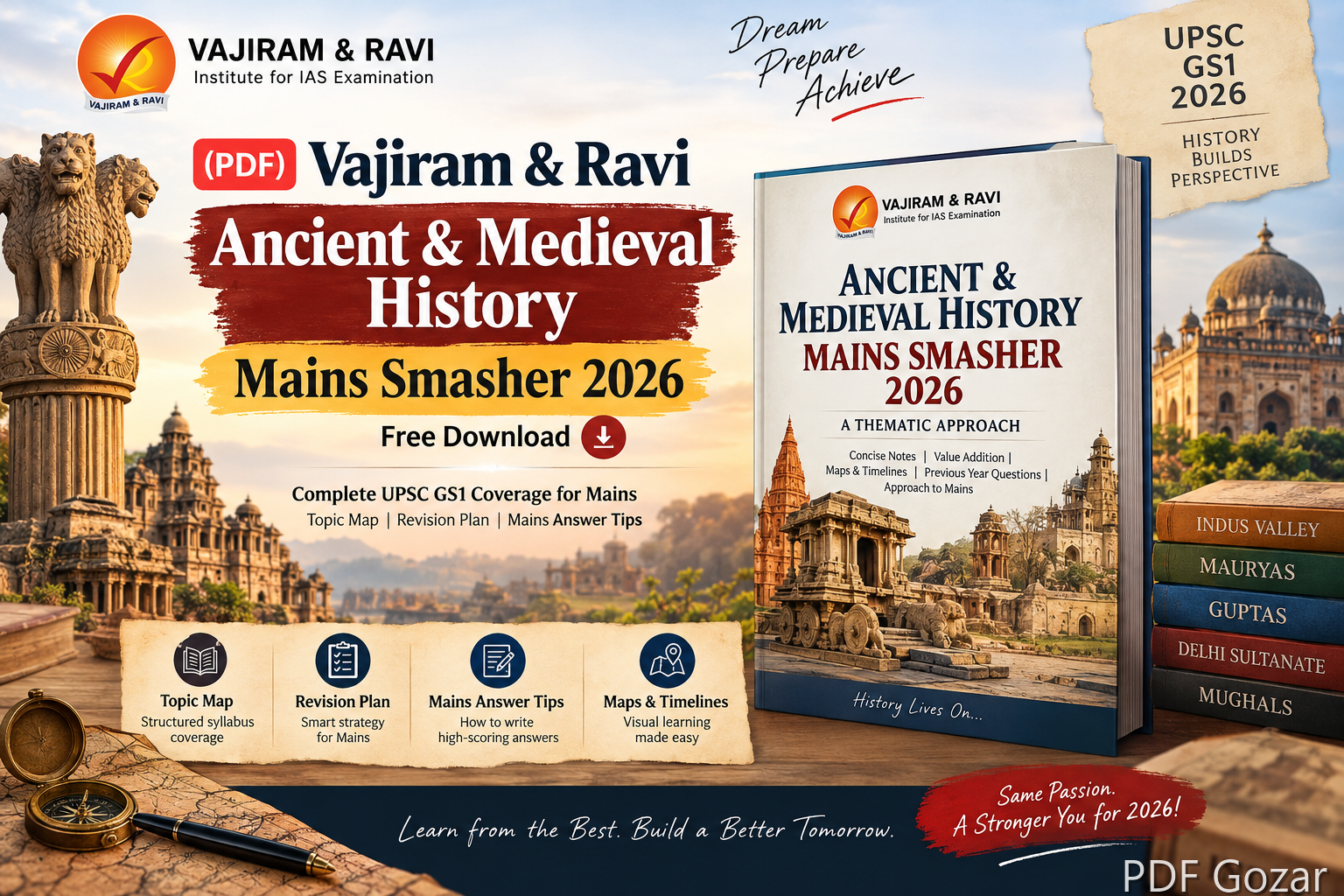
Ancient and Medieval History often feels vast, but UPSC Mains rewards clear themes more than endless kings and dates. The Vajiram & Ravi Ancient & Medieval History Mains Smasher 2026 PDF is meant for that theme-based revision. It helps you turn art, culture, polity, economy, and society into answer-ready points for GS Paper 1.
PDF Gozar publishes free Education resources for civil services and other competitive exams. This guide explains how to use the Mains Smasher with NCERTs, how to avoid rote learning, and how to connect Ancient–Medieval topics with Art & Culture questions.
PDF details#
| Field | Details |
|---|---|
| PDF Name | Vajiram & Ravi Ancient & Medieval History Mains Smasher 2026 |
| Publisher | Vajiram & Ravi |
| Subject | Ancient & Medieval Indian History |
| Paper | UPSC GS Paper 1 |
| Language | English |
| Format | |
| Best for | Mains revision, culture linkages, quick theme notes |
Why this PDF matters for Mains 2026#
UPSC rarely asks only “list the rulers.” It asks about:
- State formation and administration
- Agrarian systems and revenue
- Trade, urbanisation, and technology
- Religion, philosophy, and Bhakti–Sufi trends
- Architecture, literature, and cultural synthesis
A good Mains Smasher groups these themes so you can write structured 10–15 markers without dumping raw chronology.
Topic map you should cover#
Ancient India#
- Sources of ancient history (literary, archaeological, foreign accounts)
- Indus Valley: urban planning, economy, decline debates
- Vedic society and later Vedic changes
- Mahajanapadas, Buddhism, Jainism
- Mauryan polity, Ashokan Dhamma, economy
- Post-Mauryan trends: Sungas, Satavahanas, Kushanas, Sangam age
- Gupta age: polity, economy, science, culture
- Early medieval South India: Pallavas, Chalukyas, Cholas
Medieval India#
- Early medieval north India and feudal debates
- Delhi Sultanate: administration, market control, iqta
- Vijayanagara and Bahmani: state, society, culture
- Mughal administration, mansabdari, jagirdari
- Economy: land revenue, trade, crafts, towns
- Bhakti and Sufi movements
- Art and architecture: Indo-Islamic synthesis
- 18th-century regional states as bridge to Modern History
While revising, always ask: polity / economy / society / culture. That four-box habit improves answers fast.
12-day revision schedule#
Days 1–2: Sources + Indus + Vedic. Write one answer on urbanisation.
Days 3–4: Buddhism–Jainism + Mauryas. Practice Dhamma and administration questions.
Days 5–6: Post-Mauryan to Gupta. Make a science–culture fact sheet.
Days 7–8: Early medieval + Sultanate. Focus on iqta, market reforms, architecture.
Days 9–10: Mughals + regional kingdoms. Compare mansabdari and Chola local self-government.
Days 11–12: Bhakti–Sufi + art–architecture + full PYQ drill.
Keep one notebook page per dynasty cluster with only: key ruler, system, economy cue, culture cue, one analytical line.
How to write better Ancient–Medieval answers#
- Open with a source or concept (“Literary sources like… show…”).
- Use continuity and change language across periods.
- Add one map mental image (trade routes, temple regions, capital shifts).
- For culture questions, name style + example monument + feature.
- Link to present only when natural (heritage, federalism debates, pluralism).
Avoid long battle narratives unless the question demands military history.
Pair this with related PDFs#
- Modern History Mains Smasher 2026
- World History Mains Smasher 2026
- Art & Culture UPSC Notes
- Indian Society Mains Smasher 2026
- Geography Mains Smasher 2026
Art & Culture questions often cut across Ancient and Medieval chapters. Revise temples, paintings, music, and literature from both sections together once a week.
Mistakes aspirants make#
- Memorising king lists without administrative themes
- Ignoring South Indian history in favour of Delhi-centric notes
- Separating culture from political history completely
- Writing essays that are chronological stories, not arguments
- Skipping historiography cues (debates on feudalism, urban decline, economic prosperity)
Practice prompt set#
Try these after each revision block:
- Discuss the nature of Mauryan administration with reference to sources.
- Examine the economic basis of the Gupta period.
- Critically analyse the iqta system under the Delhi Sultanate.
- Assess the contribution of Bhakti and Sufi traditions to Indian society.
- Compare Chola local governance with Mughal mansabdari features.
Write in 150–250 words, timed. Then match your points with the Smasher themes.
FAQ#
1. Do I need separate books if I have this Mains Smasher?
Yes for foundation. Use NCERTs and one standard Ancient/Medieval source first. Use Smasher for compression and recall.
2. Is Ancient–Medieval still important after Prelims?
Yes. GS1 Mains continues to ask theme-based questions, especially on culture, society, and administration.
3. Can State PCS aspirants use this PDF?
Yes. Many State PCS Mains papers overlap on Indian history themes. Adjust examples to your state where needed.
4. Hindi medium students — is this useful?
If the file is English, use it for structure and keywords, then rewrite points in Hindi in your own notes.
5. How much time should I give Ancient–Medieval before Mains?
For revisers, 10–14 focused days with answer practice is usually enough if basics are done.
Culture integration sheet#
Create one sheet titled “Culture across periods” while reading the Smasher:
| Theme | Ancient cue | Medieval cue | Answer use |
|---|---|---|---|
| Architecture | Stupa, rock-cut, Nagara/Dravida roots | Indo-Islamic arches, tombs, forts | Style + example + feature |
| Literature | Sangam, Sanskrit classics | Persian chronicles, Bhakti poetry | Language + social context |
| Religion | Buddhism/Jainism expansion | Bhakti–Sufi synthesis | Continuity and change |
| Economy | Guilds, trade routes | Iqta, monetisation, crafts | Link polity and revenue |
This sheet helps when UPSC mixes Art & Culture with political history in one question.
Source-based answering habit#
Ancient–Medieval answers improve when you mention sources briefly:
- Ashokan edicts for Mauryan policy
- Arthashastra for administration and economy debates
- Foreign accounts for trade and society
- Temple inscriptions for Chola local governance
- Ain-i-Akbari and farmans for Mughal systems
Do not force sources into every answer. Use them where authenticity strengthens your claim.
Optional vs GS depth#
If History is your optional, treat this Mains Smasher as a GS1 compression file only. Optional needs historiography, debates, and deeper regional coverage. If History is not optional, this file plus NCERT-level clarity is usually enough for GS1 with regular answer practice.
Quick revision checklist#
Test yourself without opening the file:
- Indus urban features and decline debates in five points
- Mauryan administration and Ashokan Dhamma difference
- Gupta cultural contributions without listing only names
- Iqta versus jagirdari in plain language
- Bhakti and Sufi social impact beyond temple–dargah mentions
- One South Indian polity example with local governance detail
If you fail two or more, schedule an extra half-day on Ancient–Medieval before moving to Modern History. Weak foundations here show up in culture questions later.
Download Ancient & Medieval History Mains Smasher 2026 PDF#
Download your file#
If the download needs an update, comment on this post. Meanwhile revise with related free notes on PDF Gozar.
Comment for any query and feedback.
Thank you
Disclaimer#
All PDFs provided here are for education purposes only. Please use them to build your knowledge and do not use them commercially. We request you to respect the hard work of authors and publishers. pdfgozar.com does not charge for this service.
pdfgozar.com does not own this material, neither created nor scanned it. Links shared are already available on the internet for educational reference. If any content violates the law or rights, kindly contact us at [email protected]. Thank you.