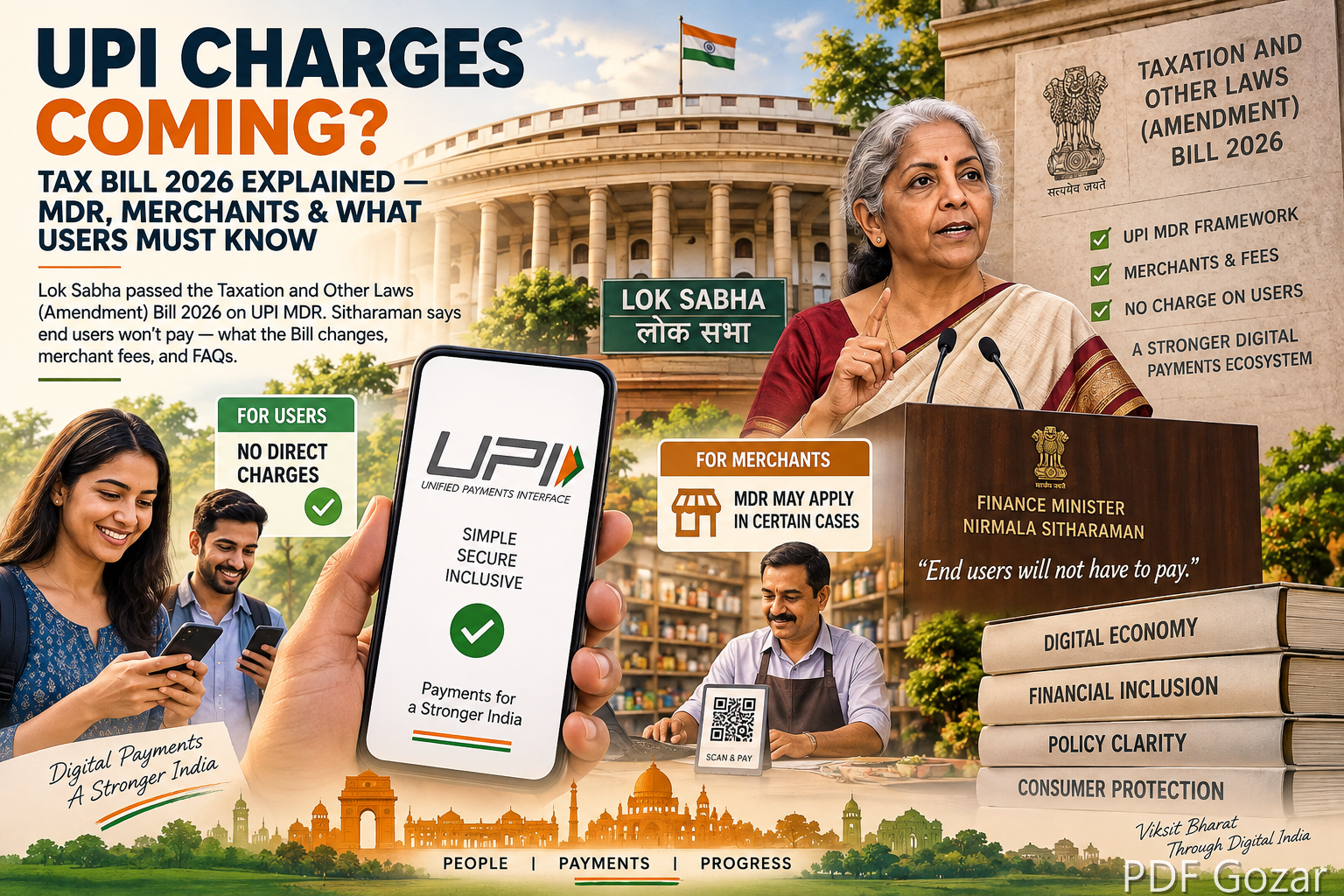
UPI Charges Coming? Tax Bill 2026 Explained — MDR, Merchants & What Users Must Know
Will you suddenly pay every time you scan a QR code? That fear exploded after Lok Sabha cleared the Taxation and Other Laws (Amendment) Bill, 2026. Finance Minister Nirmala Sitharaman has clarified: any Merchant Discount Rate (MDR) would apply to merchants, not end users.
Here is a plain-language guide to what the Bill does, what it does not do, and what to watch next.
The short answer#
| Question | Status (as of 7 Aug 2026) |
|---|---|
| Has Parliament opened the legal door to change zero-MDR rules? | Yes |
| Are UPI customer charges live today? | No automatic charge announced |
| Who would pay MDR if introduced? | Merchants, per FM clarification |
| Has NPCI fixed a fee rate? | Not yet — committee decision pending |
What the Bill actually changes#
The Bill amends the Payment and Settlement Systems Act, 2007 (notably the framework around Section 10A).
Since 2020, a statutory zero-MDR approach helped keep UPI/RuPay merchant acceptance free in the notified sense. The amendment removes that hard legal firewall and lets the government notify which electronic payment modes/transactions stay free.
Important: the Bill itself does not set a percentage fee. It restores power to decide later.
What is MDR in one minute?#
Merchant Discount Rate is a fee merchants pay to banks / payment providers for accepting digital payments.
- Customer pays ₹100 via UPI
- Merchant may receive slightly less if MDR applies (or absorb it in pricing)
- The fee funds rails, fraud controls, and payment infrastructure
It is not the same as a customer convenience fee shown on your phone — though critics worry merchants may raise prices to recover costs.
What Sitharaman clarified#
Responding to Congress leader Jairam Ramesh’s concern that ordinary people would ultimately pay, the Finance Minister said on X that:
- MDR applies only on merchants, not end users/customers
- It can help banks and fintechs invest in infrastructure, innovation and security
- The UPI and Services Steering Committee (NPCI-led) will examine MDR after the Bill’s parliamentary process
- No final MDR decision was announced in that clarification
Government sources in media coverage have also floated the idea that any future MDR may focus more on large merchants / high turnover businesses, while small-value and P2P flows stay protected — but that is policy discussion, not a notified rate card yet.
Why banks wanted this debate#
UPI volumes exploded. Rails are expensive to run at national scale:
- Settlement and uptime
- Fraud monitoring
- Customer support and dispute handling
- Constant product upgrades
Zero-MDR was great for adoption. Banks argue long-term sustainability needs a revenue model. The political fight is over who pays and whether prices quietly rise for consumers.
What this means for you#
If you are a customer / end user#
- Keep using UPI as usual for now
- Watch for app prompts about fees — report anything unclear to your bank
- Person-to-person transfers are the least likely first target in most policy talk
If you are a small shop / kirana#
- No automatic new MDR rate is live just because the Bill passed
- Ask your bank/acquirer what (if anything) changes after notifications
- Do not accept verbal “new government UPI tax” scare sales pitches
If you are a large merchant / marketplace#
- Model scenarios if MDR returns on UPI/RuPay
- Compare card MDR vs possible UPI MDR
- Track NPCI / MeitY / Finance Ministry notifications
RuPay and related modes#
Coverage of the Bill also ties the zero-MDR unwind to notified electronic modes linked with the broader digital-payments framework (including RuPay-related acceptance rules in the older zero-charge architecture). Treat UPI and RuPay discussions as linked policy, but wait for the exact notification text.
Other pieces in the same Bill (quick note)#
The same legislation package also eased certain conditions around data-centre / cloud tax-related rules, aimed at making India more flexible for large digital infrastructure. That is separate from your grocery QR scan — but it shows the Bill is a broader digital-economy amendment, not only a UPI headline.
Myth vs fact#
| Myth | Fact |
|---|---|
| “UPI will charge ₹5 per scan from tomorrow” | No such universal fee is notified |
| “Bill itself creates MDR rate” | Bill enables government power; rate comes later |
| “Customers must pay MDR” | FM says MDR is on merchants |
| “Small shops are already billed” | Watch notifications; don’t rely on rumours |
What to track next#
- Final parliamentary / assent status of the Bill
- NPCI UPI Services Steering Committee recommendations
- Government notification listing free vs chargeable modes
- Any turnover threshold for merchant MDR
- Consumer-protection statements if merchants pass costs into MRP
FAQ#
Will I have to pay to use UPI?#
As clarified by the Finance Minister, end users are not the MDR target. No customer fee schedule has been rolled out with the Bill itself.
Are merchant UPI charges starting immediately?#
No automatic nationwide MDR rate is live merely from Bill passage. A committee process and notifications come first.
What is the Taxation and Other Laws (Amendment) Bill, 2026?#
A Bill that, among other things, amends payment-law provisions so the government can modify the zero-MDR framework for notified electronic payments.
Can merchants raise prices if MDR returns?#
They might try to recover costs. That is an economic pass-through risk — different from a direct UPI “scan fee” on your phone.
Should I switch back to cash?#
No need based on current clarifications. Stay informed; keep UPI apps updated; verify any fee claim with your bank.
Conclusion#
The UPI charges debate is real — but the accurate story on 7 August 2026 is legal flexibility first, fee later (maybe). The Bill opens the door; Sitharaman says customers are not the MDR payer; NPCI’s committee still has to decide the framework. Until a notification lands, treat viral “UPI tax on every payment” posts as noise, not policy.