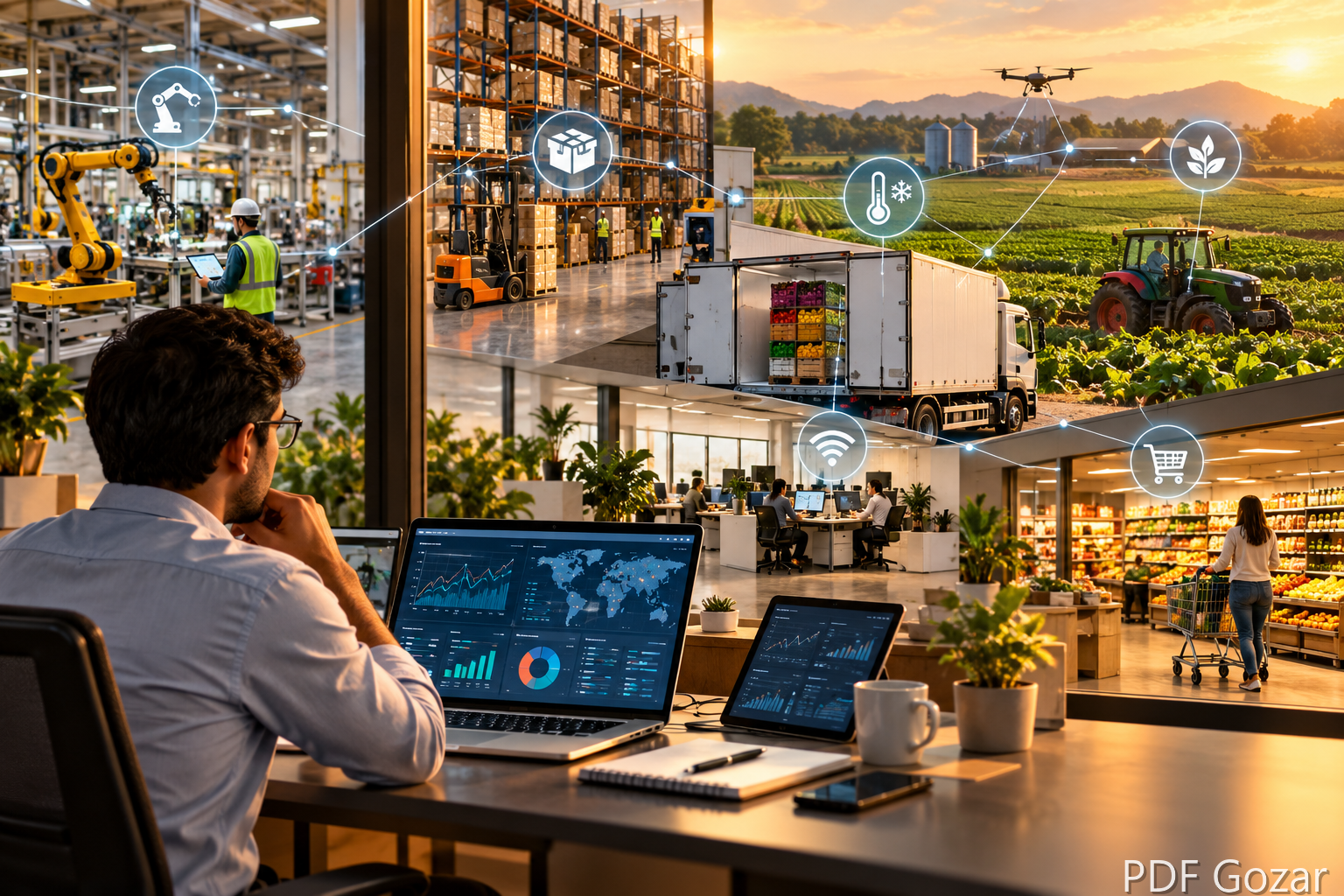
Internet of Things Examples in Business: Factories, Farms, and Stores
Business IoT is the same idea as a home sensor, pointed at money, safety, or waste. A machine reports vibration before a bearing fails. A pallet reports temperature so a grocery buyer can reject a warm shipment. A soil probe tells a farm when to irrigate a block instead of a whole field.
This article walks through examples that show up in U.S. operations, what they measure, and why many pilots stall. Household gadgets are covered in IoT examples at home. Public systems, clinics, and vehicles are in cities, health, and cars.
How a business deployment differs from a gadget#
A consumer device is allowed to be a convenience. A business device has to beat a cheaper alternative: a clipboard, a barcode scan, or a person walking the floor.
The pattern that works has a narrow question, a sensor that can answer it, and a person who changes a decision because of the answer. “Install IoT” is not a question. “Which compressors are running hot on second shift?” is.
You also inherit constraints a living room does not have. Radios struggle around metal racks. Workers will not babysit an app. A vendor outage can stop a line if you let the sensor become the only control. The sensor should inform a process that still has a manual fallback.
Warehouses and inventory#
Location is the classic warehouse example. Tags on pallets, bins, or high-value tools report where stock sits so pickers stop searching aisles. The radios vary. Barcodes and handheld scanners are still the backbone. Bluetooth or ultra-wideband tags help when items move without a scan. GPS is a poor fit indoors.
Other warehouse sensors earn their keep on conditions, not coordinates:
- Door and dock sensors that show a trailer left open
- Temperature and humidity in a storage zone
- People-counting or forklift alerts at blind corners
- Scales on packing lines that catch short shipments
Start with the loss you can name in dollars. Missing tools, spoiled goods, and mis-picks each justify a different sensor. A map of every bin looks impressive and often goes stale the week the process changes.
Factories and maintenance#
Industrial IoT usually means condition monitoring. Vibration, temperature, current draw, and oil quality on a motor or pump feed a model, or a simple threshold, that flags “look at this machine.” The goal is to schedule the repair before the failure, and to stop doing calendar maintenance on equipment that is still healthy.
This fails when the plant has no history to compare against, or when maintenance cannot get the part anyway. A sensor that says “bearing” on a Friday does nothing if the bearing is a six-week order. Pair the alert with a spare-parts rule.
Other factory examples are more direct:
- Vision cameras that reject a mislabeled bottle
- Energy submeters on one line so a plant can see which product run is expensive
- Environmental sensors for dust, gas, or heat in a work zone
- Tool-tracking cabinets that know which calibration is overdue
Keep safety systems on their own certified hardware. A wireless temperature sticker is not a replacement for an interlock that stops a press.
Cold chain and shipping#
Food, flowers, and many medicines have a temperature range. Loggers in a trailer or on a pallet record that range from dock to dock. If the record shows a spike, the receiver can refuse the load instead of discovering the problem in a cooler three days later.
Useful details are sampling rate, what happens when the logger is out of coverage, and who owns the data at delivery. A pretty graph that arrives after the customer has already accepted the freight is a report, not a control.
Shock and tilt sensors do the same job for fragile freight. Tilt is especially clear: a sensor that proves a crate was laid on its side is easier to argue than a dent nobody photographed.
Offices and job sites#
Commercial buildings already have controls for HVAC. IoT adds room-level occupancy, air quality, and leak detection so a 12-story office does not condition empty floors the same way all week. Desk sensors and badge data can support hybrid schedules. They also worry employees. Say what you collect, how long you keep it, and what you will not use it for. Surveillance dressed up as “space planning” gets resisted, and then the sensors get unplugged.
On a job site, the examples are tougher and more physical. Concrete maturity sensors estimate strength so a crew knows when a pour can take load. Equipment telematics show which machines are idling. Environmental sensors document dust or noise against a permit. These are records as much as they are gadgets. If the city or the owner asks for proof, you want the export, not a login to a vendor portal that may not exist in five years.
Farms and greenhouses#
Agriculture IoT is mostly water, weather, and animals.
Soil moisture probes and weather stations let an irrigator water a dry block and skip a block that got rain. Flow meters on pivots catch a broken line. In a greenhouse, sensors hold temperature, humidity, and light inside a band the crop needs.
Livestock examples include collars or ear tags that flag an animal that has stopped moving the way the herd moves, which can mean illness, and tank monitors that report when a water trough is low. Ranch connectivity is the hard part. If the field has no reliable signal, the design is a sensor that stores readings and uploads at the barn, not a live dashboard that pretends the pasture has broadband.
Do not buy a drone program and call it IoT. A drone is a camera flight. It becomes part of this stack only when the images feed the same irrigation or scouting decision as the probes.
Retail floors#
Stores use IoT in three ways shoppers rarely see.
Shelf sensors and camera counts estimate what is out of stock so staff refill before the aisle looks empty. Cameras and people counters estimate traffic by hour, which feeds staffing. Beacons and Wi-Fi analytics try to tie a phone to a visit. The third one is the weakest. Phone operating systems limit tracking, and a customer who feels followed does not become loyal.
Electronic shelf labels are a cleaner example. The tag on the rail shows the current price from the point-of-sale system, so a promotion does not depend on someone swapping paper. That is a connected object with one job and a clear fallback: staff can still read a price.
Cold cases in a grocery store repeat the cold-chain idea at a smaller scale. A case that warms up overnight should alert a manager before the health inspector or a customer does.
Why projects stall#
The sensor is rarely the expensive part. The stall usually looks like this:
- Nobody owns the alert, so it lands in an inbox and dies.
- The network was an afterthought, and half the tags never check in.
- Data sits in a vendor portal that does not export.
- The crew was not in the room when the threshold was set, so they ignore it.
Write the decision first. “If dock three stays above 45°F for 20 minutes, the shift lead moves the product and logs a refusal.” Then buy the sensor that can support that sentence.
Keep the proof in files you control#
Vendors change dashboards. Auditors and insurers ask for documents. Export calibration certificates, installation photos, temperature logs, and the one-page rule for who answers an alert. Turn phone photos of an install into a single file with JPG to PDF if you need a packet. Merge PDFs when a customer wants the logger report and the bill of lading together. Compress the PDF when a portal rejects a large upload.
Name files by site, asset, and date. “Compressor-4-vibration-2026-10.pdf” is findable. “export (3).pdf” is not.
FAQ#
Is a barcode scanner IoT?#
A scanner that only types a code into a screen is ordinary data capture. It becomes part of an IoT setup when the label, the dock sensor, and the temperature logger all feed one view of the same shipment.
Do small businesses need this?#
A two-truck florist can use a temperature logger and a door sensor. A machine shop can meter one expensive tool. You do not need a platform team to run one or two questions.
What is the first metric to track?#
Count false alarms and missed events for 30 days. A system that cries wolf will be muted. A system that stays silent during a real excursion is not installed yet.
How is this different from regular IT?#
IT networks move files and email. These projects add physical failure: water, forklifts, heat, and people who will not reboot a sensor mid-shift. The useful design assumes the radio will drop.
Where to go next#
Choose one loss you can price, put a sensor on it, and write down who acts. Expand only after that loop works without the vendor on the phone.
Home setups are simpler versions of the same loop in IoT examples at home. City streets, clinics, and vehicles raise different privacy and safety issues in IoT examples in cities, health, and cars.