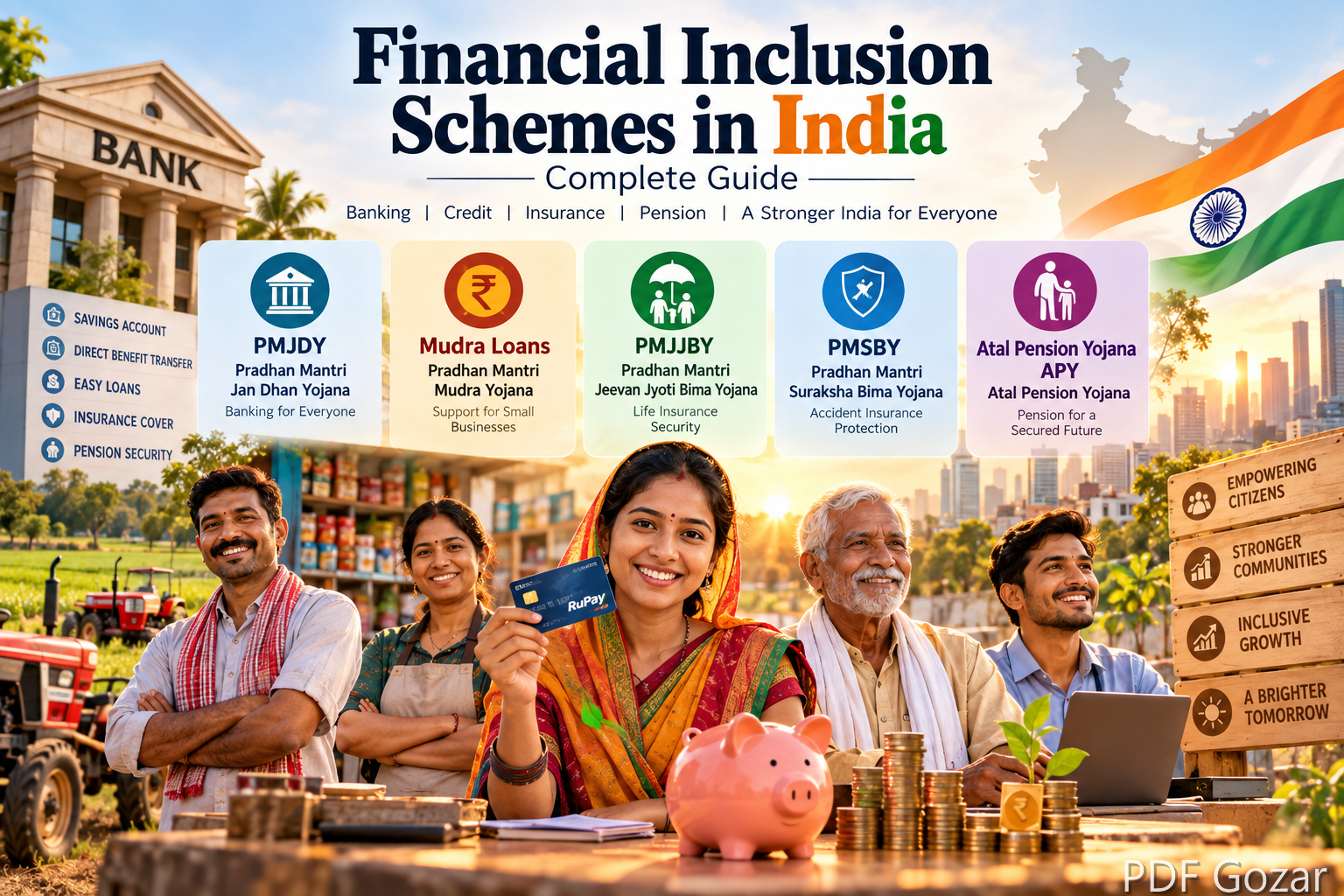
Nearly 1.4 billion adults worldwide still do not have a bank account. They live entirely on cash, hide savings at home, and have zero access to credit during emergencies. India has made significant progress in changing this through financial inclusion schemes.
These schemes bring banking, insurance, and credit to people who were previously excluded from the formal financial system. Here is what you need to know.
What Is Financial Inclusion?#
Financial inclusion means providing affordable financial services to all citizens, especially the underserved. This includes:
- Basic banking accounts with no minimum balance
- Access to credit and loans
- Insurance and pension products
- Digital payment systems
Key Government Schemes#
Pradhan Mantri Jan Dhan Yojana (PMJDY)#
Launched in 2014, PMJDY opened over 50 crore zero-balance bank accounts. It provides:
- Zero-balance savings account
- RuPay debit card for digital transactions
- Accidental insurance cover of Rs 2 lakh
- Overdraft facility of Rs 10,000
Pradhan Mantri Mudra Yojana (PMMY)#
Mudra provides loans up to Rs 10 lakh to small businesses without collateral. Three categories:
- Shishu — loans up to Rs 50,000
- Kishore — loans from Rs 50,000 to Rs 5 lakh
- Tarun — loans from Rs 5 lakh to Rs 10 lakh
Pradhan Mantri Jeevan Jyoti Bima Yojana (PMJJBY)#
Life insurance at just Rs 436 per year. Provides Rs 2 lakh cover to nominees in case of the subscriber’s death.
Pradhan Mantri Suraksha Bima Yojana (PMSBY)#
Accidental insurance at Rs 20 per year. Provides Rs 2 lakh cover for accidental death or permanent disability.
Atal Pension Yojana (APY)#
Pension scheme for unorganized sector workers. Guarantees minimum pension of Rs 1,000 to Rs 5,000 per month after age 60.
How Digital Technology Helps#
Technology has accelerated financial inclusion through:
- UPI payments — instant money transfers without bank visits
- Aadhaar-enabled services — biometric authentication for account access
- Business Correspondents — banking agents in remote villages
- Mobile banking apps — 24/7 access to financial services
Impact on Economy#
Financial inclusion drives economic growth by:
- Increasing savings rates among rural households
- Enabling small business growth through credit access
- Reducing dependency on informal moneylenders
- Direct benefit transfers reduce corruption
Challenges Remaining#
- Financial literacy gaps in rural areas
- Internet connectivity issues in remote regions
- Inactive accounts after initial registration
- Limited awareness of available schemes
Key Takeaways#
- PMJDY opened 50+ crore zero-balance bank accounts
- Mudra loans support small businesses without collateral
- PMJJBY and PMSBY provide affordable insurance
- UPI and Aadhaar have accelerated digital financial access
- Financial inclusion boosts savings, credit access, and economic growth
Have you opened a Jan Dhan account? Visit your nearest bank branch with Aadhaar and PAN to open a zero-balance account today. Start your financial journey now.