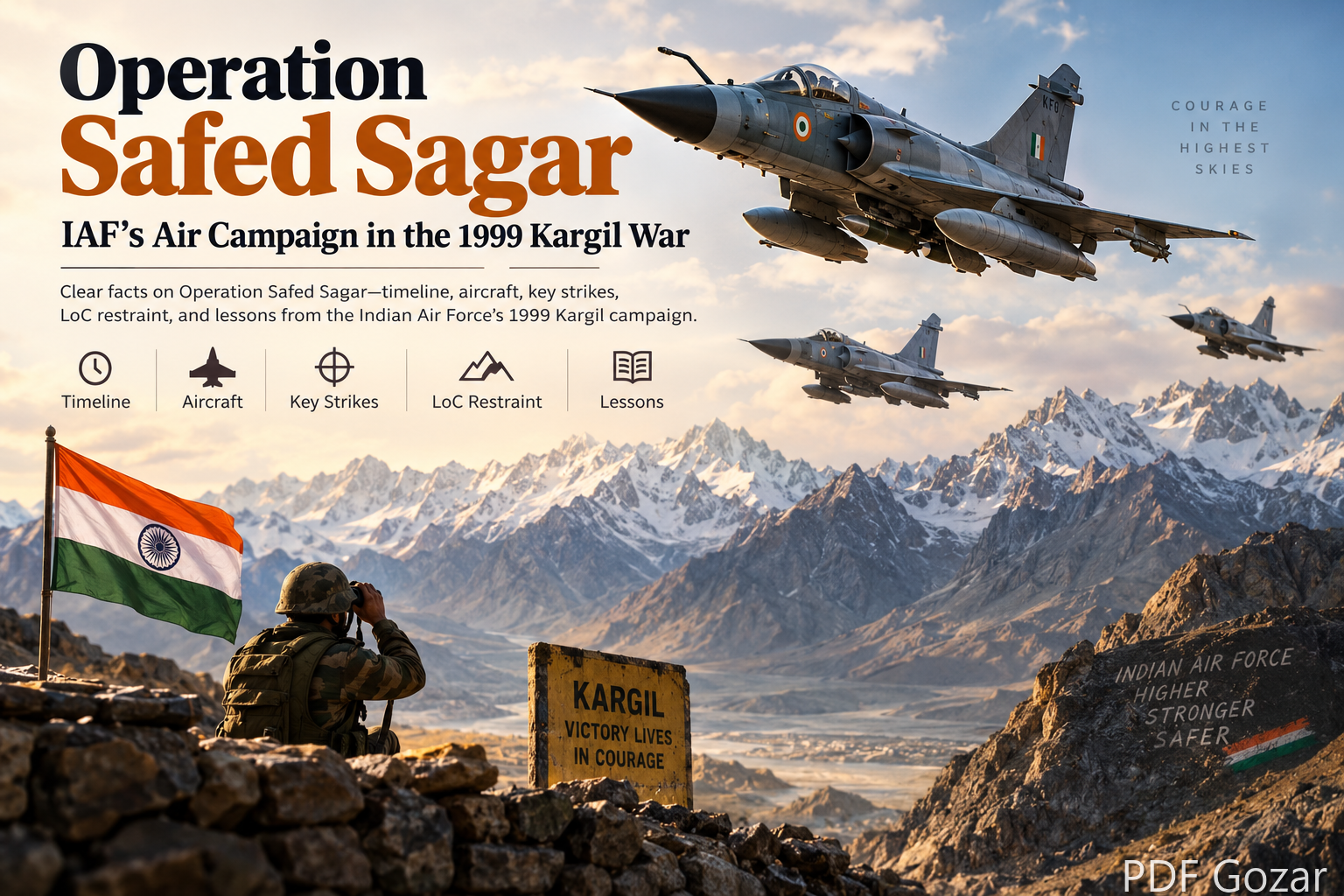
Operation Safed Sagar: IAF’s Air Campaign in the 1999 Kargil War
Operation Safed Sagar was the Indian Air Force code name for air operations during the 1999 Kargil War. While the Army fought under Operation Vijay, the IAF flew strikes, reconnaissance, and logistics missions over some of the highest combat terrain in modern warfare. The name means “White Ocean,” after the snow-covered Himalayan ridges of the Kargil sector.
This guide covers what the operation was, why air power was needed, how the campaign unfolded, which aircraft flew, and what lasting lessons it left for India’s defence planning. It is useful for general readers and for UPSC or defence exam revision.
Background: Why Kargil Needed Air Power#
In early 1999, Pakistani troops and irregulars occupied vacant Indian posts along the Line of Control (LoC) in the Kargil sector. The aim was to threaten the Srinagar–Leh highway (NH-1), isolate Ladakh, and pressure India’s hold near the Siachen Glacier. India responded with a large Army mobilisation under Operation Vijay.
Artillery helped in some sectors, but many intruder positions sat on steep, high ridges that ground troops could reach only at great cost. The government therefore cleared limited use of air power on 25 May 1999. One rule was non-negotiable: IAF aircraft must not cross the LoC. That restraint reduced the risk of a wider war between two nuclear-armed states.
Safed Sagar became the first large-scale use of air power in Jammu and Kashmir since the 1971 war. It was also a first for high-altitude mountain air combat at this intensity—targets often sat well above 15,000 feet, in thin air, with snow and rock that made bunkers hard to spot.
Timeline of Operation Safed Sagar#
Before the first strike#
From early May, the IAF flew photo and electronic reconnaissance. On 21 May, a Canberra PR57 on a recon mission was hit by a shoulder-fired missile but returned safely to Srinagar. From about 11 May, the force also airlifted troops, ammunition, and stores into the sector while crews practised high-altitude attack profiles.
Combat begins: 26 May 1999#
At first light on 26 May, MiG-21, MiG-23, and MiG-27 fighters began striking camps, dumps, and supply routes overlooking Dras, Kargil, and Batalik. Bases such as Srinagar, Awantipora, and Adampur supported the effort. Srinagar airport was closed to civilian traffic for military use.
Early losses and a change of tactics#
The first days were costly. On 26 May, Flight Lieutenant K. Nachiketa’s MiG-27 was hit; he ejected and was captured (later released). On 27 May, Squadron Leader Ajay Ahuja’s MiG-21 was shot down and he was killed. On 28 May, an Mi-17 helicopter was downed near Tololing with the loss of all four crew. After that, attack helicopters were pulled from offensive roles because of the MANPADS (shoulder-fired missile) threat.
Daylight low-level strafing proved too risky. The IAF shifted to higher release altitudes, better targeting data, GPS-aided bombing, and—later—laser-guided bombs with targeting pods.
Precision phase: June–July 1999#
Mirage 2000s entered the fight from late May and became the most effective strike platform in the thin air. Fitted with Litening pods and a small number of laser-guided bombs, they hit Tiger Hill, Muntho Dhalo, and other key points. Jaguars also joined with precision kits. By mid-June, melting snow exposed camouflaged positions and opened them to continuous day and night attacks.
Air strikes on dumps and bunkers cut enemy logistics and morale. Combined with Army assaults, India restored the pre-war LoC status by late July 1999.
Aircraft and Roles#
Safed Sagar was not only fighter jets. A large share of sorties were transport and helicopter flights that kept the Army supplied.
Combat and strike
- MiG-21 — widely used for strikes, photo recon, and even lofted bombing; also night CAS methods were refined mid-campaign
- MiG-23 / MiG-27 — heavy bomb and rocket load for high-value targets in Batalik, Dras, Mashkoh, and Muntho Dhalo
- Mirage 2000 — precision strikes with pods and LGBs; two squadrons flew hundreds of sorties with high availability
- Jaguar — photo recon and guided weapons later in the campaign
- MiG-29 — combat air patrol and escort with beyond-visual-range missiles
Reconnaissance and support
- Canberra and MiG-25 — high-altitude imagery and intelligence
- Transports — troop and stores airlift into the theatre
- Mi-17 / Cheetah — logistics; Cheetahs also helped as airborne forward air control platforms after offensive gunship use was curtailed
Across roughly 50 days, published IAF figures put total sorties in the several thousands (often cited near 5,000–7,800 depending on how categories are counted). Transport and helicopter effort made up the majority; combat aircraft flew air strikes, CAP/escort, and reconnaissance.
Key Battles and Strike Targets#
Tololing and Point 5140#
Early helicopter and fighter action around Tololing showed both the value and the danger of close air support in MANPADS-rich terrain. After the Mi-17 loss, tactics shifted toward safer release profiles while the Army pressed the ground fight.
Muntho Dhalo#
Muntho Dhalo was a major Pakistani supply camp. Mirage and MiG strikes devastated stores and structures there, weakening the logistics chain that fed posts across the sector.
Tiger Hill and Dras–Mashkoh#
Tiger Hill became a focus of Mirage and other strike packages. Laser-guided bombs were used sparingly—only about nine LGBs in the entire war—because dumb bombs guided by good pods and coordinates proved effective. Hits on bunkers and a battalion headquarters disrupted command links. Night attacks also helped locate and silence artillery positions that threatened NH-1.
The LoC red line#
Every strike stayed on the Indian side of the LoC. That political decision shaped tactics: lucrative targets across the line were off-limits. The Pakistan Air Force did not mount attacks across the LoC either, which left the IAF freer to operate within Indian airspace—but still under missile and altitude constraints.
Challenges of High-Altitude Air War#
Operating over Kargil tested machines and crews in unusual ways:
- Thin air reduced engine thrust, bomb trajectories, and helicopter lift
- Narrow valleys limited attack directions and escape routes
- Camouflage — black rock and white snow hid bunkers; from a cockpit at high speed, a gun position looked like a speck
- MANPADS forced higher flight profiles after early losses
- Targeting was weak at first; Army coordinates improved as the campaign matured
- Weapons — some older bombs needed fuse improvisation until precision kits and pods arrived
These limits explain why Safed Sagar is studied worldwide as a case of mountain air power, not a conventional deep-strike war.
Strategic Outcome and Legacy#
Safed Sagar did not win Kargil alone—the Army’s infantry and artillery did the final eviction—but air power shortened the conflict and cut enemy supply and morale. India’s restraint in not crossing the LoC earned international notice, while Pakistan faced diplomatic isolation as the intrusion was exposed as a state-backed operation rather than freelancing militants.
Lessons fed into later modernisation: stronger joint Army–IAF targeting, more precision munitions, better sensors and night capability, and accelerated fighter and weapons programmes in the 2000s. For students of strategy, the operation shows how limited, carefully controlled air power can support limited war aims without opening a full theatre war.
Quick Facts for Revision#
- Code name: Operation Safed Sagar (IAF); Army: Operation Vijay
- Meaning: White Ocean
- Offensive air start: 26 May 1999
- Political clearance: 25 May 1999; no LoC crossing
- Theatre: Kargil / Dras / Batalik / Mashkoh (then J&K, now partly Ladakh)
- Notable losses: Nachiketa (captured), Ahuja (killed), Mi-17 crew of four (killed)
- Standout platform: Mirage 2000 with Litening pods and limited LGBs
- End state: Occupied Indian positions cleared; LoC restored by late July 1999
Frequently Asked Questions#
What was Operation Safed Sagar?#
It was the Indian Air Force’s air campaign in the 1999 Kargil War, supporting the Army’s Operation Vijay to remove Pakistani intruders from Indian territory along the LoC.
Why was the IAF not allowed to cross the LoC?#
The government wanted to avoid escalation with a nuclear-armed neighbour. Strikes were limited to intruder positions and supply nodes on the Indian side of the LoC.
Which aircraft played the biggest role?#
MiG-21/23/27 fleets flew many early and mid-campaign sorties. Mirage 2000s delivered the most effective precision strikes. Transports and helicopters carried a large share of total sorties for logistics.
How is Safed Sagar different from Operation Vijay?#
Operation Vijay was the overall Indian Army operation on the ground. Operation Safed Sagar was the IAF’s air component of the same conflict.
Why is it important for UPSC and defence exams?#
It sits at the intersection of military history, limited war, nuclear deterrence, civil-military decision-making, and technology (high-altitude ops, precision weapons). Questions often ask for timeline, LoC restraint, and lessons for joint operations.
Conclusion#
Operation Safed Sagar proved that air power can shape a limited mountain war—if politics, tactics, and technology stay aligned. The IAF adapted after early losses, moved to safer high-altitude profiles and precision attacks, and helped choke the intruders’ logistics while staying inside the LoC. For anyone studying the Kargil War, remember the pairing: Operation Vijay on the ground, Operation Safed Sagar in the air, and a clear political ceiling that kept the conflict from spreading. Use the timeline, aircraft list, and FAQs above as a compact revision sheet before exams or for a quick refresh of this chapter of India’s military history.