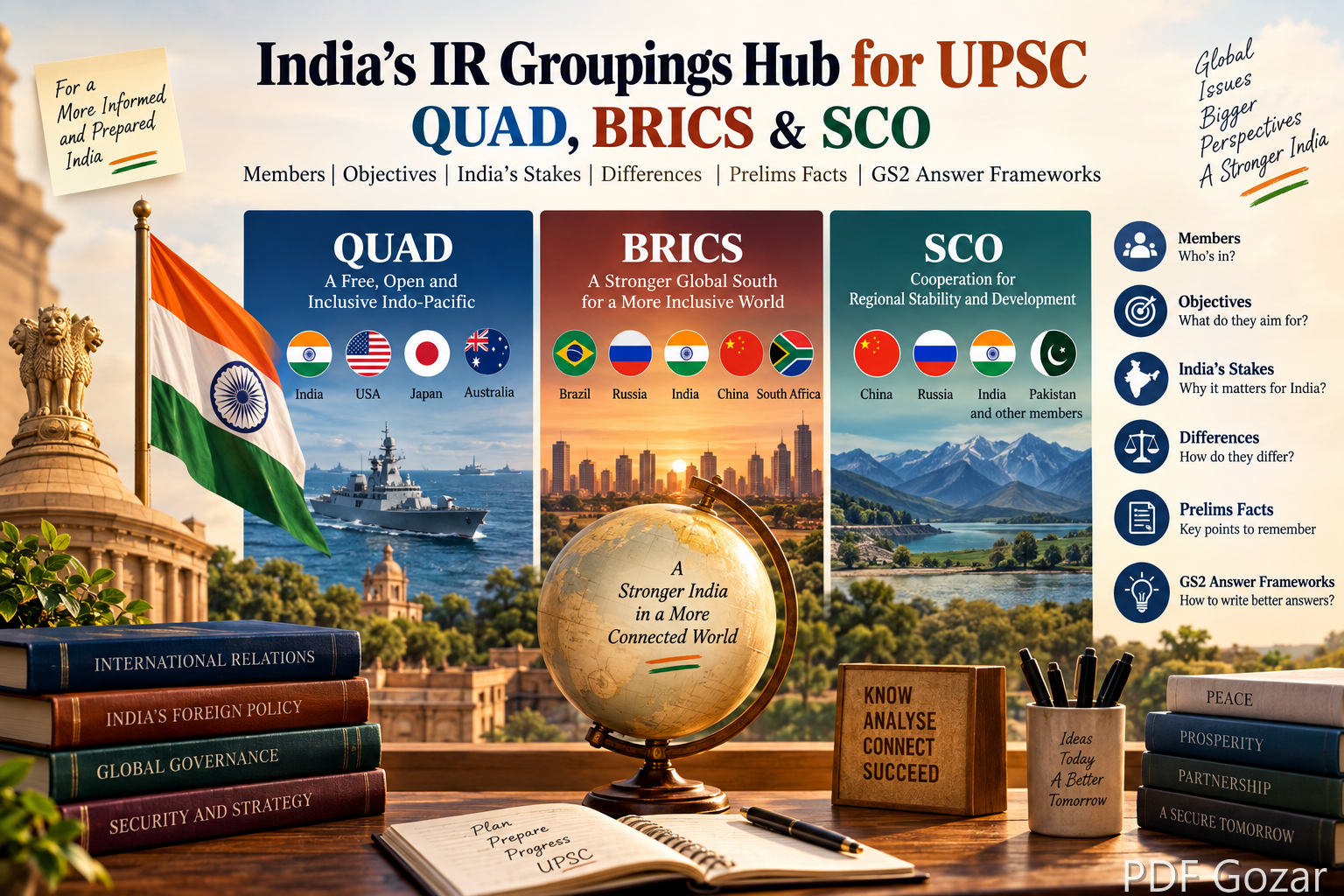
India’s IR Groupings Hub for UPSC: QUAD, BRICS & SCO#
UPSC does not ask you to memorise summit logos. It asks whether you understand why India sits in different clubs at the same time. QUAD, BRICS, and SCO look contradictory on the surface—one is Indo-Pacific and maritime, one is Global South/economic-political, one is Eurasian security-connectivity. For India, they are tools of multi-alignment.
This hub gives you members, purpose, India’s interests, friction points, and answer frameworks for Prelims and GS2. Use it with GS2 strategy, S&T for dual-use themes, and related posts like QUAD collaboration and India–China in BRICS.
Why These Three Matter Together#
| Grouping | Core geography | Main flavour | India’s broad aim |
|---|---|---|---|
| QUAD | Indo-Pacific | Strategic + public goods | Balance, maritime security, resilient supply chains |
| BRICS | Global / emerging economies | Economic-political voice | Multipolarity, Global South agency, finance alternatives |
| SCO | Eurasia | Security + connectivity | Continental stability, terror, Central Asia access |
India’s doctrine is not “pick a camp.” It is strategic autonomy: engage where interests match, disagree where they do not.
QUAD (Quadrilateral Security Dialogue)#
Members#
India, United States, Japan, Australia.
What it is#
An informal strategic grouping focused on a free, open, and inclusive Indo-Pacific. It is not a NATO-like mutual defence treaty. Cooperation spans maritime domain awareness, HADR (humanitarian assistance and disaster relief), critical technologies, health security, infrastructure quality, and climate/ocean initiatives.
Why it emerged#
Shared concerns about rules-based order, sea-lane security, coercion risks, and supply-chain resilience in the Indo-Pacific. For background evolution and working themes, see enhancing QUAD collaboration.
India’s stakes#
- Secure Indian Ocean and wider Indo-Pacific commons
- Technology and quality infrastructure partnerships
- Diversify dependence in critical minerals, semiconductors, and digital standards
- Keep ASEAN centrality and avoid being seen as a pure military bloc
India’s caution points#
- Avoid automatic entanglement in great-power conflict
- Maintain space for Russia/China diplomacy where needed
- Keep QUAD practical (vaccines, maritime info, capacity building), not only rhetoric
Prelims hooks#
- Four members
- Informal nature (not a formal alliance treaty)
- Indo-Pacific focus
- Malabar naval exercise often discussed in the same strategic conversation (related, not identical to QUAD membership history)
BRICS#
Members (core idea + expansion awareness)#
Original: Brazil, Russia, India, China, South Africa.
Later expansion added more emerging economies (keep the latest official member list updated from current affairs each year).
What it is#
A plurilateral platform of major emerging economies seeking greater voice in global governance, development finance, and multipolar order. Key institutions include the New Development Bank (NDB) and the Contingent Reserve Arrangement (CRA) concept for financial safety nets.
India’s stakes#
- Reform of international financial institutions
- South–South cooperation and development finance
- Space to engage China and Russia in a multilateral setting
- Voice for Global South priorities (energy, food, climate finance)
Friction India must manage#
- China–India boundary and influence competition (India–China BRICS angle)
- Consensus culture vs competing agendas
- Debates on de-dollarisation: India is interested in payment resilience, not ideological rupture
- Expansion politics: more members can mean more voice and more dilution
Prelims hooks#
- Full form and founding members
- NDB purpose
- Difference from G7 (emerging economies platform vs advanced economies club)
- Summit outcomes from the latest year (finance, membership, declarations)
SCO (Shanghai Cooperation Organisation)#
Nature#
A Eurasian regional organisation with stronger institutional form than QUAD. Focus areas include counter-terrorism, extremism, separatism (“three evils”), regional security, connectivity, and economic cooperation.
India’s place#
India is a full member. SCO gives New Delhi a seat in continental Eurasia—Central Asia connectivity, counter-terror cooperation, and dialogue with Russia and China inside a regional body.
India’s stakes#
- Access and partnership with Central Asian states
- Counter-terror intelligence and capacity frameworks
- Balance China’s Belt and Road narrative with India’s own connectivity vision (Chabahar, INSTC, etc., as complementary themes)
- Keep Afghanistan-related security concerns on the table when relevant
Friction points#
- India–Pakistan presence dynamics inside the organisation
- BRI and connectivity projects India does not endorse
- Risk of organisation statements that dilute India’s concerns
- Need to prevent SCO from becoming only a China-centric agenda forum
Prelims hooks#
- Headquarters / institutional identity (as per standard notes)
- RATS (Regional Anti-Terrorist Structure) as a key SCO body
- Membership category awareness (members vs dialogue partners—update with CA)
- Contrast: SCO is Eurasia-continental; QUAD is Indo-Pacific-maritime
Comparison Capsule (High-Scoring Mains Table)#
| Point | QUAD | BRICS | SCO |
|---|---|---|---|
| Formality | Informal | Plurilateral forum + institutions | Formal regional organisation |
| Geography | Indo-Pacific | Global emerging powers | Eurasia |
| Hard security | Maritime cooperation, not treaty alliance | Limited | Stronger security mandate |
| Economy/finance | Supply chains, infra quality | NDB, payment/finance debates | Connectivity + economic track |
| China factor | Strategic balancing context | Partner + competitor inside | Partner + competitor inside |
| India’s style | Issue-based Indo-Pacific partnership | Multipolar economic-political voice | Continental security-connectivity |
Memorise this table. It wins both Prelims elimination and GS2 structure.
How India Uses Multi-Alignment (GS2 Core Argument)#
- Threats are multi-vector: maritime Indo-Pacific and continental Eurasia both matter.
- Partners are issue-based: tech with one set, energy/defence legacy with another, Global South voice with a third.
- Autonomy is the constant: no exclusive camp; flexible engagement.
- Public goods diplomacy: vaccines, disaster response, connectivity, and climate raise legitimacy.
- Domestic capacity decides external options: manufacturing, defence indigenisation, and digital public infrastructure strengthen bargaining power.
This is the “why India is in all three” thesis for almost any IR groupings question.
Answer Framework for GS2#
Intro: In a multipolar world, India practises multi-alignment through complementary groupings rather than bloc politics.
Body:
- QUAD: Indo-Pacific public goods + strategic balance
- BRICS: Global governance reform + development finance
- SCO: Eurasian security and Central Asia
- Challenges: China factor, consensus limits, narrative management
- Way forward: issue-based coalitions, ASEAN centrality, stronger domestic capabilities
Conclusion: Strategic autonomy is not isolation; it is calibrated engagement across theatres.
Use diagrams: a simple Venn or three-column table. Follow the Mains answer writing framework for timing and structure.
Prelims Practice Logic#
Expect questions like:
- Which countries are in QUAD but not BRICS?
- Which body is associated with SCO counter-terror work?
- Which statement about NDB is correct?
- Informal vs formal organisation distinctions
Train with statement-splitting. When confused, return to geography + purpose + formality.
Current Affairs Tracker (Weekly 20 Minutes)#
For each summit/news item, note:
- Host / year
- 3 outcomes
- India’s specific gain
- One unresolved tension
Tag news as QUAD / BRICS / SCO / Plus (I2U2, IPEF, ASEAN, G20). Do not create separate thick notes for every mini-initiative; park “plus” items under a fourth page titled Other minilaterals.
Common Mistakes#
- Calling QUAD a formal military alliance
- Treating BRICS as only an anti-West bloc
- Ignoring SCO’s counter-terror institutional track
- Writing India–China conflict into every paragraph with no cooperation examples
- Forgetting to update expansion memberships from latest CA
FAQ#
Is QUAD anti-China by definition?#
It is shaped by Indo-Pacific balance concerns, but India’s preferred language emphasises rules, inclusivity, and public goods—not a named enemy alliance.
Can BRICS and QUAD memberships clash?#
They create narrative tension, not a legal clash. India manages both through issue separation and strategic autonomy.
Is SCO useful despite India–China strains?#
Yes, as a dialogue and counter-terror platform with Central Asia. Utility depends on agenda shaping, not wishlist harmony.
Should I also prepare I2U2 and AUKUS?#
Yes at awareness level. AUKUS is not an India grouping; I2U2 is a useful minilateral for West Asia economic-tech themes. Keep them secondary to this hub.
Next Step#
Make a one-page sheet with the comparison table + 5 India interests per grouping + latest summit bullets. Revise it before every IR mock. Then write one 15-mark answer: “India’s engagement with QUAD, BRICS and SCO reflects multi-alignment, not confusion.” Link preparation back to your UPSC roadmap so IR stays a weekly habit, not a pre-Mains scramble.