What Is a Dirty Bomb? The Complete Guide
Science | Threat Context | Preparedness | Iran–Washington, D.C. Reporting
At a Glance#
What is it? A conventional explosive packaged with radioactive material — technically a radiological dispersal device (RDD).
Is it a nuclear weapon? No. No fission/fusion, no mushroom cloud, cannot destroy a city.
Main danger Local contamination, cleanup cost, evacuation, and widespread fear — not mass radiation deaths.
Best label: A "weapon of mass disruption," not mass destruction.
⚠️ Iran–D.C. reporting (November 2026): CNN reported that U.S. intelligence detected Iranian planning discussions to potentially target senior Trump administration officials with a dirty bomb or chemical weapon in Washington, D.C. U.S. officials characterized the planning as exploratory, not imminent. Iran denies the report. No operational device has been publicly confirmed.
1. What Is a Dirty Bomb?#
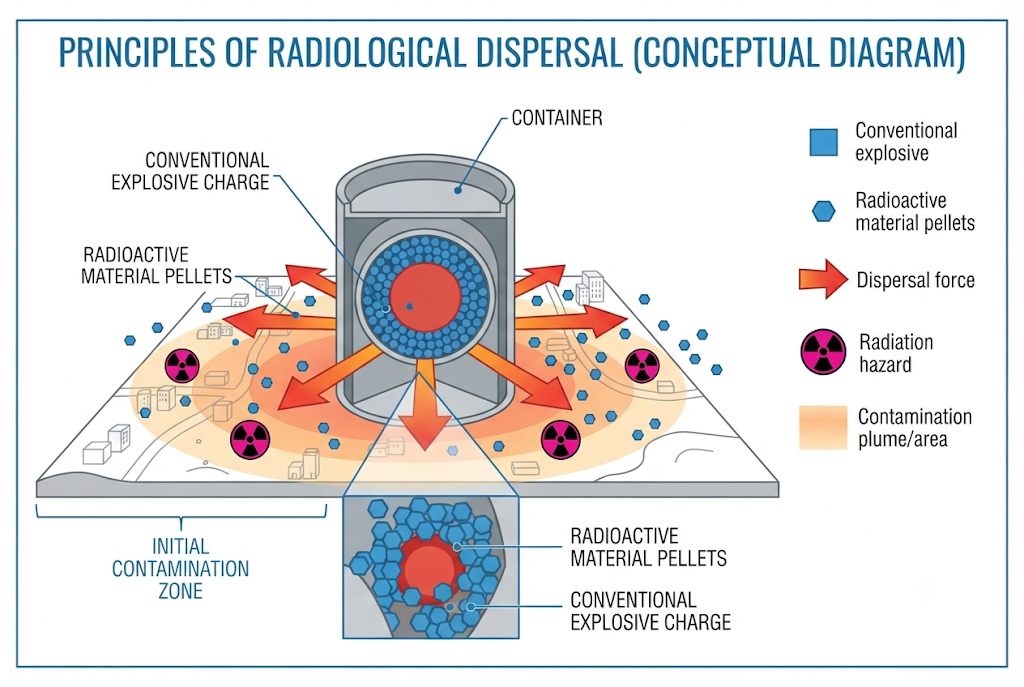
A dirty bomb — formally a radiological dispersal device (RDD) — combines two things:
- A conventional explosive (dynamite, TNT, or similar), and
- Radioactive material (from medical, industrial, or research sources).
When the explosive detonates, it scatters radioactive dust or particles over the surrounding area. Unlike an atomic bomb, there is no nuclear chain reaction. A dirty bomb cannot become a nuclear explosion no matter how much radioactive material is packed into it.
---
2. Anatomy of a Dirty Bomb#
Four elements determine what an RDD actually does:
| Component | Role |
|---|---|
| Conventional explosive | Provides the force that spreads the material; primary cause of injuries and deaths |
| Radioactive source | The material dispersed (e.g., cesium-137, cobalt-60) |
| Dispersal mechanism | How material is mixed with or placed around the explosive |
| Container / shielding | Affects how much material is released and how easily detected beforehand |
More radioactive material does not make the blast bigger — it only increases the size of the potentially contaminated area. A tiny conventional charge with a large source may contaminate more ground than a huge charge with a small source.
3. Radioactive Materials That Could Be Used#
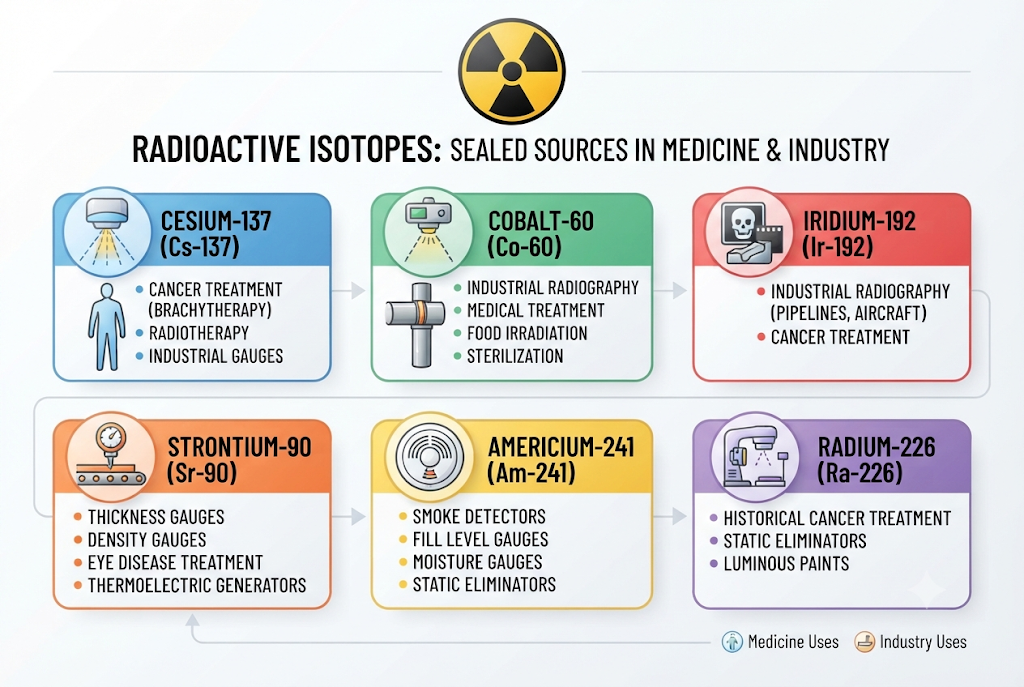
RDD material does not need to be weapons-grade uranium or plutonium. It comes from legitimate medical, industrial, and research sources.
| Isotope | Common legitimate uses | Typical hazard |
|---|---|---|
| Cesium-137 | Cancer treatment, industrial gauges, food irradiation | High gamma exposure; water-soluble |
| Cobalt-60 | Cancer radiotherapy, sterilizing medical equipment | Strong gamma emitter |
| Iridium-192 | Industrial radiography (pipeline/weld inspection) | High activity in small packages |
| Strontium-90 | Radioisotope thermoelectric generators (RTGs) | Beta emitter; bone-seeking |
| Americium-241 | Smoke detectors, industrial gauges | Low external hazard; dangerous if inhaled/ingested |
| Radium-226 | Older medical sources, luminous paint | Long-lived alpha/gamma emitter |
These sources are regulated (NRC in the U.S.; IAEA Code of Conduct internationally), but thousands exist in hospitals, factories, and universities worldwide — so security experts focus on source protection as much as bomb-making.
4. How the Radiation Actually Spreads#
After detonation, danger depends on physics:
- Particle size: Fine powder spreads farther and is more easily inhaled; larger chunks fall nearby.
- Weather: Wind speed/direction determine where fallout lands; rain can wash material into soil and water.
- Terrain: Buildings can shield or trap radiation; urban canyons change dispersal patterns.
- Distance & time: Radiation intensity drops sharply with distance and decays over time.
Contamination typically spans a few blocks to a few miles — not a state or country. Highest radiation is at the blast site and drops off quickly.
5. Dirty Bomb vs. Nuclear Weapon — A Critical Distinction#
Public fear often conflates the two, but they are fundamentally different.
| Dirty Bomb (RDD) | Nuclear Weapon | |
|---|---|---|
| Energy source | Conventional chemical explosives | Nuclear fission / fusion |
| Blast power | Limited to the conventional charge | City-leveling destructive force |
| Radiation released | Dispersal of existing radioactive material | Intense prompt radiation + widespread fallout |
| Primary effect | Local contamination, panic, economic disruption | Mass destruction and mass casualties |
| Classification | Weapon of mass disruption | Weapon of mass destruction |
| Can it become a nuclear explosion? | No | N/A — that is its design |
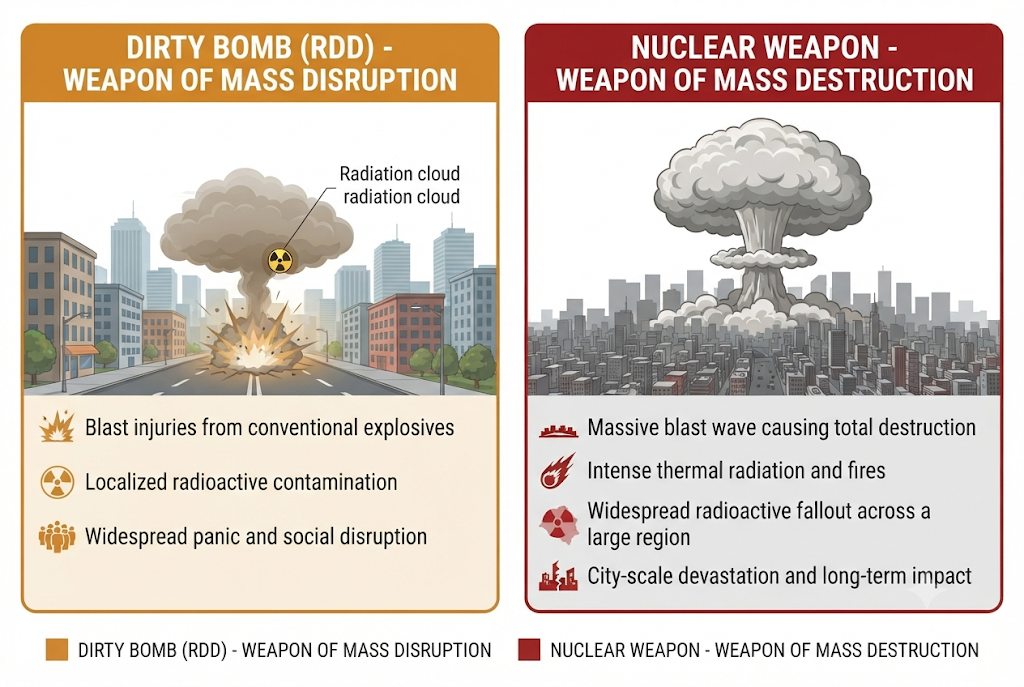
Experts generally agree a dirty bomb is unlikely to kill large numbers through radiation alone. Its greatest impact is psychological and economic: fear, evacuation, decontamination costs, and long-term disruption.
6. Health Effects and Radiation Dose#
Risk depends on dose, distance, and exposure route:
| Exposure route | Risk level | Notes |
|---|---|---|
| External exposure (standing near the cloud) | Lower risk | Unless very close for a long time |
| Inhalation / ingestion of particles | More serious | Source stays inside the body |
| Acute Radiation Syndrome (ARS) | Very high dose only | Close to the source; unlikely for bystanders several blocks away |
| Long-term cancer risk | Elevated at high doses | Hard to attribute at low levels |
| Psychological harm | Near-certain | Anxiety, fear, disruption even with minimal physical harm |
Guiding principle: time, distance, shielding — limit time near the source, maximize distance, put solid material between yourself and radiation.
7. History: Attempts and Incidents#
There has never been a confirmed dirty-bomb attack causing mass casualties, but the concept has appeared repeatedly:
📜 1990s: Chechen rebels reportedly claimed to have a dirty bomb; Russian authorities found a cesium-137 source in Moscow (1995) and defused a device linked to Chechen militants (1996).
Iraq (1980s–1990s): Saddam Hussein's program reportedly explored radiological weapons.
Al-Qaeda: reportedly experimented with RDD concepts; arrests involved individuals seeking radioactive material.
Various plots: Multiple foiled attempts worldwide involved people seeking or selling radioactive sources; few approached a functional device.
Building a crude RDD is technically easier than a nuclear bomb — but still non-trivial, and obtaining enough high-activity material without detection is difficult.
8. Detection, Security, and Prevention#
Countermeasures focus on securing the source, not just the bomb:
Radiation monitoring Portal monitors at ports, borders, and major venues.
Source security Locking up and tracking medical/industrial radioactive sources (NRC in the U.S.; IAEA Code of Conduct internationally).
Interdiction Intelligence and law-enforcement efforts to track illicit trafficking of radioactive material.
Reduced-use alternatives Hospitals replacing high-activity sources with lower-risk alternatives (e.g., X-ray instead of cesium irradiators).
9. Emergency Response: What to Do#
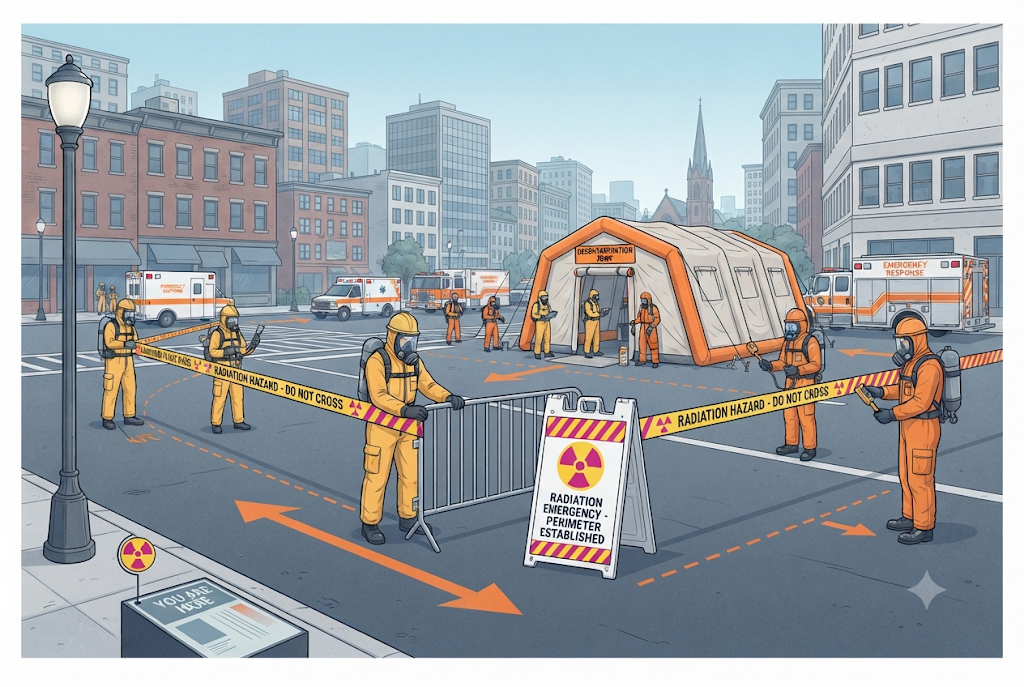
Official U.S. guidance (DHS, CDC, EPA) for a radiological incident:
- Get away from the blast site — move upwind if you can see the cloud.
- Go indoors — shelter in a central room or basement; close windows and vents.
- Stay tuned to official emergency alerts (radio, TV, mobile alerts).
- Follow instructions — evacuate only if told to; do not self-evacuate into a contaminated zone.
- Decontaminate carefully — remove outer clothing, seal it in a bag, shower with soap and water if instructed; do not scrub harshly.
- Seek medical screening if you were near the blast or think you inhaled dust.
Personal Preparedness Checklist#
🎒 Before an incident
- Know your local emergency alert systems (Wireless Emergency Alerts, local radio/TV).
- Keep a basic emergency kit: water, non-perishable food, flashlight, batteries, first-aid supplies, medications, copies of important documents.
- Identify shelter locations at home, work, and school (interior rooms, basements, away from windows).
- Make a family communication plan (where to meet, out-of-area contact).
🚨 During an incident
- Move away from the blast; go indoors immediately.
- Close windows, doors, and ventilation; turn off fans/AC drawing outside air.
- Listen for official instructions; do not panic-evacuate unless directed.
- If outdoors near the blast, remove outer clothing carefully, seal it in a plastic bag, shower with soap and water.
✅ After an incident
- Follow public-health guidance on food, water, and shelter safety.
- Seek medical screening if you may have inhaled radioactive dust or have symptoms.
- Do not return to evacuated areas until authorities declare them safe.
- Document property damage for insurance; keep records of any exposure screening.
10. The Reported Iran–Washington, D.C. Plot (November 2026)#
In mid-November 2026, CNN reported — citing seven U.S. officials — that American intelligence had detected Iranian planning to potentially target senior Trump administration officials with a dirty bomb or a chemical weapon in Washington, D.C.
What the reporting said#
- U.S. intelligence intercepted what officials described as "very specific" discussions, including locations and targets.
- The planning is characterized as exploratory — an effort to give Iran options — not evidence that an attack is imminent.
- No operational dirty bomb has been publicly confirmed; the reports describe planning discussions, not acquisition or deployment.
Responses#
- Iran denied the report, calling it fabricated.
- President Donald Trump said the administration takes the reports "very seriously."
- National security commentators cautioned that threat reporting often represents one possible scenario among many, and that intelligence assessments can change.
⚠️ How to read this: Treat specific claims about an imminent Iranian dirty-bomb attack in D.C. as unverified unless confirmed by official U.S. government statements. The reporting itself emphasizes that planning does not equal an imminent attack.
11. Is Iran Going to Attack the U.S.?#
This is one of the most searched questions tied to the dirty-bomb reporting. The honest answer: nobody outside the intelligence community knows for certain, and public reporting points in different directions.
What suggests heightened risk#
Adversarial relationship The U.S. and Iran have been in conflict for decades over Iran's nuclear program, regional influence, U.S. sanctions, and the targeted killing of Iranian officials (such as Qassem Soleimani in 2020).
Reported planning The November 2026 CNN reporting indicates Iran has at least discussed options for striking U.S. officials on American soil.
Proxy capabilities Iran has supported militant groups and proxies across the Middle East with demonstrated reach.
What suggests restraint#
No confirmed device Public reporting describes planning discussions, not a built or deployed dirty bomb.
Exploratory, not imminent U.S. officials characterized the plotting as an effort to keep options open.
Deterrence A radiological attack on U.S. soil, especially in Washington, D.C., would risk massive U.S. retaliation and could unify international opinion against Iran.
Denials Iran has rejected the reporting as fabrication.
Bottom line#
The threat environment is serious, but serious does not mean imminent. Intelligence agencies track many potential scenarios; most never materialize. For the public, the safest approach is to follow official guidance from DHS, the FBI, and state/local emergency management, and to treat unverified social-media claims with skepticism.
12. Myth vs. Fact#
| Myth | Fact |
|---|---|
| "A dirty bomb is a small nuclear bomb." | False — no nuclear reaction; cannot produce a nuclear explosion. |
| "It would kill everyone in a city." | False — casualties would likely come from the conventional blast; radiation effects are localized. |
| "It's easy to build from stolen nuclear warheads." | False — it uses industrial/medical radioactive sources, not warhead material. |
| "Radiation from it lasts forever." | False — most isotopes decay over time; contamination can be cleaned up. |
| "You can see or smell radiation." | False — radiation is undetectable without instruments; that's why monitors matter. |
| "Iran has already built a dirty bomb for D.C." | Unverified — reporting describes planning discussions, not a confirmed device. |
13. Recent "Dirty Bomb News" Timeline#
| Date | Development |
|---|---|
| November 2026 | CNN reports U.S. intelligence detected Iranian planning discussions for a dirty bomb or chemical attack targeting officials in Washington, D.C. Iran denies the report; Trump says administration takes it "very seriously." |
| 2022 | Russia raises dirty-bomb allegations in the context of the war in Ukraine; Western officials and the IAEA reject the claims after inspections find no evidence. |
| Ongoing | U.S. and international agencies continue securing radioactive medical/industrial sources and monitoring for illicit trafficking. |
14. Bottom Line#
A dirty bomb is a real but limited-threat weapon: a conventional bomb paired with radioactive material that can contaminate a localized area, frighten a population, and impose large cleanup and economic costs — but it cannot replicate the destruction of a nuclear weapon.
Recent reporting suggesting Iran has discussed dirty-bomb plots targeting officials in Washington, D.C. has been denied by Tehran and described by U.S. officials as exploratory planning rather than an imminent attack. As with any developing national-security story, rely on official government statements and established news outlets rather than unverified social-media claims.
Sources#
- U.S. Nuclear Regulatory Commission — "Backgrounder on Dirty Bombs"
- U.S. Department of Homeland Security — Radiological Attack fact sheet
- Council on Foreign Relations — "Dirty Bombs" backgrounder
- Environmental Protection Agency — Radionuclide basics and dirty-bomb guidance
- CDC — Radiation emergency guidance (shelter, decontamination)
- IAEA — Code of Conduct on the Safety and Security of Radioactive Sources
- CNN reporting on U.S. intelligence and Iran (November 2026)
- Al Jazeera / The New York Times explainers on radiological dispersal devices
Figure Library#
| Figure | Section | Image File |
|---|---|---|
| FIGURE 1 | Section 2 | /images/blog/dirty-bomb-diagram.png |
| FIGURE 2 | Section 3 | /images/blog/dirty-bomb-radioactive-sources.png |
| FIGURE 3 | Section 9 | /images/blog/dirty-bomb-radiation-response.png |
| FIGURE 4 | Section 5 | /images/blog/dirty-bomb-vs-nuclear.png |
All four figures have been generated and saved in the public/images/blog/ directory.