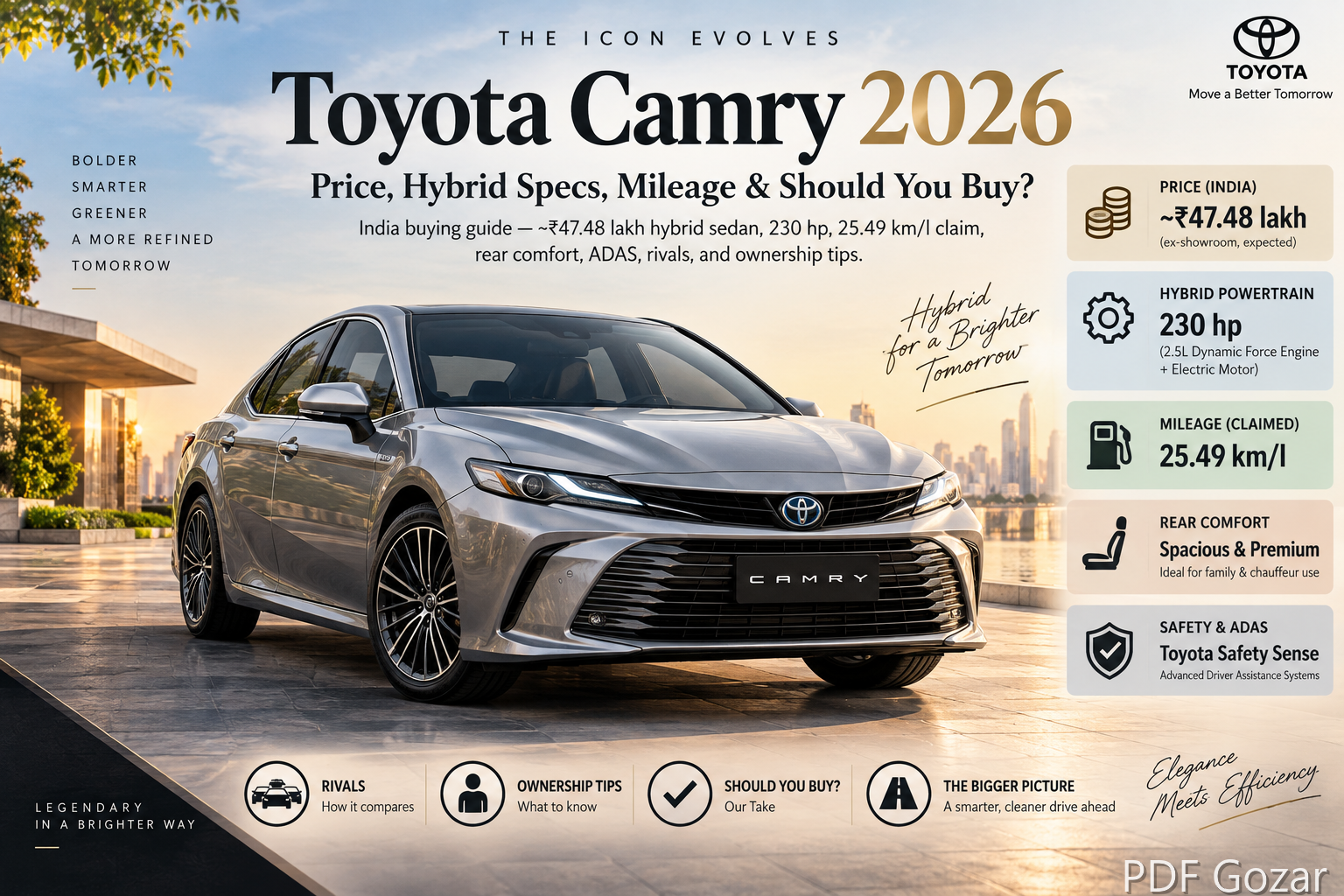
Toyota Camry 2026: Price, Hybrid Specs, Mileage & Should You Buy?
The Toyota Camry is the premium executive sedan many Indian buyers still shortlist when they want quiet hybrid efficiency, rear-seat comfort, and Toyota reliability — without stepping fully into a badge-led luxury showroom.
This guide covers Camry 2026 price, the strong-hybrid powertrain, real ownership mileage, features that matter for chauffeur use, how it stacks against entry luxury sedans, and the mistakes to avoid before you book.
Camry ex-showroom price in 2026#
Recent listings place the India Camry around:
| Item | Approx. figure |
|---|---|
| Ex-showroom (Elegant / Sprint Edition) | ~₹47.48 lakh |
| On-road (metros such as Mumbai) | ~₹55–57 lakh+ |
Toyota sells the Camry as a fully loaded hybrid — there is no long petrol-only ladder and no stripped base trim to “save” on. Elegant and Sprint Edition sit at the same price band; the difference is mostly styling accents (chrome-led elegance vs sportier black / Sprint graphics), not a big feature gap.
Always ask for a city-specific on-road breakup with zero forced accessories. At this price, insurance, RTO, and dealer packs move the cheque more than brochure fine print.
Strong hybrid powertrain — what you actually get#
India gets one powertrain: Toyota’s 2.5-litre petrol + electric motor strong hybrid with an e-CVT, front-wheel drive.
| Spec | Approx. figure |
|---|---|
| Engine | 2487 cc Atkinson-cycle petrol |
| Combined system output | ~230 hp |
| Peak engine torque | ~221 Nm |
| Gearbox | e-CVT (multi-step feel) |
| Claimed mileage (ARAI) | 25.49 km/l |
| Fuel tank | ~50 litres |
| Kerb weight | ~1645 kg |
How it drives day to day#
Low-speed city work is the Camry’s comfort zone. The electric motor covers a lot of crawling traffic, so the cabin stays quiet and fuel use stays sensible. Transitions between petrol and electric are smooth when you drive calmly.
Push hard and you will hear the petrol engine and feel the familiar e-CVT “rubber band” effect — this is not a sport sedan. Think effortless overtakes and composed cruising, not redline thrills. Autocar-style instrumented figures put 0–100 km/h in the ~8-second neighbourhood, which is more than enough for Indian highways when driven with passengers and luggage.
Drive tip: spend part of the test drive in Eco and Normal with the AC on full, then a short Sport burst. That tells you whether the power delivery matches your chauffeur (or self-drive) style.
Real-world mileage vs the brochure#
ARAI’s 25.49 km/l is a lab number. Independent real-world tests often land closer to:
| Use case | Rough expectation |
|---|---|
| Dense city | Mid-teens km/l |
| Highway cruise | Low-to-mid 20s km/l |
| Mixed with AC | Between those bands |
Even at “real” city figures, the hybrid usually beats a large petrol luxury sedan on monthly fuel. That is a big part of the Camry pitch in India: premium comfort with running costs closer to a sensible executive car than a thirsty V6 of the past.
If your month is mostly short trips with a cold engine, do not expect brochure efficiency. Long daily stretches in traffic with gentle throttle reward the hybrid system most.
Cabin, space, and chauffeur-focused kit#
Camry buyers in India often sit in the back. Toyota designs around that:
- Long wheelbase feel and adult-friendly rear knee room
- Power-reclining rear seats on the loaded India pack
- Rear armrest with touch controls on higher equipment lists
- Rear sunshades for heat and privacy
- Soft-touch cabin with dual 12.3-inch screens (infotainment + digital cluster) on the current generation
- JBL multi-speaker audio, wireless Apple CarPlay / Android Auto, wireless charging, panoramic sunroof, HUD, and ambient lighting on the fully loaded India car
Boot space is in the ~500+ litre class — usable for airport runs and weekend bags without folding seats every time. Confirm spare-tyre packaging and boot floor height in person if you carry golf bags or large suitcases weekly.
Ride quality is tuned for Indian roads more than for canyon carving. Steering is light for parking; enthusiasts may want more feel, but most executive buyers will not miss it.
Safety and ADAS#
The current Camry’s India safety story is strong on paper:
- Multiple airbags (commonly listed as nine on the current generation)
- ESC, traction control, hill assist, TPMS
- 360° / panoramic view camera
- Toyota Safety Sense–style Level 2 ADAS: adaptive cruise, lane support, pre-collision alerts, blind-spot monitoring, auto high beam, and related assists
Treat ADAS as a highway helper, not autopilot. On Indian roads, the 360° camera and clear mirrors often deliver more weekly value than every ADAS toggle. Still, for long expressway runs with a chauffeur, adaptive cruise and blind-spot alerts are genuine stress reducers.
Also note: Toyota has issued camera-related service campaigns on some Camry cars — ask the dealer to confirm any open recall or software update before delivery.
Who the Camry is for#
| Buyer type | Fit |
|---|---|
| Chauffeur-driven executive | Strong — rear comfort is the product |
| Self-drive hybrid enthusiast | Strong — if you want quiet efficiency over sport |
| Badge-focused luxury shopper | Weaker — C-Class / 3 Series / A4 may win on brand prestige |
| Family needing three rows | Weak — look at Innova Hycross / Fortuner instead |
| Fleet / high annual km sedan | Strong — hybrid running costs help |
Camry vs rivals#
True segment twins are thin after the Superb / Passat era. Cross-shop by budget and use case, not by identical body style alone.
| Alternative | Why people compare |
|---|---|
| Mercedes-Benz C-Class | Badge, dealer experience, sharper cabin theatre |
| BMW 3 Series LWB | Rear space + drive feel; petrol thirst vs Camry hybrid |
| Audi A4 | Similar money in many quotes; different brand pull |
| Toyota Innova Hycross | Same hybrid logic, more people / luggage flexibility |
| Lexus ES (if available in your city) | Closest spiritual twin, usually pricier |
Camry usually wins on hybrid efficiency + Toyota service calm. Luxury badges win on showroom status and some interior drama. Decide which of those you will still care about in year three.
Ownership costs beyond the invoice#
Budget for more than the on-road cheque:
- Premium fuel where specified
- Periodic hybrid system checks at authorised Toyota workshops
- Tyres on large alloys — more expensive than compact-SUV rubber
- Insurance — shop outside the dealer at renewal
- Extended warranty if you plan long ownership or high km
Toyota’s service network and residual strength are real ownership advantages. Ask for a 3–5 year service package quote before you negotiate the car — it softens later surprises.
Hybrid batteries are designed for the life of the car under normal use; follow Toyota’s cooling / parking guidance in extreme heat and avoid cutting corners on scheduled service.
Buying checklist#
- Confirm exact pack name in writing (Elegant vs Sprint Edition)
- City-specific ex-showroom from the current price list
- Itemised on-road with zero accessories first
- Demo of rear recline, sunshades, and dual-zone climate from the back seat
- ADAS + 360° camera demo on a real road, not only in the showroom
- Delivery month and colour availability in writing
- Open recall / software campaign check on the VIN before handover
Mistakes to avoid#
- Buying Camry only for the badge fight with BMW / Mercedes without driving all three
- Expecting sports-car responses from an e-CVT hybrid
- Skipping a rear-seat test with your usual chauffeur height and posture
- Accepting a bundled “special on-road” without unbundling insurance and accessories
FAQ#
What is the Toyota Camry price in India in 2026?#
Ex-showroom is commonly around ₹47.48 lakh for the fully loaded hybrid. On-road in large cities often lands in the mid-₹50 lakh range once tax and insurance stack up.
Is the Camry only available as a hybrid?#
Yes in India — strong hybrid + e-CVT only. There is no pure petrol Camry on the current India price list.
What mileage can I expect?#
Brochure claim is 25.49 km/l. Real city figures are lower; highway runs get closer to the mid-20s for calm drivers. Your right foot and traffic density matter more than the brochure.
Camry Elegant vs Sprint Edition — which one?#
Same money band and same core kit in most quotes. Pick Elegant for a cleaner chrome-led look, Sprint if you want darker / sportier accents. Feature differences are small — choose on styling.
Is Camry better than a C-Class or 3 Series?#
Different products. Camry wins on hybrid running costs and calm reliability. German rivals win on badge theatre and, in many cases, sharper drive feel. Test all with the same budget week.
Conclusion#
The Toyota Camry 2026 remains the sensible premium sedan for buyers who value rear comfort, strong-hybrid efficiency, and Toyota ownership peace more than a star on the grille. At roughly ₹47.48 lakh ex-showroom you get one well-equipped hybrid — so the decision is less about variants and more about whether this mission beats an entry luxury badge or a hybrid MPV. Sit in the back, drive the hybrid in your real traffic, then negotiate a clean on-road breakup. That order beats chasing the flashiest rival on the showroom floor.