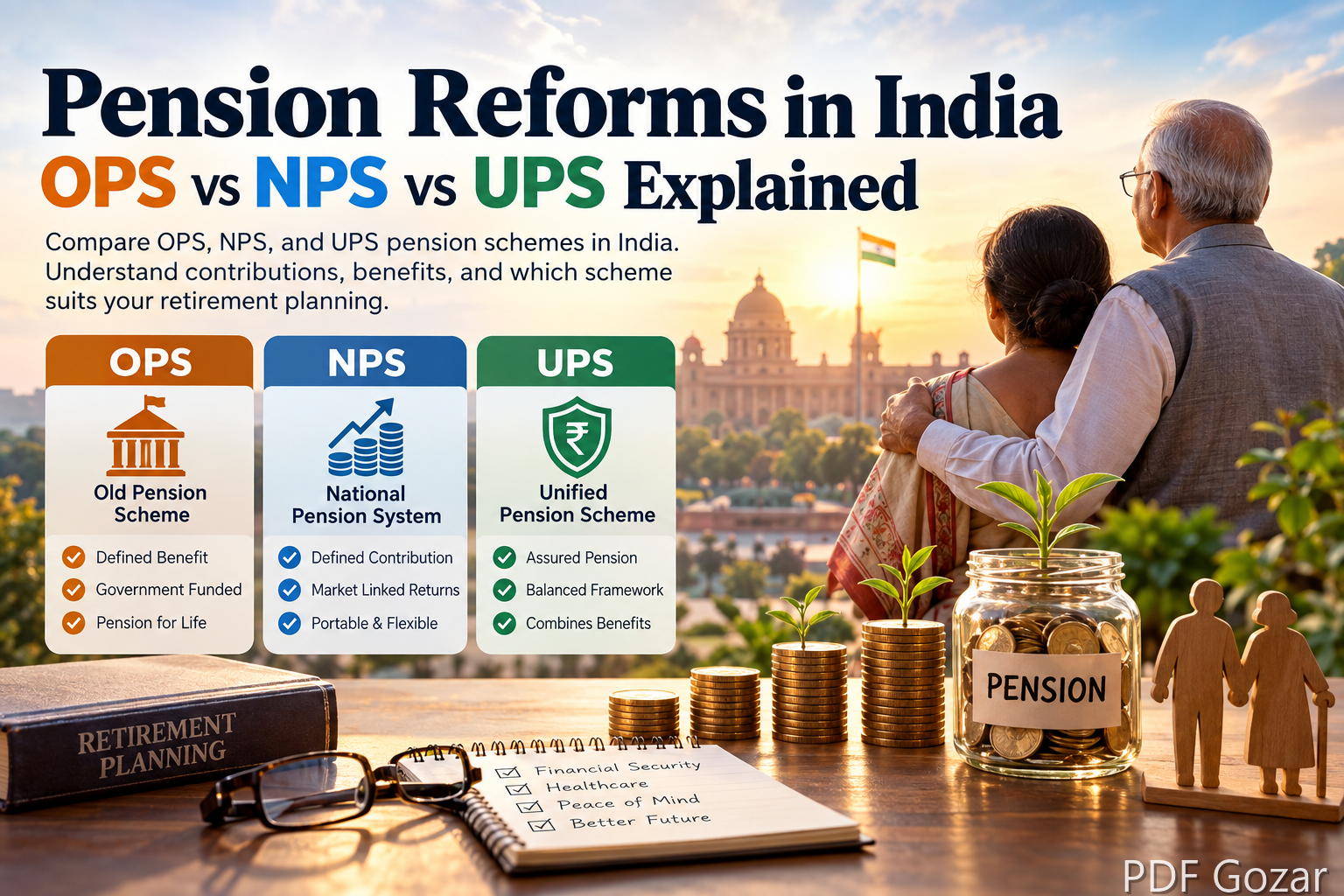
By 2050, India will have over 340 million elderly citizens. That is more than the entire population of the United States needing financial support without a monthly paycheck. Understanding pension schemes is no longer optional.
India has shifted from guaranteed pensions to market-linked systems. Let’s break down the three main pension models and what they mean for your retirement.
Old Pension Scheme (OPS)#
The OPS was the original government pension system. It guaranteed 50% of the last drawn salary as monthly pension after retirement.
Key features:
- Defined benefit — fixed pension amount
- Government bore all costs
- No employee contribution required
- Inflation adjustment through DA revisions
OPS was discontinued in 2004 due to its massive fiscal burden on the government.
National Pension System (NPS)#
NPS replaced OPS in 2004. It is a market-linked, defined-contribution scheme where both employee and government contribute.
How NPS works:
- Employee contributes 10% of basic salary
- Government contributes 14% of basic salary
- Money is invested in equity, bonds, and government securities
- Pension depends on market performance
NPS offers tax benefits under Section 80C and additional 80CCD(1B) deductions.
Unified Pension Scheme (UPS)#
UPS was approved in 2024 as a middle path between OPS and NPS. It offers assured pension benefits with some market linkage.
UPS features:
- Assured pension of 50% of average basic salary
- Minimum 25 years of service required
- Government guarantees the pension amount
- Employee contributes 10%, government contributes 18.5%
OPS vs NPS vs UPS: Quick Comparison#
- Pension amount — OPS: 50% fixed / NPS: Market-dependent / UPS: 50% assured
- Employee contribution — OPS: 0% / NPS: 10% / UPS: 10%
- Government contribution — OPS: 100% / NPS: 14% / UPS: 18.5%
- Market risk — OPS: None / NPS: High / UPS: Partial
- Fiscal impact — OPS: Unsustainable / NPS: Low / UPS: Moderate
Which Pension Scheme Is Best for You?#
If you are a government employee joining after 2004, NPS is mandatory. UPS is available for those who opt in. Private sector employees can also join NPS for retirement savings.
Key Takeaways#
- OPS guaranteed 50% of last salary but was discontinued in 2004
- NPS is market-linked with employee and government contributions
- UPS offers assured 50% pension with government guarantee
- NPS offers tax benefits under Section 80C and 80CCD(1B)
- Choose based on risk appetite and retirement goals
Planning for retirement? Start investing in NPS or PPF today. The earlier you start, the more your money grows through compounding.