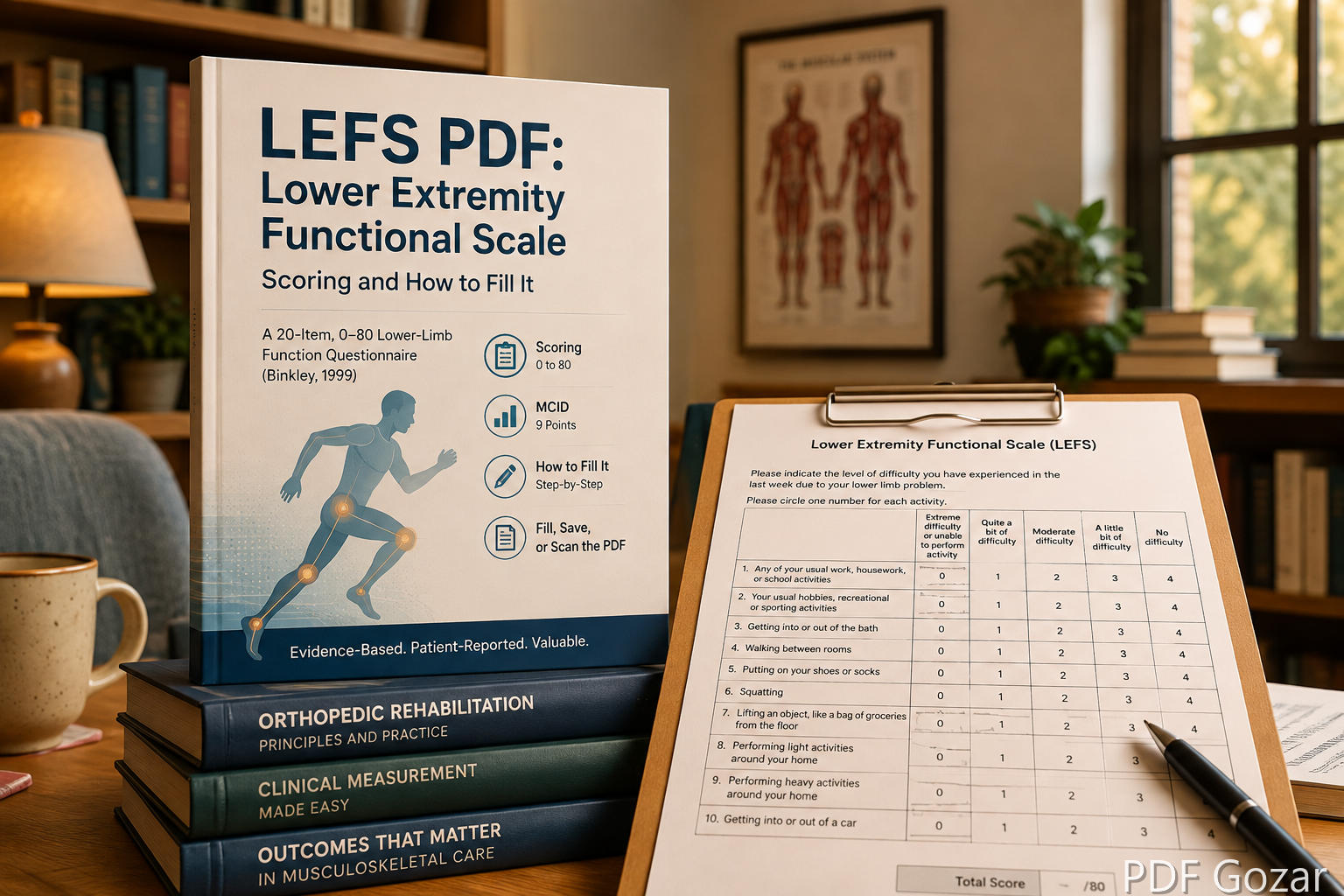
LEFS PDF: Lower Extremity Functional Scale Scoring and How to Fill It
LEFS PDF almost always means the Lower Extremity Functional Scale: a 20-question form physical therapists use for hip, thigh, knee, leg, ankle, or foot problems. You rate everyday tasks from “extreme difficulty / unable” to “no difficulty.” The total is 0 to 80. Higher is better function.
This page explains what the form is, how scoring and the 9-point change threshold work, and how to print, fill, or scan a PDF for a clinic portal. It is not medical advice and not a substitute for your PT, physician, or the official instrument.
What the LEFS is#
Jill Binkley, Paul Stratford, Sheryl Lott, and Daniel Riddle published the scale in Physical Therapy in April 1999 (North American Orthopaedic Rehabilitation Research Network). They wanted a region-specific questionnaire for lower-limb musculoskeletal conditions that was short enough for clinic use and sensitive to change.
It is a patient-rated outcome measure (PROM). You fill it; the clinician scores and tracks it. Typical moments:
- First visit (baseline)
- Re-eval or a set number of visits later
- Discharge
- After surgery (for example hip or knee arthroplasty follow-up, where later papers also studied the scale)
The LEFS is not an X-ray and not a diagnosis. A score of 52 does not name a torn ligament. It describes how hard daily movement feels right now.
Official reprints are widely posted by U.S. hospital systems and rehab sites, usually with the 1999 citation. Use a clinic-issued PDF or a source that credits Binkley et al. Do not treat a random blog screenshot as the scoring authority.
How scoring works#
Each of the 20 items uses the same five boxes:
| Points | Meaning (standard LEFS wording, summarized) |
|---|---|
| 0 | Extreme difficulty or unable to perform |
| 1 | Quite a bit of difficulty |
| 2 | Moderate difficulty |
| 3 | A little bit of difficulty |
| 4 | No difficulty |
Add the 20 numbers. Maximum 80. Minimum 0.
Clinics also report percent of maximal function:
(LEFS score ÷ 80) × 100
Example: 56 / 80 = 70%.
Lower score = more limitation. That is the opposite of some pain scales (where higher pain is worse). If you mix LEFS with a 0–10 pain rating, keep the directions straight.
The original paper reported strong test–retest reliability (about 0.94) and better sensitivity to change than the SF-36 physical function subscale in that sample. Potential error at a single time point was on the order of ±5 scale points. Those figures are from the 1999 development study (n = 107 patients with mixed lower-extremity conditions). Your clinic may cite later papers for a specific surgery or age group.
What a 9-point change means#
Two numbers show up on almost every LEFS PDF footer:
- Minimal detectable change (MDC): 9 points
- Minimal clinically important difference (MCID): 9 points (Binkley et al., 1999)
In plain language: a shift of more than 9 points is the usual bar for “this is a real, meaningful change,” not just day-to-day noise. Later work (for example Abbott & Schmitt, 2014, on a large lower-extremity sample) reported higher MCIDs when patients said they were “moderately” or “quite a bit” better (on the order of 12 and 16 points). Your PT may use 9 as the classic cutoff or a context-specific number.
A 4-point bump from visit 1 to visit 2 is not a failure. It may be inside measurement error. A 12-point gain is the kind of change clinics write into goals.
What the 20 items cover (without reprinting the form)#
The questions move from easier indoor tasks to harder sport-like tasks. Categories include work or housework, hobbies, bathing, walking between rooms, shoes and socks, squatting, lifting, light vs heavy activities, car transfers, walking a couple of blocks vs a mile, stairs, standing or sitting for about an hour, running on even and uneven ground, sharp turns while running, hopping, and rolling over in bed.
You answer how you are today, including the involved leg. If an item is not part of your life (you never run), clinics still want an honest rating: unable, or not applicable per their instructions. Follow the printed directions on your PDF. Do not skip items unless the form says you may.
The scale was built for Western, English daily life. Translations exist; use the version your clinic issued.
LEFS vs other lower-limb questionnaires#
| Tool | Typical focus |
|---|---|
| LEFS | Whole lower extremity, mixed conditions, 20 items, 0–80 |
| KOOS | Knee (including sport and quality-of-life subscales) |
| HOOS | Hip |
| FAAM | Foot and ankle |
| WOMAC | Osteoarthritis (pain, stiffness, function) |
PTs pick based on body region and the question they need to answer. A knee-only sports clinic might prefer KOOS. A general outpatient clinic seeing ankle sprains and hip OA on the same day often likes one LEFS for everyone. You do not need to fill every acronym. Fill what you were given.
How to fill a LEFS PDF#
On paper in the waiting room#
- Read the header: rate today, one box per activity.
- Work top to bottom. Do not leave blanks if you can avoid it.
- If an activity hurts but you can still do it, that is usually “difficulty,” not automatic 0.
- Hand it back. Staff sum the columns.
On a fillable PDF at home#
- Open the clinic’s file in a browser or Acrobat.
- If the checkboxes work, click one per row.
- If it is a flat scan (no fields), print it, or mark boxes in Edit PDF with a shape or highlight, then type the total in a note if they asked you to self-score.
- Save a copy:
lefs-2026-08-17.pdf.
Portal uploads often cap file size. A phone photo of the page is a terrible LEFS. Use a scan or a real PDF.
Phone photo to PDF (if they insist you “just send a picture”)#
- Shoot the page square, full frame, no shadow across the boxes.
- Convert with JPG to PDF.
- If you also have a home exercise sheet, Merge PDF into one attachment.
- Compress PDF if the portal rejects a 15 MB scan. Use Print if staff must read small checkboxes; Email if the portal is strict.
How clinicians use the number#
Typical pattern:
- Baseline LEFS 38 after a lateral ankle sprain
- Goal language: increase LEFS by ≥9 in four weeks
- Re-test 50 → that meets the classic MCID
- Discharge 64 → closer to the “higher function” end of the 0–80 range
Some write-ups group 61–80 as limited-to-minimal limitation. Treat that as a rough band, not a pass/fail. Age, sport, and the other knee matter. A 70 that still cannot run on uneven ground may be a fine daily-life score and a poor return-to-sport score. The individual items tell the PT what to treat; the total tracks change.
Common LEFS PDF mistakes#
- Rating “on a good day” instead of today. The form is a snapshot.
- Leaving sport items blank because you are not training. Ask the clinic; many still want a 0 if you cannot do it.
- Comparing your 55 to a teammate’s 70. Compare your score to your last score.
- Calling a 6-point change a success or a failure. Check the 9-point MDC/MCID (or your PT’s preferred cutoff).
- Uploading a dark, cropped phone pic. Staff cannot score what they cannot see.
- Using an unlabeled internet form that dropped the 1999 citation or changed the 0–4 anchors.
FAQ#
What does LEFS stand for?#
Lower Extremity Functional Scale.
What is a good LEFS score?#
80 is no difficulty on all 20 items. There is no universal “normal” for every age and sport. Clinicians watch change of about 9 points more than a single number.
Who created the LEFS?#
Binkley, Stratford, Lott, and Riddle, Physical Therapy, 1999.
Can I download an official LEFS PDF here?#
We do not host the copyrighted questionnaire. Use the form your clinic, hospital, or a cited rehab source provides (the 1999 paper is the reference). Then print, mark, merge, or compress it with the tools above.
Is the LEFS only for knees?#
No. It is for lower extremity problems: hip through foot.
How often should I fill it out?#
Whenever your PT or surgeon asks — often evaluation, progress note, and discharge. Filling it daily on your own is optional and not required by the original scale.
Conclusion#
A LEFS PDF is a 20-item, 0–80 snapshot of lower-limb function. Score by adding item ratings of 0–4. A change of about 9 points is the classic bar for a real difference. Get the form from your clinic or a credited source, fill every item for today, and send a readable PDF — Edit PDF for marks, JPG to PDF for a paper scan, Compress PDF if the portal bounces the file. Bring questions about your score to your physical therapist, not to a web article.